
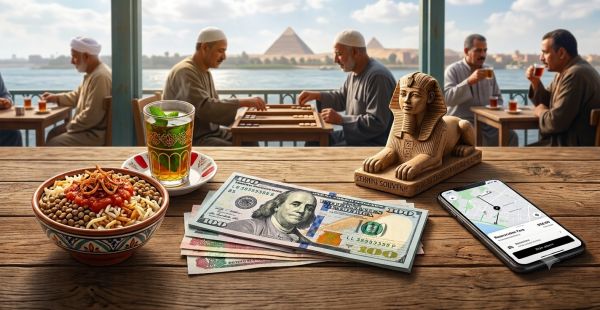
The Power of a Greenback: Understanding Egypt’s Modern Purchasing Power
For any curious mind looking at a map of North Africa, Egypt stands out not just for its monumental history, but for its incredibly complex economic landscape. If you are holding a crisp $100 US bill, you are holding a surprising amount of leverage. Following recent macroeconomic shifts, floatation of the Egyptian Pound (EGP), and stabilization of annual urban inflation at around 14.6%, the purchasing power of foreign currency inside Egypt has reached historic highs.
With the official exchange rate hovering beautifully around 50 to 52 Egyptian Pounds per US Dollar, your $100 bill instantly transforms into roughly 5,000 to 5,200 EGP.
To a local, this is an important sum—nearly half of a starting civil service or entry-level retail monthly wage. To a visitor or cultural researcher, it is a passport to an incredibly rich experience. But how far does that money actually go when you leave the sterile airport terminals and look into the raw, fascinating fabric of everyday Egyptian life? Let’s break it down by real-world costs.
Navigating the Commute: The Cost of Urban Velocity
Transportation in Egypt highlights the stark contrast between public utility and private convenience. If you want to spend your $100 bankroll on getting around Cairo—a sprawling megalopolis of over 20 million people—you will find your money stretches remarkably far.
- The Subway System: Cairo’s Metro is clean, efficient, and one of the cheapest transit systems on earth. A standard ticket across multiple zones costs between 8 to 15 EGP ($0.15 to $0.30 USD). With $100, you could theoretically buy over 400 cross-city metro rides.
- Ride-Hailing Apps (Uber/InDrive): If you prefer air-conditioned private cars, a 30-minute Uber ride from central Downtown Cairo to the upscale suburbs of Maadi or Zamalek averages about 120 to 180 EGP ($2.40 to $3.50 USD).
- Intercity Trains: Ready to travel south to Luxor? A premium, air-conditioned Spanish or VIP train ticket booked via Egyptian National Railways will cost you roughly 350 to 500 EGP ($7 to $10 USD).
If you allocate your $100 purely to local transport, you can seamlessly navigate Cairo for an entire month, complete with private rides and intercity train travel, without ever burning through the full budget.
A Feast for a Kingdom: Street Food vs. Fine Dining
Food is where the true heart of Egyptian culture beats, and it is also where your $100 bill turns you into an absolute culinary king. The Egyptian food scene is heavily segmented between local street staples and high-end dining.
- Traditional Koshary Bowl: 30 - 60 EGP ($0.60 - $1.20 USD)
- Falafel (Ta'ameya) Sandwich: 7 - 15 EGP ($0.14 - $0.30 USD)
- Mid-Range Restaurant Meal: 250 - 450 EGP ($5.00 - $9.00 USD)
- High-End Nile View Dinner: 1,200 - 2,000 EGP ($24.00 - $40.00 USD)
If you live like a local, eating Egypt's national dish—Koshary (a delicious, high-carb mix of lentils, macaroni, rice, chickpeas, crispy onions, and spicy tomato sauce)—a massive, filling bowl sets you back about 50 EGP ($1.00 USD). You could eat Koshary twice a day for 50 days on your $100 budget.
Conversely, if you choose to spend that money in a white-tablecloth establishment overlooking the Nile in Zamalek, ordering fine cuts of grilled meat, mezze platters, and fresh juices, the bill for two people will come out to around 1,500 EGP ($30 USD). Even at the highest tier of local dining, your $100 covers three absolute feasts for a pair of diners.
Daily Essentials and the Unspoken "Cafe Culture"
To understand the unspoken lifestyle of Egypt, one must understand the Ahwa Baladi (traditional street cafe). This is the social engine of the country, where neighbors gather to drink tea, play backgammon, and talk politics.
A cup of traditional mint tea or a strong Turkish coffee at a local street cafe costs roughly 20 to 30 EGP ($0.40 to $0.60 USD). Your $100 bill buys more than 180 cups of coffee, allowing you to sit for endless hours absorbing the vibrant local atmosphere.
At the supermarket, daily essentials show why the exchange rate favors foreign currency holders so intensely:
- A large 1.5-liter bottle of local mineral water: 8 to 12 EGP ($0.18 to $0.24 USD).
- A kilo of fresh local oranges or mangoes from a street vendor: 25 to 50 EGP ($0.50 to $1.00 USD).
- A pack of local artisanal flatbread (Aish Baladi): Often highly subsidized, costing mere cents.
The Tourist Paradox: Monuments and Entrance Fees
Here is where our $100 journey encounters a deliberate structural pivot. The Egyptian Ministry of Tourism and Antiquities dual-prices almost all historical landmarks. Locals pay heavily subsidized nominal fees, while international visitors pay premium rates in order to fund the country’s massive archaeological preservation efforts.
- The Giza Pyramids Complex: A standard adult international entry ticket sits around 540 EGP (approx. $10.50 USD).
- The Grand Egyptian Museum (GEM) / The Egyptian Museum in Tahrir: Entry passes run between 450 to 1,000 EGP ($9 to $20 USD) depending on the access tier.
- The Valley of the Kings (Luxor): A general entry ticket to view three legendary tombs costs roughly 600 EGP ($12 USD).
While these numbers are higher than the local cost of food or transit, look at the grand total. For roughly $50 to $60 USD, you can buy access to the Pyramids, the Sphinx, the Egyptian Museum, and the primary tombs of Luxor. Your remaining $40 will still easily cover all your food, local taxis, and historical guides for those days.
The True Value of $100: Human Capital and Generosity
Beyond the cold metrics of menus and entry stubs, the most profound realization of how far $100 goes in Egypt is found in the service industry and tipping customs (Baksheesh).
Because local salaries have been heavily squeezed by the country's recent 14-15% inflation rate, small dollar amounts possess life-changing utility on the ground. A tip of 250 EGP ($5 USD) given to a hard-working felucca captain, a hotel housekeeper, or a dedicated local driver represents a significant financial boost to their daily household budget.
Ultimately, $100 in Egypt does not just buy you a mountain of street food, endless miles of travel down the Nile, or access to ancient wonders. When deployed with a bit of local insight and cultural empathy, that single green bill allows you to experience world-class hospitality, move through an ancient landscape with absolute ease, and leave a genuinely positive footprint in the local cash economy.
Ready to Experience Egypt’s Unique Value Firsthand?
Navigating Egypt’s complex economy can be daunting, but with our expert-vetted Egypt travel packages, you gain peace of mind and access to experiences that maximize your journey. While your $100 covers incredible ground on a daily basis, our premium itineraries, from private Nile cruises to exclusive after-hours Giza Pyramids tours, utilize local expertise and partnerships to deliver unmatched value and cultural depth. Let us handle the intricate logistics while you focus on absorbing the ancient wonders and vibrant contemporary life that make this destination so unique. Choose a partner that understands the true cost and reward of traveling well—explore our curated experiences today.
Best Egypt Tours 2026
| Tour | Itinerary | Price |
|---|---|---|
| Egypt Solar Eclipse Tour | 9 Days | $ 8995 |
| All Inclusive Vacations Egypt | 10 Days | $ 1999 |
| Pyramids and Nile Cruise Holidays | 8 Days | $ 1595 |
| Luxury Egypt Tours with Nile Cruise | 12 Days | $ 2470 |
| Nile Cruise and Red Sea Stay | 12 Days | $ 2685 |
| Cairo Nile Cruise and Hurghada | 12 Days | $ 2065 |
| Package Trips to Egypt | 10 Days | $ 2065 |
| Egypt Honeymoon Packages | 10 Days | $ 3180 |
| Egypt Pyramid Tour Packages | 8 Days | $ 1775 |
| 5 Star Egypt Tours | 8 Days | $ 1680 |
| Egypt Overland Tours | 8 Days | $ 1355 |