
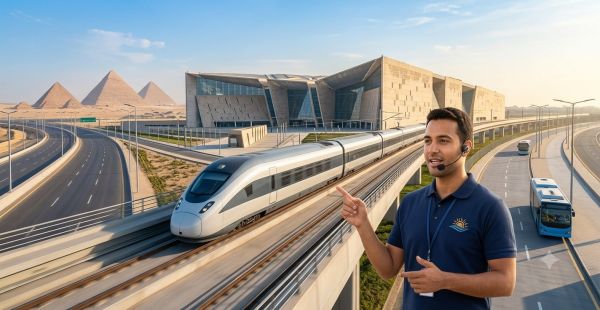
Redefining the Gateway to Antiquity
For twenty years, our team has had boots on the ground in Egypt, coordinating logistics, managing a multilingual fleet, and witnessing the ebb and flow of global tourism from Alexandria to Abu Simbel. We didn’t just read about the changes; we navigated them. We remember when the road from Cairo to Hurghada was a punishing, full-day endeavor. We remember when the traffic gridlock around the old Egyptian Museum on Tahrir Square could derail an afternoon itinerary.
Today, the story is entirely different. Driven by strategic national vision, Egypt has undergone a comprehensive infrastructure renaissance that is fundamentally reshaping how travelers experience the cradle of civilization. This transformation isn’t just about new asphalt or faster trains; it’s about restoring fluid motion, comfort, and accessibility to a destination that has always captivated the world.
1. Speed, Safety, and the Revolution of Mobility
Perhaps the most immediately visible change is the national highway grid. The road system has been completely reimagined, connecting major commercial and tourism hubs with multi-lane, high-speed corridors. A 20-year veteran knows the value of this change. Our dedicated transportation fleet now moves groups and individuals between cities in almost half the time, significantly reducing traveler fatigue and maximizing sightseeing hours.
New Nile bridges and flyovers have bypassed traditional bottlenecks. But the crown jewel of this mobility revolution is the ongoing construction of the [high-speed electric rail network]. This ambitious project will soon connect the Mediterranean coast (Alexandria and New Alamein) directly to the Red Sea (Ain Sokhna) and down to the heart of Upper Egypt (Luxor and Aswan). For a destination known for its massive scale, this network shrinks the map, offering European-style transit speed between ancient ruins and coastal luxury.
2. A New Standard of Arrival and Accommodation
The revitalization extends to how travelers enter the country. Major investments have expanded and modernized Cairo International Airport (CAI), but the strategic opening of Sphinx International Airport (SPX) is the true game-changer for logistics. Located near the Giza Plateau, SPX allows international charter groups, private jets, and regional flights to land minutes away from the Pyramids and the new Grand Egyptian Museum, entirely bypassing central Cairo’s congestion.
This ease of arrival is complemented by an explosion in accommodation inventory. Our extensive hotel and cruise network has grown in parallel with this demand. We’ve seen the revitalization of historic landmark hotels and the rise of ultra-luxury boutique properties in formerly quiet corridors. The Red Sea riviera (Sharm El Sheikh, Hurghada, Marsa Alam) now offers world-class, massive capacity all-inclusive resorts that challenge the best destinations in the Mediterranean, while simultaneously investing heavily in sustainable eco-lodge hospitality.
3. Curating the Contemporary Visitor Experience
Modern infrastructure isn’t just physical; it’s experiential. The opening of the Grand Egyptian Museum (GEM)—the largest museum in the world dedicated to a single civilization—is the physical centerpiece of this transformation. It is more than a building; it is an accessible, technologically advanced, and intelligently designed complex that offers a visitor experience that was simply not possible two decades ago.
Furthermore, the Egyptian Ministry of Tourism has rapidly digitized services. We now utilize online, streamlined group visa processes and electronic ticketing systems for all major sites. This reduction in friction—the long lines, the cash-only transactions, the confusing paperwork—allows our multilingual guides to focus entirely on their narrative and cultural storytelling, rather than administrative troubleshooting.
4. The Human Impact: Expert Logistics and Global Language
Infrastructure is only as powerful as the people who manage it. After 20 years of operations, we recognize that this physical modernization amplifies the human element of travel planning.
Our large, specialized team speaks all global languages, meaning the moment a client steps off a modern plane or train, they are met with familiar, expert communication. We merge this physical progress—our certified transportation fleet, our prioritized Nile cruise access, our deep hotel network—with local, insider knowledge. The result is a travel experience that feels seamless, safe, and profoundly immersive, honoring the weight of Egypt's history with the comfort of tomorrow’s technology.
This modern infrastructure doesn’t overwrite the past; it finally builds a bridge worthy of it. Let us show you how smoothly that bridge is crossed.
Best Egypt Tours 2026
| Tour | Itinerary | Price |
|---|---|---|
| Egypt and Kenya Tours | 15 Days | $ 6250 |
| Egypt and Dubai Tours | 8 Days | $ 999 |
| Cairo and Istanbul Tours | 8 Days | $ 1060 |
| Turkey and Egypt Tours | 12 Days | $ 2825 |
| Egypt and Petra Tours | 12 Days | $ 2255 |
| Egypt and Jordan Tours With Nile Cruise | 14 Days | $ 3066 |
| Dubai and Egypt Vacation Packages | 12 Days | $ 2270 |
| Egypt and Morocco Tours | 15 Days | $ 4499 |
| Egypt and Jordan Luxury Tours | 8 Days | $ 1275 |
| Egypt and Greece Tours | 14 Days | $ 3380 |
| Egypt Tanzania Tour | 14 Days | $ 6275 |
| Cairo to Petra Tour | 7 Days | $ 945 |
| Egypt and Holy Land Tours | 15 Days | $ 4100 |