
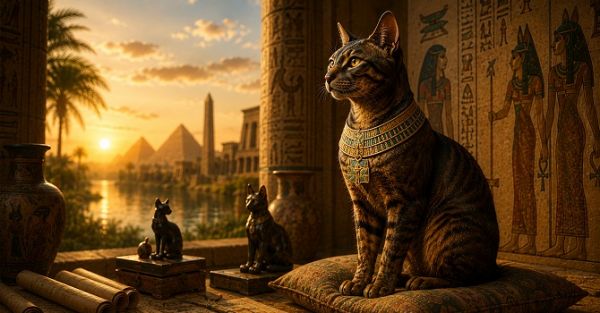
Why Were Cats So Important in Ancient Egypt?
Cats were among the most beloved animals in ancient Egypt, and their sacred status has fascinated travelers, historians, and curious readers for centuries. Many visitors to Egypt hear the famous claim that killing a cat in ancient Egypt was punishable by death. But is this dramatic story actually true, or has history exaggerated the reality?
The answer is more nuanced than a simple yes or no. While there is strong historical evidence that cats were deeply revered and harming one could have severe consequences, the idea of a formal nationwide law mandating the death penalty remains uncertain. Understanding why cats held such an extraordinary place in Egyptian society reveals far more about ancient Egypt than the myth itself.
Why Were Cats So Important in Ancient Egypt?
To understand the story, you first need to understand the relationship between ancient Egyptians and cats.
Unlike many ancient civilizations, Egyptians did not simply tolerate cats—they admired them, protected them, and often considered them sacred. Wild cats originally helped farmers by hunting rodents, snakes, and other pests that threatened grain stores. Since grain was essential to Egypt's survival, these animals became valuable partners in everyday life.
Over time, practical appreciation evolved into religious significance.
Cats became closely associated with the goddess Bastet, one of ancient Egypt's most beloved deities. Bastet represented:
- Protection
- Home and family
- Fertility
- Joy
- Motherhood
- Good health
Although Bastet was originally depicted as a fierce lioness, later artistic representations often showed her as a domestic cat or a woman with the head of a cat.
Because cats symbolized Bastet's protective power, harming one was seen as more than cruelty toward an animal—it could be interpreted as disrespect toward a divine being.
Were Cats Actually Worshipped?
This is one of the biggest misconceptions about ancient Egypt.
Egyptians did not worship ordinary cats as gods themselves.
Instead, cats were considered earthly representations or sacred companions of Bastet. Much like statues inside temples, animals associated with particular gods were treated with exceptional respect because they symbolized divine qualities.
Many Egyptian families kept cats as household pets. Archaeologists have discovered paintings showing cats sitting beneath chairs during family meals, accompanying hunters, and living comfortably inside homes.
Some cats were even buried alongside their owners, suggesting genuine affection beyond religious symbolism.
The Famous Story of the Death Penalty
The belief that killing a cat was punishable by death largely comes from ancient Greek historians.
The best-known account comes from the Greek historian Herodotus, who visited Egypt during the 5th century BC. He described Egyptians mourning cats that died naturally and noted how highly they valued these animals.
Another famous account comes from the Greek historian Diodorus Siculus, writing in the 1st century BC.
He tells the story of a Roman accidentally killing a cat in Egypt. According to Diodorus, an angry Egyptian crowd killed the man despite attempts by Roman officials to save him.
This dramatic incident is often cited as proof that killing a cat carried the death penalty.
However, historians point out that the event appears to have been an act of mob justice rather than evidence of a formal written law.
Was There an Official Law?
Interestingly, no surviving ancient Egyptian legal text clearly states that killing a cat automatically resulted in execution.
Ancient Egyptian legal records are incomplete, but researchers have found no explicit law saying:
"Anyone who kills a cat shall be put to death."
Instead, historians believe several possibilities existed:
- Intentional killing of a sacred animal may have been treated as a serious religious crime.
- Public outrage could lead to violent punishment.
- Local authorities may have imposed severe penalties depending on the circumstances.
- Accidental deaths may have been treated differently from deliberate ones.
In other words, while killing a cat could indeed cost someone their life, especially if done intentionally, historians cannot confidently say there was a universal legal code requiring execution.
Why Would Egyptians React So Strongly?
Religion influenced nearly every aspect of life in ancient Egypt.
Temples were not merely places of worship—they were major political, economic, and social institutions.
Damaging something considered sacred threatened both religious order and social stability.
Imagine intentionally destroying an object considered holy by an entire civilization. For ancient Egyptians, killing a sacred cat could be viewed in a similarly shocking way.
This explains why eyewitness accounts describe intense public anger.
The Role of Bastet's Temples
One of the most important centers of cat worship was the city of Bubastis in the Nile Delta.
Thousands of pilgrims traveled there to honor Bastet during annual festivals.
Excavations have uncovered:
- Cat cemeteries
- Temple complexes
- Bronze cat statues
- Jewelry shaped like cats
- Millions of mummified cats
These discoveries demonstrate just how widespread the reverence for cats became during certain periods of Egyptian history.
Cat Mummies: A Surprising Discovery
One of the most remarkable archaeological finds in Egypt has been the enormous number of cat mummies.
Millions have been discovered across the country.
Some belonged to beloved household pets.
Others were bred specifically to be offered as religious votive gifts at temples dedicated to Bastet.
Pilgrims often purchased mummified cats as offerings, believing they carried prayers to the goddess.
This practice became especially popular during the Late Period of ancient Egypt.
Did Egyptians Mourn Their Cats?
Historical sources and archaeological evidence suggest they certainly did.
According to Herodotus, when a family cat died naturally, household members shaved their eyebrows as a sign of mourning.
While historians debate whether this custom was universal throughout Egypt, archaeological discoveries show that many cats received careful burials.
Some were wrapped in linen, placed in decorated coffins, and buried with the same care given to human family members.
Did Every Egyptian Love Cats?
Probably not.
Ancient Egypt lasted for over 3,000 years.
Religious beliefs changed over time.
Different regions also had different customs.
Although cats became enormously popular, not every Egyptian would have viewed them in exactly the same way.
However, archaeological evidence leaves little doubt that cats occupied an unusually respected position compared to almost any other domestic animal in the ancient world.
What About Other Sacred Animals?
Cats were not the only animals considered sacred.
Ancient Egyptians also revered:
- Falcons associated with Horus
- Ibises connected to Thoth
- Crocodiles linked to Sobek
- Bulls associated with Apis
- Jackals connected to Anubis
Many of these animals were protected and even mummified after death.
This reflects a broader Egyptian belief that nature and the divine were closely connected.
What Can Travelers See Today?
Visitors exploring Egypt can still discover this fascinating relationship between humans and cats.
Some of the best places include:
The Egyptian Museum in Cairo
Here you can see beautifully preserved cat statues, cat mummies, jewelry, and artifacts that illustrate their importance in everyday life and religion.
The Grand Egyptian Museum
As one of the world's largest archaeological museums, it showcases remarkable objects from ancient Egypt, including artifacts connected to animal worship and religious beliefs.
Bubastis (Tell Basta)
Located near Zagazig in the Nile Delta, this ancient city was once the principal center of Bastet's worship. Visitors can explore archaeological remains of temples and learn about one of Egypt's greatest religious festivals.
Saqqara
This vast necropolis has yielded numerous animal mummies, including cats, providing fascinating insight into Egyptian religious practices.
So, Was Killing a Cat Punishable by Death?
The popular claim is based on real historical traditions, but the evidence is more complicated than many social media posts suggest.
Cats were unquestionably sacred in ancient Egypt. Intentionally harming one could provoke enormous public outrage and may have resulted in death, especially if viewed as a religious offense. Ancient writers even recorded incidents in which people were killed after killing a cat.
However, historians have not found a surviving Egyptian law explicitly stating that every person who killed a cat was automatically sentenced to death.
The truth lies somewhere between myth and reality. Cats were so deeply respected that harming one could carry extraordinary consequences, making them among the most protected animals in the ancient world.
For modern travelers, this remarkable story offers a glimpse into how differently ancient Egyptians viewed the relationship between humans, animals, and the divine. Walking through Egypt's museums and archaeological sites, it's easy to understand why the humble cat became one of the civilization's most enduring symbols—and why its legacy continues to captivate visitors from around the world.
Walk Through the World of Ancient Egypt
If stories like the sacred cats of ancient Egypt spark your curiosity, why not experience the civilization firsthand? Our carefully designed journeys let you explore the temples, tombs, museums, and archaeological sites that bring these ancient legends to life. From the timeless Pyramids of Giza to the treasures of the Grand Egyptian Museum and beyond, our itineraries are perfect for history lovers and cultural explorers alike. Discover our Egypt Vacation Packages, Egypt Historical Tours, and Cairo Sightseeing Tours to turn your fascination with ancient Egypt into an unforgettable adventure.
Best Egypt Tours 2026
| Tour | Itinerary | Price |
|---|---|---|
| Egypt Solar Eclipse Tour | 9 Days | $ 8995 |
| All Inclusive Vacations Egypt | 10 Days | $ 2940 |
| Cairo and Luxor Holidays | 5 Days | $ 1305 |
| Pyramids and Nile Cruise Holidays | 8 Days | $ 1690 |
| Cairo Private Tours | 4 Days | $ 780 |
| Cairo City Breaks | 3 Days | $ 575 |
| Luxury Egypt Tours with Nile Cruise | 12 Days | $ 2610 |
| Nile Cruise and Red Sea Stay | 12 Days | $ 2815 |
| Cairo Nile Cruise and Hurghada | 12 Days | $ 2200 |
| Package Trips to Egypt | 10 Days | $ 2165 |
| Egypt Honeymoon Packages | 10 Days | $ 3180 |
| Wheelchair Accessible Nile Cruise | 4-5 Days | $ 1345 |
| Cairo Wheelchair Accessible Tours | 5 Days | $ 875 |
| Cairo and Nile Cruise for Disabled Travellers | 8 Days | $ 3300 |
| Egypt Wheelchair Accessible Tours | 10 Days | $ 3225 |