
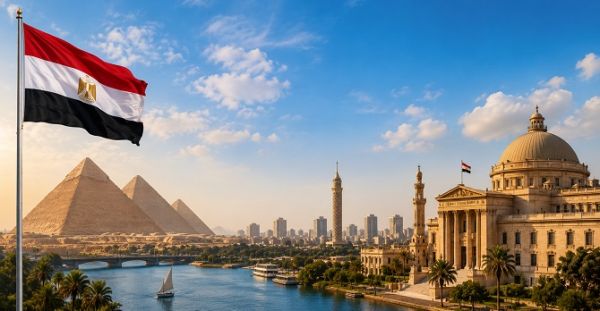
Egypt Is a Republic
When most people think of Egypt, they picture the Great Pyramids, the Nile River, bustling bazaars, and ancient temples. But if you're planning a trip—or you're simply curious about modern Egypt—it's worth understanding how the country is governed today.
Egypt is one of the most influential countries in the Middle East and Africa, with a political system that has evolved dramatically over thousands of years. While ancient Egypt was ruled by pharaohs believed to be divine kings, today's Egypt is a modern republic with a constitution, elected institutions, and a structured government.
Here's a simple guide to Egypt's political structure and what it means for visitors.
Egypt Is a Republic
Officially known as the Arab Republic of Egypt, the country operates as a presidential republic.
This means that the President serves as both:
- Head of State
- Head of Government
Unlike parliamentary systems where a prime minister leads the executive branch independently, Egypt's President holds the primary executive authority.
The current political framework is based on the Constitution adopted in 2014, with amendments approved in 2019.
The Three Branches of Government
Like many modern states, Egypt separates government into three branches.
1.Executive Branch
The Executive Branch is responsible for running the country on a daily basis.
It includes:
- The President
- The Prime Minister
- The Cabinet (Council of Ministers)
The President appoints the Prime Minister, who coordinates the work of government ministries such as:
- Tourism and Antiquities
- Health
- Education
- Finance
- Foreign Affairs
- Transportation
These ministries manage everything from museums and airports to hospitals and road construction.
The President
The President is Egypt's highest political authority.
Responsibilities include:
- Implementing national policies
- Representing Egypt internationally
- Appointing the Prime Minister
- Commanding the armed forces
- Signing laws approved by Parliament
- Leading foreign policy
The presidential term is six years.
The Prime Minister
The Prime Minister oversees the government's daily administration.
Although the President holds significant executive powers, the Prime Minister coordinates ministries and supervises implementation of government policies.
2.Legislative Branch
Egypt's legislative authority belongs primarily to Parliament.
Today Parliament consists mainly of:
House of Representatives
This is the lower chamber and the country's principal legislative body.
Its responsibilities include:
- Passing laws
- Approving the national budget
- Monitoring government performance
- Reviewing government policies
- Ratifying international agreements
Members are elected by Egyptian citizens.
Senate
Egypt also has a Senate.
Unlike the House of Representatives, the Senate mainly serves an advisory role.
It reviews proposed legislation and provides recommendations on important national issues such as:
- Constitutional amendments
- Economic development
- National unity
- Foreign affairs
While its opinions may influence legislation, the House of Representatives remains the primary law-making institution.
3. Judicial Branch
The judiciary is responsible for interpreting and applying Egyptian law.
Its role includes:
- Settling legal disputes
- Protecting constitutional rights
- Reviewing the legality of laws
- Supervising court proceedings
Egypt's judicial system includes:
- Ordinary courts
- Administrative courts
- Economic courts
- Specialized courts
- The Supreme Constitutional Court
The Supreme Constitutional Court determines whether laws comply with the Constitution
Egypt's Administrative Divisions
Egypt is divided into 27 governorates.
Each governorate is managed by a governor appointed by the President.
Examples include:
- Cairo
- Giza
- Alexandria
- Luxor
- Aswan
- South Sinai
- Red Sea
Each governorate oversees local services such as:
- Roads
- Schools
- Public transportation
- Waste collection
- Urban planning
For travelers, this mainly affects local administration rather than tourism itself.
Political Parties in Egypt
Egypt has multiple legally recognized political parties representing different political viewpoints.
These parties participate in parliamentary elections and public political life.
Like many countries, the influence of political parties has changed over time as Egypt's political landscape has evolved.
Elections in Egypt
Egyptians vote in several types of elections, including:
- Presidential elections
- Parliamentary elections
- Senate elections
The Constitution establishes procedures governing elections, terms of office, and eligibility requirements.
How Politics Affects Tourists
Fortunately for most visitors, politics has very little impact on everyday tourism.
Whether you're exploring:
- Cairo
- Luxor
- Aswan
- Alexandria
- Sharm El Sheikh
- Hurghada
your experience will revolve around Egypt's history, hospitality, cuisine, and landscapes rather than its political institutions.
Tourists are generally free to enjoy museums, archaeological sites, beaches, and resorts without interacting with government processes.
As in any country, visitors should:
- Carry identification
- Respect local laws
- Follow security instructions at major attractions
- Avoid demonstrations or political gatherings if they occur
These are common travel precautions rather than Egypt-specific concerns.
From Pharaohs to Presidents
One of Egypt's most fascinating stories is how its political system has transformed over five millennia.
Ancient Egypt was governed by pharaohs, who combined political, military, and religious authority. The pharaoh was considered the earthly representative of the gods and ruled over one of history's earliest centralized states.
Over the centuries, Egypt was ruled by various empires and dynasties, including Persian, Greek, Roman, Arab, Ottoman, and British administrations.
Modern Egypt became a republic in 1953, replacing the monarchy that had existed until the revolution of 1952.
Today's political institutions are therefore part of a long historical journey that spans thousands of years.
Why Travelers Find Egypt So Unique
Few destinations allow visitors to witness such an extraordinary contrast between ancient and modern governance.
In one day, you might:
- Visit the temples where pharaohs ruled as living gods.
- Walk through Cairo, home to modern government institutions.
- Cruise the Nile past landscapes that have supported civilization for thousands of years.
- Explore museums that tell the story of Egypt's political evolution from the world's earliest kingdoms to a contemporary republic.
Understanding this transition adds another layer of appreciation to every historical site you visit.
Quick Facts About Egypt's Political Structure
- Official name: Arab Republic of Egypt
- Government type: Presidential republic
- Head of State: President
- Head of Government: Prime Minister
- Legislature: House of Representatives and Senate
- Judiciary: Independent court system headed by the Supreme Constitutional Court
- Administrative divisions: 27 governorates
- Capital city: Cairo
Egypt's political structure
Egypt's political structure reflects a blend of modern constitutional governance and one of the world's richest historical legacies. While today's republic is built around a president, parliament, independent courts, and local governorates, the country's political story stretches back to the age of the pharaohs, making it one of the longest continuously documented histories of government anywhere in the world.
For travelers, understanding how Egypt is governed isn't just about politics—it offers valuable context for appreciating the nation's remarkable journey from ancient civilization to modern state. Whether you're standing before the pyramids, wandering through Islamic Cairo, or cruising the Nile, you're exploring a country whose political evolution has shaped history for more than five thousand years.
Best Egypt Tours 2026
| Tour | Itinerary | Price |
|---|---|---|
| Egypt Solar Eclipse Tour | 9 Days | $ 8995 |
| All Inclusive Vacations Egypt | 10 Days | $ 2940 |
| Cairo and Luxor Holidays | 5 Days | $ 1305 |
| Pyramids and Nile Cruise Holidays | 8 Days | $ 1690 |
| Cairo Private Tours | 4 Days | $ 780 |
| Cairo City Breaks | 3 Days | $ 575 |
| Luxury Egypt Tours with Nile Cruise | 12 Days | $ 2610 |
| Nile Cruise and Red Sea Stay | 12 Days | $ 2815 |
| Cairo Nile Cruise and Hurghada | 12 Days | $ 2200 |
| Package Trips to Egypt | 10 Days | $ 2165 |
| Egypt Honeymoon Packages | 10 Days | $ 3180 |
| Wheelchair Accessible Nile Cruise | 4-5 Days | $ 1345 |
| Cairo Wheelchair Accessible Tours | 5 Days | $ 875 |
| Cairo and Nile Cruise for Disabled Travellers | 8 Days | $ 3300 |
| Egypt Wheelchair Accessible Tours | 10 Days | $ 3225 |