
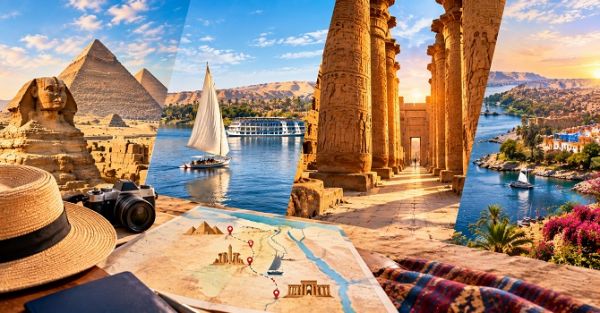
The ultimate first-timer’s itinerary
Planning your first trip to Egypt can feel surprisingly difficult. The country is huge, the major sights are
spread along the Nile, and there is far more to see than most visitors realize. Should you spend more time in Cairo? Is a Nile cruise worth including? Can you visit Abu Simbel? And should you add the Red Sea or focus entirely on ancient Egypt?
For most first-time visitors, the best answer is to concentrate on Cairo, Giza, Luxor, and Aswan, rather than trying to cover the entire country. This route combines Egypt's most famous archaeological sites with its modern culture, Nile scenery, and local experiences. Egypt's official tourism information similarly highlights Cairo and Giza, Luxor, Aswan, and Abu Simbel as core destinations for exploring the country's ancient heritage.
Below is a practical 7-day Egypt itinerary, followed by a more relaxed 10-day Egypt itinerary for travelers who have extra time.
The Best Route for a First Trip to Egypt
The classic first-time route is:
Cairo → Giza → Luxor → Nile Cruise → Aswan → Abu Simbel → Cairo
This itinerary works well because it follows the Nile Valley rather than constantly crossing the country. It also gives you a good balance between major monuments and time to actually enjoy Egypt.
Cairo introduces you to modern Egyptian life and historic Islamic Cairo, while Giza provides the iconic pyramids. Luxor then takes you deep into ancient Thebes, with Karnak, Luxor Temple, the Valley of the Kings, and Hatshepsut Temple. Continuing south toward Aswan adds a slower pace, beautiful Nile landscapes, Nubian culture, and temples such as Philae.
The Ultimate 7-Day Egypt Itinerary
Day 1: Arrive in Cairo
Begin your Egypt vacation in Cairo, one of the world's great megacities and the country's cultural and historical center.
Keep your first day relatively light, especially if you have traveled a long distance. After checking into your hotel, take some time to relax and get your first impression of the city.
Depending on your arrival time, you could enjoy a Nile-side dinner, explore part of Downtown Cairo, or simply rest before the sightseeing begins.
Overnight: Cairo
Day 2: Giza Pyramids, Sphinx and Ancient Cairo
Start early with the Giza Pyramids, one of the world's most recognizable archaeological landscapes.
Visit the Great Pyramid of Khufu, the pyramids of Khafre and Menkaure, and the Great Sphinx. The Giza Plateau forms part of the Memphis and its Necropolis UNESCO World Heritage Site, which also includes important archaeological areas such as Saqqara and Dahshur.
If time and energy allow, continue to Saqqara to see the Step Pyramid of Djoser and learn how pyramid construction developed over centuries.
Later, return to Cairo for an introduction to the city's historic neighborhoods, perhaps including Khan el-Khalili and Historic Cairo.
Overnight: Cairo
Day 3: Cairo to Luxor
On your third day, travel south to Luxor by flight or another suitable transfer.
Luxor is often described as an open-air museum, and for good reason. Ancient Thebes, the city's ancient predecessor, contains an extraordinary concentration of temples and royal tombs.
Spend the afternoon exploring Karnak Temple or Luxor Temple. If your schedule permits, a sunset felucca ride can provide a quieter way to experience the Nile.
Overnight: Luxor or Nile cruise
Day 4: Luxor's West Bank
Begin early to explore Luxor's West Bank.
The highlights include the Valley of the Kings, where New Kingdom rulers were buried, and the spectacular Temple of Hatshepsut at Deir el-Bahari. Depending on your interests and available time, you can also visit the Colossi of Memnon or additional tombs and temples.
The Valley of the Kings is particularly memorable because the experience is not simply about seeing enormous monuments. Walking into the decorated tombs gives you a glimpse into the beliefs and artistic traditions surrounding ancient Egyptian ideas of death and the afterlife.
In the afternoon, begin your Nile cruise from Luxor toward Aswan, if your itinerary includes a cruise.
Overnight: Nile cruise
Day 5: Nile Cruise and Temples Along the River
One of the most enjoyable aspects of a first trip to Egypt is slowing down after several busy sightseeing days.
A Nile cruise from Luxor to Aswan allows you to combine transportation, accommodation, scenery, and sightseeing in one experience.
Rather than simply traveling between destinations, you watch villages, farmland, palm trees, desert landscapes, and the Nile pass by from the deck.
Depending on the cruise schedule, visits may include temples such as Edfu and Kom Ombo.
This is one reason the Nile Valley works so well as a first-time Egypt itinerary: the river connects many of the country's most important archaeological sites. Egypt's tourism guide describes the Nile cruise as a classic way to experience the monuments between Luxor and Aswan.
Overnight: Nile cruise
Day 6: Aswan and Philae Temple
Arrive in Aswan, where the atmosphere becomes noticeably more relaxed.
Visit Philae Temple, located on an island and reached by boat. The temple complex was relocated to Agilkia Island following the construction of the Aswan High Dam, preserving one of Egypt's remarkable ancient monuments.
You can also explore the city's traditional markets, visit a Nubian village, or simply enjoy the Nile views.
Aswan offers something different from Cairo and Luxor: instead of the intensity of major archaeological sites, you get a slower rhythm, colorful Nubian culture, islands, gardens, and beautiful river scenery.
Overnight: Aswan
Day 7: Abu Simbel and Departure
If your flight schedule allows, make an early trip to Abu Simbel.
The massive temples of Ramesses II are among the most impressive monuments in southern Egypt. Their enormous statues and monumental architecture make them a fitting finale to a first Egyptian journey.
After Abu Simbel, return to Aswan for your onward flight or connection to Cairo.
For a seven-day trip, this itinerary is busy, but it covers an impressive amount without trying to include every possible destination.
The Better 10-Day Egypt Itinerary
If you have 10 days in Egypt, resist the temptation to simply add more destinations. Instead, use the extra time to make the same route more comfortable.
Days 1–2: Cairo and Giza
Spend two nights exploring Cairo and Giza.
Visit the pyramids and Sphinx, and consider adding Saqqara and Dahshur. Reserve another half-day for Cairo's museums and historic districts.
This gives you time to experience Cairo beyond the pyramids.
Day 3: More Cairo or Saqqara
Use your third day for attractions you couldn't comfortably fit into the first two days.
You could explore Historic Cairo, visit additional museums, shop at Khan el-Khalili, or spend more time discovering Egyptian food and everyday city life.
Historic Cairo itself is a UNESCO World Heritage Site and contains mosques, madrasas, historic houses, and other architectural treasures.
Day 4: Cairo to Luxor
Fly or travel to Luxor and spend the afternoon exploring Karnak Temple and Luxor Temple.
A relaxed evening beside the Nile makes a good contrast to Cairo's energy.
Overnight: Luxor
Day 5: Luxor West Bank
Dedicate the morning to the Valley of the Kings, Hatshepsut Temple, and other West Bank attractions.
Spend the afternoon relaxing before beginning your Nile cruise.
Overnight: Nile cruise
Days 6–7: Nile Cruise to Aswan
Enjoy two days sailing through Upper Egypt, with scheduled temple visits along the way.
This is where the extra time makes the journey feel much less rushed.
Day 8: Aswan and Nubian Culture
Explore Philae Temple, Aswan's markets, Elephantine Island, or a Nubian village.
The official tourism guide highlights Nubian culture, local food, traditional architecture, and hospitality as important parts of the Aswan experience.
Overnight: Aswan
Day 9: Abu Simbel
Take a day trip to Abu Simbel, then return to Aswan.
If you prefer a slower luxury experience, this day can also be used simply to relax in Aswan rather than adding another major excursion.
Day 10: Return Home or Add the Red Sea
Return to Cairo for your international flight, or, if your flight arrangements allow, extend the trip with a few days on the Red Sea.
Hurghada or Sharm El Sheikh can work well if beaches, snorkeling, diving, and relaxation are priorities. Egypt's tourism resources describe the Red Sea and Sinai as destinations particularly suited to beach activities, diving, and desert adventures.
7 Days or 10 Days: Which Is Better?
For a first-time traveler, 10 days is the ideal length if your schedule allows it.
Seven days is enough to see the essential highlights, but the pace will be relatively fast. Ten days gives you more breathing room and makes it easier to appreciate the difference between Cairo's urban energy, Luxor's archaeological treasures, the peaceful Nile Valley, and Aswan's Nubian atmosphere.
Most importantly, don't make the common mistake of trying to visit Cairo, Luxor, Aswan, Abu Simbel, Alexandria, the Red Sea, and the desert all in one week. Egypt rewards travelers who leave enough time to actually experience each place.
The ultimate first Egypt itinerary is therefore not necessarily the one with the largest number of attractions. It is the one that combines the Pyramids of Giza, ancient Cairo, Luxor's temples and tombs, a Nile cruise, Aswan, and Abu Simbel at a pace that lets you enjoy the journey.
And if you want to experience Egypt in comfort, a private Egypt tour combining guided sightseeing, carefully selected hotels, and a Nile cruise can make this route considerably easier—especially for first-time visitors who want to spend their time experiencing Egypt rather than organizing transportation between every destination.
Best Egypt Tours 2026
| Tour | Itinerary | Price |
|---|---|---|
| Cairo and Nile Cruise Package | 7 Days | $ 1375 |
| Nile Cruise and Stay | 8 Days | $ 2210 |
| Egypt Pyramid Tour Packages | 8 Days | $ 1775 |
| Luxor and Aswan Tours | 4 Days | $ 665 |
| 5 Star Egypt Tours | 8 Days | $ 1680 |
| Egypt Pyramids Nile Cruise | 10 Days | $ 2300 |
| Cairo Holiday Packages | 5 Days | $ 815 |
| Egypt Overland Tours | 8 Days | $ 1355 |