
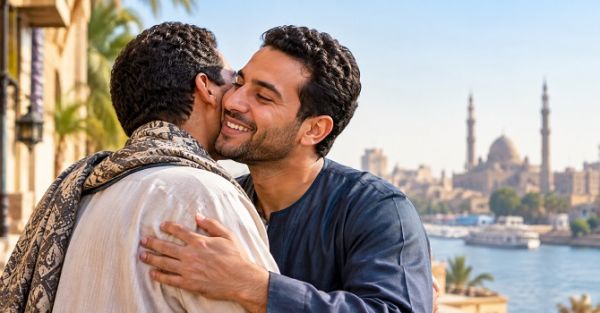
A simple gesture that reflects friendship, warmth, and respect
If you visit Egypt, one social custom may catch you by surprise: two Egyptian friends meeting on the street may shake hands, hug, and kiss each other on the cheeks as if they have known each other forever.
For many visitors, the obvious question is: Why do Egyptian friends kiss each other on the cheeks?
The answer is less about romance and more about friendship, warmth, respect, familiarity, and social connection. Cheek-kissing is part of everyday Egyptian greeting etiquette, particularly among close friends and relatives of the same gender.
Understanding this simple gesture can help travelers interpret many of the friendly interactions they experience while exploring Egypt.
Cheek Kissing Is a Greeting, Not Usually a Romantic Gesture
One of the first things visitors should understand about Egyptian culture and social customs is that physical affection can have a different meaning from what someone might expect in their own country.
When two close Egyptian male friends kiss each other on the cheeks, for example, it is generally a sign of friendship and affection, not romantic interest. The same applies to many interactions between female friends and relatives.
Cultural Atlas describes cheek-kissing among friends and relatives as a common Egyptian greeting, particularly between people of the same gender. It may happen together with a handshake, embrace, or friendly pat on the back.
So if you see two Egyptian men greeting each other with a handshake followed by cheek kisses, there is usually nothing unusual about it. It is simply part of their social language.
Why the Cheek?
A greeting communicates more than the words “hello.”
In Egyptian society, relationships and personal connections are highly valued. Family, friendship, hospitality, and community play important roles in everyday life. Egypt's official tourism authority also emphasizes the warmth, hospitality, and close-knit relationships that visitors often encounter.
A cheek kiss adds a physical expression of that closeness.
Compare it with a quick nod from across the street. Both can mean “hello,” but they communicate very different levels of familiarity.
A cheek kiss can essentially say:
“You are one of us.”
It can communicate affection, trust, familiarity, and happiness at seeing someone again.
This is particularly noticeable when friends have not seen each other for some time. The greeting may become more enthusiastic, involving an embrace, several cheek kisses, a handshake, and plenty of conversation.
Egyptian Greetings Are Often More Personal
Another interesting aspect of Egyptian social etiquette is that greetings are not necessarily brief.
A greeting can quickly develop into questions about your health, your family, your work, and what you have been doing recently. Cultural Atlas notes that Egyptian greetings can be relatively lengthy, with people asking about each other's well-being and families.
This is useful for travelers to understand because Egyptian hospitality often extends beyond formal politeness.
Someone asking, “How are you?” may genuinely expect an answer.
Someone you have just met may invite you for tea.
A friend may insist that you eat something before leaving.
And someone who has not seen you for months may greet you with a hug and cheek kisses before even beginning the conversation.
These interactions are part of the broader social culture rather than isolated customs.
Is It Always Two Kisses?
Not necessarily.
There is no single nationwide formula that every Egyptian follows.
The exact greeting can vary depending on the people involved, their relationship, gender, age, religious or social background, region, and situation.
You might see:
- A handshake
- A handshake followed by cheek kisses
- A hug and cheek kisses
- A simple verbal greeting
- A nod or smile
- Several cheek kisses between very close friends
Cultural norms can also vary between urban and rural environments and between different social groups.
So visitors should avoid thinking of Egyptian cheek-kissing as a strict ritual with one universal number of kisses.
It is better understood as a flexible social greeting.
Men Can Kiss Male Friends
This is one of the customs that can surprise some international travelers.
In many Western cultures, particularly in some English-speaking countries, two adult men kissing each other on the cheek may be interpreted as unusually intimate.
In Egypt, however, close male friends and relatives can greet one another this way without the romantic meaning that some foreigners might associate with it.
The gesture fits into a wider Egyptian pattern of physical warmth between close friends of the same gender. Cultural Atlas notes that good friends of the same gender may hold hands or kiss when greeting in public.
The important factor is the relationship between the people, not simply the physical gesture itself.
What About Men and Women?
This is where travelers need to be more careful.
Cheek-kissing between men and women is not governed by exactly the same expectations as same-gender greetings.
Egyptian social norms regarding physical contact between men and women can be more conservative, and expectations may differ according to religion, family background, age, and personal preference.
Cultural Atlas advises that visitors follow the Egyptian person's lead when they are uncertain about an appropriate greeting. It also notes that cheek-kissing between men and women is generally associated with very close relationships, such as close relatives.
For a traveler, the safest approach is simple:
Don't automatically initiate a cheek kiss with an Egyptian of the opposite gender.
Instead, observe what the other person does and follow their lead.
If someone extends a hand, shake it. If they offer a cheek for a greeting, respond appropriately. If they simply smile and say hello, a verbal greeting is perfectly fine.
Should Tourists Kiss Egyptians on the Cheek?
Not necessarily.
You do not need to imitate every Egyptian greeting to be polite during your Egypt trip.
If you are meeting an Egyptian friend you already know well, you can follow the greeting style that has developed between you. But with someone you have just met, it is better to let them establish the level of physical contact.
This is especially important because Egyptian greetings can depend on gender, age, religion, social setting, and personal comfort.
A friendly smile, “Ahlan,” or “Salam aleikum” is more than enough when you are unsure.
What Does “Salam Aleikum” Have to Do With It?
You may frequently hear “Salam aleikum” when traveling in Egypt.
It means approximately “peace be upon you” and is a common Arabic greeting. The traditional response is “Wa aleikum es-salam.” Egypt's official tourism materials also list these expressions among useful Arabic phrases for visitors.
You may therefore encounter a greeting that combines words and gestures:
“Salam aleikum!” + handshake + hug + cheek kisses
The physical greeting and the verbal greeting work together to express warmth and goodwill.
It Reflects a Bigger Part of Egyptian Hospitality
Perhaps the most interesting thing about cheek-kissing is that it makes more sense when viewed alongside other aspects of Egyptian hospitality.
Egyptians are often described as having strong family and community connections. Cultural Atlas identifies loyalty, community, hospitality, and family relationships as important elements of Egyptian social life.
The country's tourism authority similarly highlights close relationships, hospitality, humor, shared meals, and social gatherings as important parts of contemporary Egyptian life.
For a traveler, this means that Egyptian culture can sometimes feel more socially expressive than cultures where personal space and emotional restraint are emphasized.
You might notice friends sitting very close together, greeting each other enthusiastically, sharing food, staying together for hours, or repeatedly checking whether someone has eaten.
The cheek kiss is simply one small expression of this broader social warmth.
What Should You Do If Someone Tries to Kiss Your Cheek?
Don't panic!
If an Egyptian friend or acquaintance greets you with cheek kisses, you can simply follow their movement if you are comfortable.
If you are not comfortable with physical contact, a smile and verbal greeting are perfectly acceptable. You do not have to force yourself to participate in a greeting that makes you uncomfortable.
For first meetings, especially across genders, waiting for the other person to initiate physical contact is a good rule.
And remember: Egyptians themselves don't all greet each other in exactly the same way.
The Real Meaning Behind the Gesture
So, why do Egyptian friends kiss each other on the cheeks?
Because in many situations, it is simply a culturally familiar way of saying:
“I'm happy to see you.”
It can represent friendship, affection, respect, familiarity, and belonging. It is particularly common among close friends and relatives of the same gender, while greetings between men and women can follow different social expectations.
For visitors exploring Cairo, Alexandria, Luxor, Aswan, or the Red Sea, understanding small customs like this can make Egyptian social interactions much easier to interpret.
And perhaps that is one of the most enjoyable parts of traveling in Egypt: the country is not only about pyramids, temples, museums, and the Nile. It is also about understanding the people you meet along the way.
A cheek kiss between two friends may last only a second, but it tells you something important about Egyptian culture: relationships matter, and greetings are often meant to feel personal.
Ready to experience Egypt beyond the famous landmarks? Explore our carefully designed Egypt travel packages and discover the country’s history, culture, local traditions, and warm hospitality with a trip tailored to your interests.
Best Egypt Tours 2026
| Tour | Itinerary | Price |
|---|---|---|
| Egypt and Kenya Tours | 15 Days | $ 6250 |
| Egypt and Dubai Tours | 8 Days | $ 999 |
| Cairo and Istanbul Tours | 8 Days | $ 1060 |
| Turkey and Egypt Tours | 12 Days | $ 2825 |
| Egypt and Petra Tours | 12 Days | $ 2255 |
| Egypt and Jordan Tours With Nile Cruise | 14 Days | $ 3066 |
| Egypt and Morocco Tours | 15 Days | $ 4499 |
| Egypt and Jordan Luxury Tours | 8 Days | $ 1275 |
| Egypt and Greece Tours | 14 Days | $ 3380 |
| Egypt Tanzania Tour | 14 Days | $ 6275 |
| Cairo to Petra Tour | 7 Days | $ 945 |