
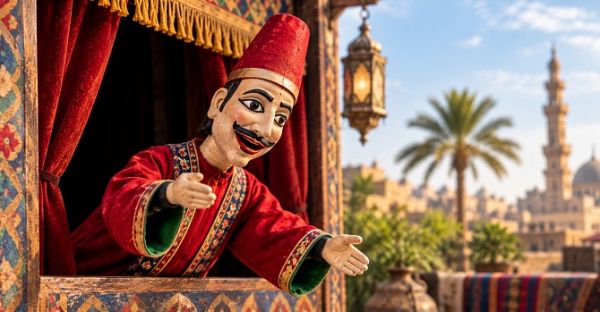
The Egyptian Puppet That Made People Laugh at Power
Have you ever imagined a puppet becoming a voice for ordinary Egyptians, commenting on society, corruption, and even politics? Meet Aragouz (Al-Aragoz), one of Egypt’s most distinctive traditional performing arts.
At first glance, Aragouz may look like a simple hand puppet used to entertain children. But behind its colorful appearance, unusual voice, and humorous performances lies a much deeper story. For generations, this traditional Egyptian puppet theatre has reflected everyday life, social problems, and public concerns through comedy, improvisation, and satire.
Today, discovering Aragouz in Egypt offers travelers something beyond the famous pyramids and temples: a glimpse into the living cultural traditions that have helped Egyptians tell stories and comment on society.
What Is Aragouz?
Al-Aragoz is a traditional form of Egyptian hand-puppet theatre. The name comes from the main puppet character, Aragouz, who is recognizable by his distinctive appearance and especially his unusual, high-pitched voice.
During a traditional performance, the puppeteer stays hidden inside a small portable stage while an assistant helps interact with the puppets and the audience. The performance is not simply a prepared show delivered to a silent crowd. Audience interaction, improvisation, music, comedy, and spontaneous reactions are all important parts of the experience.
UNESCO describes Al-Aragoz as an old form of Egyptian theatre in which performers explore themes connected with daily life. A recurring theme is the struggle against corruption.
That combination of humor and social commentary is what makes Aragouz particularly interesting to anyone curious about Egyptian culture.
Why Does Aragouz Matter in Egyptian Culture?
Egyptian culture is often associated internationally with ancient civilization, pharaohs, pyramids, temples, and hieroglyphics. Those are certainly important parts of Egypt’s identity, but Egyptian heritage did not stop thousands of years ago.
Aragouz represents a different side of Egypt: popular culture and living heritage.
The performances traditionally addressed everyday experiences and social behavior. They could discuss family relationships, negative social practices, corruption, and other topical issues while maintaining a comic atmosphere.
UNESCO notes that the tradition conveys moral principles, social norms, cultural values, and messages about negative social behavior and contemporary issues.
For travelers, this makes Aragouz an interesting way to understand how Egyptians have historically used humor not simply for entertainment, but also to reflect on the society around them.
Aragouz and Political Satire
One of the most fascinating aspects of Egyptian Aragouz is its relationship with political and social criticism.
Aragouz became a vehicle through which performers could mock authority, comment on political circumstances, and criticize aspects of the social order. Historical accounts describe the puppet theatre as a form of popular satire, with performances addressing political and social issues alongside comedy.
This does not mean that every Aragouz performance was political. In fact, the tradition covered a broad range of everyday subjects. But satire gave performers a way to turn serious subjects into comedy.
Instead of delivering a formal political speech, the performer could put words into the mouth of a puppet.
Instead of directly confronting a powerful figure, the story could make a fictional character ridiculous.
And instead of discussing corruption in a serious lecture, the audience could laugh at a character behaving corruptly.
This mixture of comedy, criticism, and audience participation helped make Aragouz an unusual form of popular expression.
A Puppet That Could Speak About Corruption
Corruption is particularly important in understanding Aragouz.
UNESCO identifies the struggle against corruption as a recurring theme of the tradition. Its 2018 inscription also recognizes Aragouz as a form of theatre that communicates messages about negative social behavior and topical issues.
The idea is surprisingly modern.
Imagine watching a traditional puppet show in which a foolish official, dishonest character, or abusive figure becomes the subject of jokes. The audience recognizes the behavior, laughs at it, and understands the criticism without needing a formal explanation.
This is one reason Aragouz can be viewed as more than children's entertainment. It provided a popular language for discussing problems that affected ordinary people.
Aragouz Through Egypt’s History
The history of Aragouz is closely connected with public celebrations and popular gatherings.
Historical accounts describe the puppet theatre as having been performed in different parts of Egypt, with traveling performers moving from one celebration to another. Over time, however, the tradition declined and performances became increasingly concentrated in Cairo.
Some historical accounts also connect Aragouz with political commentary during the Ottoman period and later during the period of British occupation. These accounts describe the puppet as being used to criticize political conditions and colonialism.
These historical interpretations are especially interesting because they show how a seemingly simple folk-art character could become part of public conversation.
The puppet was small, but the subjects it could address were sometimes much bigger.
How Did the Audience Participate?
Traditional Aragouz theatre was highly interactive.
The puppeteer remained hidden behind the portable stage, while an assistant interacted with the puppets and the audience. The crowd was therefore part of the atmosphere rather than simply a group of spectators.
Improvisation was an important skill. According to UNESCO, practitioners needed to master puppet manipulation, music, and improvisation.
This helps explain why Aragouz performances could respond to their surroundings.
A joke could be adapted.
A character could react to the audience.
A social issue could be incorporated into a performance.
That flexibility is one of the characteristics that distinguish traditional folk theatre from a completely scripted modern performance.
The Famous Aragouz Voice
One of the first things visitors notice about Aragouz is the voice.
The puppet's distinctive voice is produced using a traditional voice modifier known as al-amana. The unusual sound contributes significantly to the character's comic identity.
For someone encountering Egyptian traditional puppetry for the first time, the voice can be just as memorable as the puppet itself.
It is part of what transforms a simple hand puppet into the recognizable character of Aragouz.
From Egyptian Celebrations to Cairo
Aragouz was once associated with traveling performers who moved between popular celebrations and public gatherings.
As the tradition declined, performers increasingly settled in fixed locations, particularly in Cairo. UNESCO has noted the disappearance of traditional performance venues and the shrinking number of practitioners as significant challenges facing the tradition.
This is an important reminder for travelers: some of Egypt's cultural experiences are not disappearing because people stopped caring about them overnight. Traditional arts can gradually become harder to maintain when audiences, entertainment habits, performance spaces, and opportunities for younger performers change.
Television and other forms of modern entertainment have also changed the environment in which traditional puppet theatre operates.
UNESCO Recognition
In 2018, UNESCO inscribed Egypt's Traditional Hand Puppetry, Al-Aragoz, on the List of Intangible Cultural Heritage in Need of Urgent Safeguarding.
This is an important distinction.
The inscription is not simply an award declaring Aragouz famous. It recognizes the cultural importance of the tradition while also acknowledging that it is at risk.
UNESCO identified several challenges, including the declining number and advanced age of practitioners, disappearing traditional venues, reduced interest among younger generations, and difficulties in transmitting the knowledge and skills to new performers.
More recently, UNESCO approved international assistance for a 2025–2027 Egyptian project focused on safeguarding and building capacity for Al-Aragoz. The project includes documentation, training new performers, training puppet-makers, and expanding educational and social uses of the tradition.
Where Can Travelers Experience Aragouz?
For visitors interested in Cairo cultural experiences, Aragouz can provide a completely different perspective on Egypt.
Rather than looking only at ancient monuments, travelers can explore the traditions that developed in Egyptian communities over more recent centuries.
Performances have historically been associated with celebrations and public gatherings, while contemporary safeguarding efforts are working to create new opportunities for performances and transmission to younger generations. UNESCO's documentation has identified Al-Suhaimi House in Cairo as a regular performance venue in the period covered by its safeguarding reports.
If you are planning a trip to Egypt and want to experience local culture beyond the pyramids, ask your guide or travel consultant about opportunities to see traditional Egyptian performing arts such as Aragouz.
Availability can vary, so it is worth checking current performance schedules before visiting.
Why Should Travelers Care About Aragouz?
Egypt is often introduced to travelers through its monumental history: the Great Pyramid, the temples of Luxor, the Valley of the Kings, and ancient Egyptian civilization.
But traveling through Egypt can also mean discovering how Egyptians have entertained one another, told stories, criticized social problems, and preserved traditions.
Aragouz provides a window into that side of Egypt.
It shows how humor can become a form of storytelling, how a puppet can reflect society, and how traditional entertainment can carry serious messages without losing its ability to make people laugh.
For a curious traveler, that may be one of the most interesting things about Aragouz.
It is not simply a puppet.
It is a piece of Egypt's living cultural heritage—and historically, it has sometimes been a remarkably small stage for some very big conversations.
Discover More of Egypt Beyond the Monuments
From ancient temples and archaeological treasures to traditional music, food, crafts, festivals, and performing arts, Egypt offers travelers many ways to experience its culture.
If you are planning an Egypt vacation and want to combine the major archaeological sites with authentic cultural experiences, a private Egypt tour can be tailored around your interests.
Explore Egypt your way—from the pyramids and ancient temples to the living traditions that continue to shape Egyptian culture. And when you're ready to experience more, ask our travel consultants about private Egypt tours and Nile cruises.
Best Egypt Tours 2026
| Tour | Itinerary | Price |
|---|---|---|
| Cairo and Nile Cruise Package | 7 Days | $ 1465 |
| Nile Cruise and Stay | 8 Days | $ 2300 |
| Egypt Pyramid Tour Packages | 8 Days | $ 1775 |
| Luxor and Aswan Tours | 4 Days | $ 665 |
| 5 Star Egypt Tours | 8 Days | $ 1775 |
| Egypt Pyramids Nile Cruise | 10 Days | $ 2300 |
| Cairo Holiday Packages | 5 Days | $ 870 |
| Egypt Overland Tours | 8 Days | $ 1495 |