
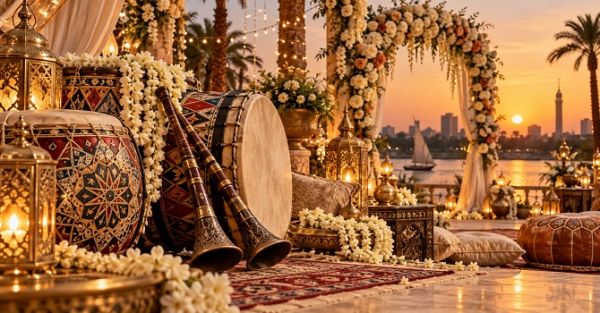
A Celebration of Love, Family & Tradition
If you happen to be in Egypt during wedding season, you may hear drums, see brightly dressed performers, or notice a lively procession entering a hotel or wedding hall. You might even hear the famous Egyptian zaghrouta, the high-pitched ululation traditionally used to express joy during celebrations.
For a traveler, an Egyptian wedding can look very different from a typical Western wedding. It is not simply a ceremony followed by a reception. Depending on the family, region, religion, and social background, an Egyptian marriage may involve several celebrations, family gatherings, traditional music, henna, gold jewelry, a marriage contract, and a spectacular zaffa procession.
But there is an important point to remember: Egyptian weddings are not identical across the country. Cairo, Alexandria, the Nile Delta, Upper Egypt, the Red Sea region, Sinai, and Nubian communities can all have their own variations. Modern urban couples may also combine traditional customs with contemporary wedding styles.
What Happens at an Egyptian Wedding?
An Egyptian wedding can involve several stages rather than one single event.
Before the wedding, families may go through an engagement period during which important matters such as the mahr, housing, furniture, and other marriage preparations are discussed. The shabka, traditionally jewelry given to the bride by the groom, is also an important part of many Egyptian engagements and marriages.
For Muslim couples, Katb el-Kitab, meaning the marriage contract, is an important part of the process. It may take place at a mosque, at home, or at another venue, depending on the family. The contract establishes the marriage and includes financial provisions such as the mahr.
The celebrations may also include Laylet el-Henna, or the Henna Night. Traditionally, women gather to celebrate the bride, apply henna, sing, dance, and enjoy food together. Today, some families keep this as a separate traditional celebration, while others make it a modern party.
Then comes the Farah, the main wedding celebration.
One of the most recognizable parts is the Zaffa. This is a lively wedding procession featuring percussion, music, dancing and, depending on the performers and region, traditional instruments such as the mizmar. The couple may enter the reception accompanied by musicians and performers while guests celebrate around them.
For someone visiting Egypt, the zaffa is often the moment when the atmosphere changes from an ordinary reception into a distinctly Egyptian celebration.
The Zaffa: One of Egypt's Most Recognizable Wedding Traditions
The word zaffa refers to the celebratory procession associated with the wedding.
The exact performance varies considerably. A traditional group may include drummers and mizmar players, while modern wedding entertainment can include singers, dancers, DJs and other performers.
Guests may clap, dance and make zaghrouta as the bride and groom make their entrance.
The tradition is particularly interesting to travelers because music and movement are central to the celebration. Rather than simply walking into the reception, the couple's arrival can become a performance of its own.
The zaffa is not limited to Cairo. Different Egyptian communities have their own musical styles and wedding customs, making weddings an interesting window into regional Egyptian culture.
What Is an Egyptian Henna Night?
Laylet el-Henna, or the Henna Night, is another well-known Egyptian wedding tradition.
Traditionally, the bride's female relatives and friends gather before the wedding to celebrate with music, food, dancing and henna. The bride's hands, and sometimes her feet, may be decorated with henna designs.
The custom has a long history in Egyptian society, although its modern form differs from family to family. Some families organize a traditional evening, while others turn it into a contemporary party.
In Nubian communities, for example, wedding celebrations can extend over several days and the Henna celebration has particular cultural importance. A publication from Egypt's General Authority for Cultural Palaces describes Nubian wedding traditions involving communal meals, henna, music, gifts and celebrations continuing over several days.
This is one reason it is difficult to describe an Egyptian wedding using one fixed formula.
Egyptian Weddings Across Different Parts of Egypt
Egypt is geographically diverse, and wedding traditions reflect that diversity.
In Cairo and other major cities, weddings are often held in hotels, wedding halls, clubs, restaurants or other event venues. Modern photography, DJs, professional entertainment and elaborate decorations may be combined with traditional customs such as the zaffa and shabka.
In Alexandria and the Nile Delta, families may combine urban wedding styles with local family traditions.
In Upper Egypt, weddings can have particularly strong communal and family-oriented traditions, with local music, dancing and customs varying between communities.
Nubian weddings are especially distinctive. In some Nubian communities, celebrations may continue over several days, with specific events such as the Henna celebration and later gatherings involving relatives and neighbors.
In Sinai and other regions, local Bedouin and tribal traditions can add another layer of cultural identity to marriage celebrations.
Religious identity also matters. Muslim and Coptic Christian Egyptian families may follow different religious ceremonies, even though they can share broader Egyptian traditions of family celebration, food, music and hospitality.
So if you attend two Egyptian weddings in different parts of the country, don't be surprised if they feel quite different.
How Long Do Egyptian Weddings Last?
There is no standard length for an Egyptian wedding.
A modern wedding reception itself may last several hours, often extending late into the evening. But when the entire marriage celebration is considered, the festivities can last much longer.
Some couples have a Henna Night before the main wedding, followed by the marriage contract and the wedding reception. In some traditional communities, celebrations can continue for several days.
Nubian wedding traditions provide a particularly good example. Cultural documentation describes celebrations involving multiple consecutive events, including the Henna celebration, the Sabahiya on the third day, and another procession associated with the seventh day.
Historically, Egyptian wedding celebrations could also involve several stages and gatherings rather than one evening. The exact length today depends heavily on the family, region, budget and style of the wedding.
For a traveler, the safest assumption is therefore that an Egyptian wedding is a series of celebrations rather than a single standardized event.
Who Pays for the Wedding in Egyptian Culture?
This is one of the questions that often surprises people from outside Egypt.
There is no single rule saying that either the bride or groom's family pays for everything.
Traditionally, marriage expenses in Egypt have been divided between the two sides according to established customs. The exact division varies according to region, family circumstances, social class and negotiations between the families.
Research on marriage costs in Egypt describes a system in which the groom's side commonly takes primary responsibility for housing and the groom provides the mahr and jewelry gifts, while both sides contribute to furniture, household goods and wedding celebrations.
The mahr is the financial gift or dower owed to the bride in an Islamic marriage. The shabka, meanwhile, traditionally refers to jewelry given to the bride.
Housing is another major part of the traditional arrangement. In many families, the groom's side is expected to secure the marital home, while the bride's family contributes substantially to furnishing it.
However, these arrangements are not universal.
Economic conditions have also encouraged some Egyptian families to reconsider expensive wedding traditions. In recent years, initiatives have promoted simpler marriages and lower wedding expenses because the traditional financial expectations can place significant pressure on young couples and their families.
So, if someone asks, "Who pays for an Egyptian wedding?" the most accurate answer is: both sides commonly contribute, but what each side pays for depends on family traditions and circumstances.
More Than a Wedding: A Family Celebration
Perhaps the most important thing for a traveler to understand is that an Egyptian wedding is often about much more than the bride and groom.
Family and community play a major role. Relatives may be involved in preparations, celebrations, gifts, food and financial arrangements. Friends and extended family can also be an important part of the guest list.
This communal character helps explain why Egyptian weddings can feel energetic, crowded and exceptionally social.
Food is another important element. Depending on the wedding and family, guests may be served large meals, sweets and drinks, while the celebration can include a wedding cake and other modern reception traditions.
And then there is the music.
From traditional percussion and mizmar performances to contemporary Egyptian music and DJs, sound is an essential part of the atmosphere.
What Should Travelers Know If They See an Egyptian Wedding?
If you are traveling through Egypt and happen to encounter a wedding celebration, remember that customs vary.
A wedding at a luxury hotel in Cairo may look very different from a village wedding in the Nile Delta or a traditional Nubian celebration in southern Egypt.
If you are actually invited to a wedding, it is polite to ask your host about the appropriate dress, timing and whether you are expected to bring a gift.
And if you simply see a wedding procession while traveling, enjoy the spectacle from an appropriate distance. The music, dancing, colorful clothing and zaffa can provide a fascinating glimpse into contemporary Egyptian social life.
Egyptian Weddings: A Living Part of Egyptian Culture
Egyptian weddings bring together many layers of Egyptian life: family, religion, regional identity, music, food, hospitality and changing modern lifestyles.
There is no single Egyptian wedding tradition that applies equally to every governorate or every family. Instead, the country has a rich collection of wedding customs that continue to evolve.
For curious travelers, that is exactly what makes Egyptian weddings fascinating. From the Henna Night and shabka to the Katb el-Kitab and zaffa, each tradition tells part of the story of how Egyptians celebrate marriage.
And whether the celebration takes place in a Cairo hotel, an Alexandria venue, a Delta village, an Upper Egyptian town or a Nubian community, one thing is easy to recognize: an Egyptian wedding is rarely a quiet affair. It is a celebration meant to be shared.
Planning to experience Egypt beyond its famous monuments? Explore our Egypt travel packages for a deeper look at the country’s culture, history, and local traditions—from Cairo and Luxor to unforgettable Nile cruises, private tours, and tailor-made journeys across Egypt.
Best Egypt Tours 2026
| Tour | Itinerary | Price |
|---|---|---|
| Cairo and Nile Cruise Package | 7 Days | $ 1375 |
| Nile Cruise and Stay | 8 Days | $ 2210 |
| Egypt Pyramid Tour Packages | 8 Days | $ 1775 |
| Luxor and Aswan Tours | 4 Days | $ 665 |
| 5 Star Egypt Tours | 8 Days | $ 1680 |
| Egypt Pyramids Nile Cruise | 10 Days | $ 2300 |
| Cairo Holiday Packages | 5 Days | $ 815 |
| Egypt Overland Tours | 8 Days | $ 1355 |