
Understanding Hasad, local beliefs, and Egyptian traditions
If you spend enough time in Egypt, you may hear someone say “عين” (ein), “حسد” (hasad), or “ما شاء الله” (mashallah) during an everyday conversation. To a visitor, these words may seem mysterious at first. Why would someone mention the “evil eye” after complimenting a baby, a beautiful home, a successful business, or even a new car?
The answer lies in one of the most interesting aspects of Egyptian culture: the belief in the evil eye and hasad (envy). These ideas have been part of Egyptian and wider Middle Eastern traditions for centuries and continue to appear in everyday conversations, expressions, decorations, and social customs.
For travelers interested in Egyptian culture, local traditions, Egyptian customs, and everyday life in Egypt, understanding hasad offers a fascinating glimpse beyond the country's famous temples and archaeological sites.
What Does Hasad Mean in Egypt?
The Arabic word hasad (حسد) generally refers to envy: wishing that another person would lose a blessing, possession, success, beauty, health, or other desirable quality.
The evil eye, commonly referred to as al-ayn (العين), is closely connected to this idea but is not necessarily exactly the same. In some Egyptian cultural interpretations, a person can supposedly cause harm simply through an envious or excessively admiring gaze, sometimes even without deliberately intending to hurt anyone.
This distinction is important when trying to understand Egyptian beliefs and traditions. Hasad is associated with envy and ill will, while the evil eye can be understood more broadly as harmful influence associated with someone's gaze.
The belief is not unique to Egypt. Similar traditions exist throughout the Middle East, North Africa, the Mediterranean, and many other parts of the world. Historical research has traced evil-eye beliefs and protective practices across ancient cultures, including Egypt and Mesopotamia.
Why Do Egyptians Say “Mashallah”?
One of the expressions visitors may hear frequently in Egypt is “Mashallah” (ما شاء الله).
The expression can be translated roughly as “what God has willed.” It is commonly said when admiring something positive, such as a child's appearance, someone's achievement, a beautiful house, or good fortune.
For example, an Egyptian might see a friend's new car and say:
“Mashallah, beautiful car!”
Or someone may compliment a child by saying:
“Mashallah, what a beautiful child.”
In the cultural context of the evil eye, saying mashallah can also serve as a way of acknowledging that blessings ultimately come from God rather than simply focusing on the person's good fortune.
The expression is therefore not necessarily a sign that the speaker believes the person being complimented is in danger. It can simply be a natural religious and cultural expression of admiration.
The Five-Hand Symbol and the Blue Eye
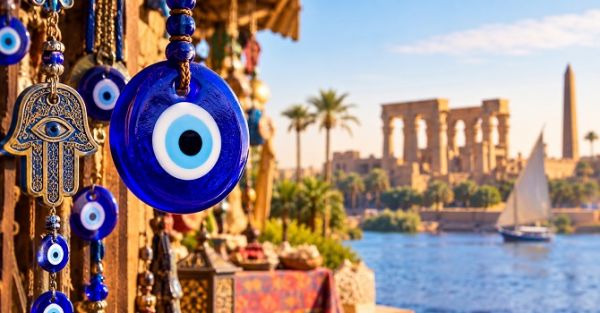
Travelers visiting Egypt will often notice blue eyes, hands, beads, and other protective symbols hanging in cars, homes, shops, or appearing as jewelry and souvenirs.
The Hamsa, often represented as an open hand, is particularly recognizable throughout the region. In Egypt, it may be called “Khamsa wa Khmesa” in popular speech, referring to the number five.
Another familiar object is the blue eye amulet, often associated with protection from the evil eye.
These symbols have complicated histories and are not exclusively Egyptian. Similar protective symbols are found across Mediterranean and Middle Eastern cultures. Nevertheless, they have become recognizable parts of Egyptian popular culture and are especially visible in markets and tourist areas.
For travelers, these objects are more than colorful souvenirs: they can introduce an important conversation about Egyptian folklore, traditional beliefs, and the relationship between religion and popular culture.
Is the Evil Eye an Ancient Egyptian Belief?
This is where the subject becomes particularly interesting.
The idea of protecting people from harmful supernatural forces has a very long history in Egypt. Archaeological and historical research has documented protective objects, amulets, and magical practices in ancient Egyptian society. Scholars studying the broader history of the evil eye have also identified early evidence and related traditions in ancient Egypt and the ancient Near East.
However, it would be misleading to say that today's Egyptian belief in hasad is simply an unchanged ancient Egyptian custom.
Modern Egyptian culture has developed through thousands of years of religious, social, and cultural influences. Ancient Egyptian traditions, Christianity, Islam, Arab culture, Mediterranean traditions, and local customs have all contributed to the country's cultural landscape.
Therefore, today's understanding of the evil eye should be viewed as part of living Egyptian culture, rather than as a direct survival of one ancient Egyptian belief.
Hasad in Everyday Egyptian Life
Perhaps the most fascinating aspect of hasad is how ordinary it can seem.
The concept may appear when people discuss a new job, a successful business, a marriage, a new home, children, expensive purchases, or an unexpected stroke of good luck.
Some Egyptians may avoid talking too openly about their achievements or possessions. This does not necessarily mean they are secretive. Instead, modesty can sometimes be considered a way of avoiding unnecessary attention or envy.
Egyptian popular culture even contains sayings related to this attitude. One traditional expression is:
“Dari ala shametak te2eed” — roughly, “Protect your candle so it can continue to shine.”
The idea reflects a broader cultural preference for enjoying good fortune without excessively displaying it.
Historical accounts of Egyptian society have also documented the importance of protective customs, charms, and practices associated with the evil eye.
“Don’t Compliment Too Much!”
Visitors may occasionally notice an interesting social habit when admiring something belonging to an Egyptian friend.
If you enthusiastically compliment someone's child, home, car, or other possession, the person may respond with “Mashallah” or another protective expression.
This does not mean you have done something wrong.
In fact, the opposite may be true: Egyptians are generally happy when visitors appreciate their country, homes, food, hospitality, or families. The protective expression simply reflects a familiar cultural way of responding to admiration.
For a traveler, the best approach is simply to be respectful and understand the expression within its cultural context.
Religious Belief and Popular Tradition
Another important point is that religious belief and popular folklore are not always identical.
In Egypt, ideas about hasad exist alongside Islamic teachings, Christian traditions, local customs, family practices, and older folk traditions.
For example, Egypt's Dar al-Ifta, the country's official Islamic advisory institution, recognizes the concept of harm associated with envy and the evil eye within Islamic tradition, while also advising people not to become consumed by superstition or seek help from charlatans.
This distinction helps explain why some Egyptians may take the evil eye very seriously while others may treat it casually, humorously, or simply as part of traditional culture.
Egypt is a diverse society, so there is no single Egyptian attitude toward hasad.
Hasad in Modern Egypt
Interestingly, the concept has not disappeared with modern technology.
A recent study of Egyptian Arabic social media found that references to the evil eye continue to appear in digital communication, including Facebook and Instagram. People may use expressions, jokes, emojis, memes, or other forms of communication when talking about envy, success, beauty, or good fortune.
This demonstrates how traditional cultural ideas can adapt to modern life.
In the past, someone might have worried about attracting attention by showing a new possession to neighbors. Today, the same concern can appear when people share photographs of vacations, expensive purchases, weddings, children, or professional achievements online.
The medium has changed, but the cultural idea remains recognizable.
What Travelers Should Know About the Evil Eye in Egypt
You do not need to believe in the evil eye to appreciate its cultural importance.
When visiting Egypt, you may see blue-eye ornaments, Hamsa hands, traditional jewelry, protective expressions, or references to hasad in conversations.
Rather than viewing these things simply as strange superstitions, consider them part of the cultural vocabulary through which people talk about luck, success, beauty, envy, protection, and social relationships.
If someone says mashallah after admiring something, there is usually no reason to feel uncomfortable. You can simply understand it as a familiar Egyptian expression connected with appreciation and protection.
The Evil Eye as a Window into Egyptian Culture
Egypt is often introduced to travelers through its pyramids, temples, tombs, and ancient monuments. But the country has another fascinating story taking place every day in homes, cafés, markets, family gatherings, and conversations.
The concept of hasad and the evil eye is one example.
It reveals how Egyptians think about success, admiration, modesty, relationships, and good fortune. It also demonstrates how ancient and modern cultural ideas can coexist in contemporary Egypt.
For curious travelers, learning about traditions such as hasad, Egyptian folklore, Egyptian superstitions, local customs, and the meaning of “mashallah” can make a journey more meaningful. Egypt is not only a destination to see—it is a culture to observe, listen to, and understand.
Discover the traditions, history, and everyday culture of Egypt firsthand with our carefully designed Egypt travel packages, combining iconic sights with authentic local experiences.
Best Egypt Tours 2026
| Tour | Itinerary | Price |
|---|---|---|
| Cairo and Nile Cruise Package | 7 Days | $ 1465 |
| Nile Cruise and Stay | 8 Days | $ 2300 |
| Egypt Pyramid Tour Packages | 8 Days | $ 1775 |
| Luxor and Aswan Tours | 4 Days | $ 665 |
| 5 Star Egypt Tours | 8 Days | $ 1775 |
| Egypt Pyramids Nile Cruise | 10 Days | $ 2300 |
| Cairo Holiday Packages | 5 Days | $ 870 |
| Egypt Overland Tours | 8 Days | $ 1495 |