
How Egypt Celebrates Easter & Spring
If you are planning a trip to Egypt in spring, you may notice something unusual about the Easter calendar. Unlike in many Western countries, Easter in Egypt does not always fall on the same Sunday as Easter in Europe or North America. The reason is Egypt’s long-standing Coptic Christian tradition and the way the Coptic Orthodox Church calculates the date of Easter.
So, when do Egyptians celebrate Easter? For Egypt’s Coptic Orthodox Christians, Easter, known locally as Eid al-Qiyamah (Feast of the Resurrection), is celebrated on a Sunday between early April and early May. The exact date changes every year. In 2026, for example, Coptic Easter was celebrated on April 12, followed immediately by the national spring celebration of Sham El Nessim on April 13. The Coptic Orthodox Church officially celebrated the Resurrection on April 12, 2026.
For travelers, understanding this calendar makes it easier to appreciate one of Egypt's most interesting cultural combinations: an ancient Christian celebration followed by a spring festival whose roots reach back thousands of years.
Why Is Easter in Egypt on a Different Date?
The main reason is the calendar used to calculate the date of Coptic Orthodox Easter.
The Coptic Orthodox Church follows an Easter calculation associated with the ancient Alexandrian tradition. The date is connected to the spring equinox, the lunar cycle, and the Jewish Passover, and Easter must fall on a Sunday. The Coptic Orthodox Church explains that this system has historical connections to the Church of Alexandria and its early expertise in astronomy and mathematics.
This is why the date of Easter in Egypt can differ from Western Easter, which is generally calculated using the Gregorian calendar.
The difference can be particularly noticeable for visitors from countries where Easter is normally associated with March or early April. In Egypt, however, Coptic Easter can occur considerably later in the spring.
The Coptic Orthodox Church places the Feast of the Resurrection within a period extending from early April into early May.
Is Easter a Major Celebration in Egypt?
Yes. Easter is an important religious occasion for Egypt's Coptic Christian community, which has a history in Egypt stretching back to the earliest centuries of Christianity.
The celebration is primarily religious rather than simply a commercial holiday. For Coptic Orthodox Christians, Easter marks the Resurrection of Jesus Christ and comes after the solemn period of Great Lent and Holy Week.
The days immediately before Easter are especially significant in the Coptic calendar. Churches hold extensive prayers and services during Holy Week, remembering the final events of Christ's earthly life, including the Crucifixion and Resurrection.
For example, in 2026, Pope Tawadros II celebrated the Holy Thursday liturgy at the Monastery of Saint Mina in Mariout, Alexandria, before the Resurrection feast on April 12.
For visitors interested in religious tourism in Egypt, this period can offer an opportunity to learn more about the country's ancient Christian heritage. Egypt is home to historic churches, monasteries, and Christian sites connected with the Coptic tradition.
What Happens During Coptic Easter?
Coptic Easter is centered on church services, prayer, family gatherings, and the celebration of the Resurrection.
For practicing Christians, the transition from the solemnity of Holy Week to Easter Sunday is especially meaningful. Churches become places of celebration, and families often gather together after the long fasting period.
One important aspect that visitors should understand is that Coptic Easter is not simply the Egyptian version of the Western Easter holiday. It follows its own religious calendar and traditions.
The fasting period before Easter is also an important part of the experience. Great Lent is traditionally a period of prayer, fasting, reflection, and spiritual preparation. In 2026, the Coptic Orthodox Church began Great Lent in February, with Pope Tawadros II describing fasting as a period for worship, prayer, drawing closer to God, and self-reflection.
What Is Sham El Nessim?
One of the most fascinating things about Easter in Egypt is what happens immediately afterward.
The Monday following Coptic Easter is Sham El Nessim, a nationwide spring celebration enjoyed by Egyptians regardless of religious background.
This means that Easter and Sham El Nessim are closely connected on the Egyptian calendar, but they are not the same holiday.
According to Egypt's State Information Service, Sham El Nessim has been celebrated in Egypt for more than 4,500 years. Its name is traditionally associated with the ancient Egyptian spring season, and many of its customs have survived into modern Egyptian life.
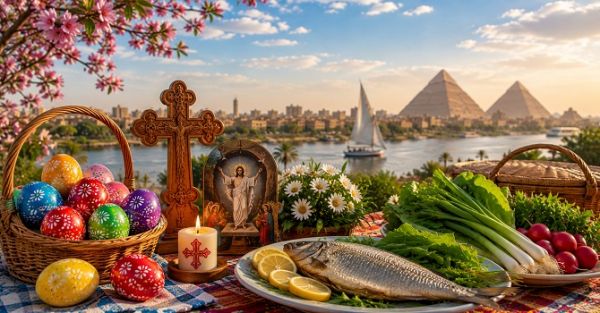
The holiday is particularly famous for outdoor gatherings, family picnics, colorful eggs, green vegetables, and traditional salted fish known as feseekh.
For many Egyptians, Sham El Nessim is one of the clearest signs that spring has arrived.
Why Do Egyptians Eat Eggs and Fish on Sham El Nessim?
If you visit Egypt around Easter, you may notice brightly colored eggs in shops and homes. Eggs have long been associated with renewal and new life, making them particularly appropriate for a spring festival.
Families also traditionally eat foods such as lettuce, green onions, and salted fish. These customs have been linked to ancient Egyptian traditions surrounding the arrival of spring and the agricultural cycle.
The most famous—and sometimes surprising to foreign visitors—food associated with Sham El Nessim is feseekh, a strongly salted and fermented mullet fish.
Visitors should understand that feseekh is a traditional food rather than an Easter religious requirement. It belongs primarily to the cultural traditions of Sham El Nessim.
In 2026, Egypt's government prepared specifically for the Easter and Sham El Nessim period, while the Prime Minister extended Easter greetings to Christian Egyptians and Sham El Nessim greetings to Egyptians generally.
Does Everyone in Egypt Celebrate Easter?
Not everyone celebrates Easter as a religious holiday.
Egypt is a predominantly Muslim country, while the Coptic Orthodox community represents the country's historic Christian population. Therefore, Easter Sunday has a particular religious meaning for Christians.
However, Sham El Nessim is much broader than Easter. Egyptians from different religious backgrounds commonly enjoy the spring holiday, making it an excellent example of how ancient customs can become part of shared national culture.
This distinction is important for travelers. Saying that "all Egyptians celebrate Easter" would be misleading. A more accurate description is that Coptic Christians celebrate Easter religiously, while Sham El Nessim is a widely shared Egyptian spring celebration.
When Is Easter in Egypt in Future Years?
Because Coptic Easter is calculated according to a variable calendar, travelers should check the date for the specific year they plan to visit.
The date can move significantly from one year to another, so it is not safe to assume that Egyptian Easter will occur on the same weekend as Western Easter.
As a simple example, Coptic Easter fell on April 12 in 2026, with Sham El Nessim following on Monday, April 13.
The same relationship generally makes Sham El Nessim easy to identify: it falls on the Monday immediately following Coptic Easter Sunday.
What Should Travelers Expect in Egypt During Easter?
For tourists, Easter can be an interesting time to experience Egypt beyond its famous archaeological attractions.
Major destinations such as Cairo, Alexandria, Luxor, and Aswan continue to welcome visitors, while Egyptian families may be preparing for church celebrations, family gatherings, or Sham El Nessim outings.
If your trip overlaps with Easter, remember that religious sites may be particularly busy around major services. Churches can also have security arrangements and access restrictions during significant religious celebrations.
For travelers interested in Egypt's Christian heritage, however, the period can provide valuable cultural context. Historic Coptic churches in Cairo and ancient monasteries elsewhere in the country are reminders that Christianity has been part of Egyptian history for nearly two millennia.
Planning to experience Egypt’s rich traditions firsthand? Explore our Egypt travel packages and discover ancient heritage, vibrant culture, and unforgettable experiences across the country.
Best Egypt Tours 2026
| Tour | Itinerary | Price |
|---|---|---|
| Egypt Solar Eclipse Tour | 9 Days | $ 8995 |
| All Inclusive Vacations Egypt | 10 Days | $ 1999 |
| Cairo and Nile Cruise Package | 7 Days | $ 1375 |
| Nile Cruise and Stay | 8 Days | $ 2210 |
| Egypt Pyramid Tour Packages | 8 Days | $ 1775 |
| Luxor and Aswan Tours | 4 Days | $ 665 |
| 5 Star Egypt Tours | 8 Days | $ 1680 |
| Egypt Pyramids Nile Cruise | 10 Days | $ 2300 |
| Cairo Holiday Packages | 5 Days | $ 815 |
| Egypt Overland Tours | 8 Days | $ 1355 |