
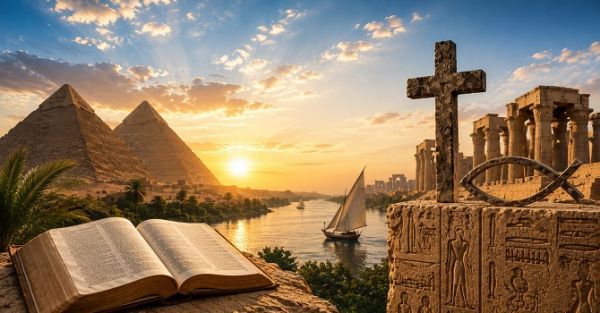
Egypt in the Bible: Meaning & History
Egypt occupies a fascinating place in the Bible. It is not simply a distant country mentioned in a few ancient stories. From Genesis to the Gospels, Egypt appears repeatedly as a place of refuge, prosperity, oppression, political power, spiritual testing, and ultimately hope.
For travelers interested in Egypt and the Bible, this makes the country more than a destination filled with pyramids and temples. Many places across Egypt can be understood within a much wider biblical story that connects the land of the Nile with Abraham, Joseph, Moses, the Exodus, and the early life of Jesus.
So, what does Egypt represent in the Bible?
The answer is surprisingly complex.
Egypt as a Place of Refuge
One of the earliest biblical connections between Egypt and the people of the Bible is surprisingly positive: Egypt can be a place of refuge during difficult times.
In Genesis, Abraham travels to Egypt because a severe famine has struck the land of Canaan. Later, Jacob's family also goes to Egypt during a famine, after Joseph rises to a powerful position in the country. Genesis describes Joseph as being placed in charge of Egypt's food supplies, allowing him to prepare for years of famine and eventually save his family from starvation.
This gives Egypt an important early role in the biblical narrative. It is a land where people go when survival becomes difficult.
That idea becomes especially interesting when visiting Egypt today. The Nile Valley was one of the ancient world's great agricultural regions, and the river's predictable cycles helped support one of the world's earliest civilizations.
Joseph and the Egypt of Pharaohs
The story of Joseph is perhaps the Bible's most detailed account of life in ancient Egypt.
According to Genesis, Joseph is sold by his brothers and eventually taken to Egypt. After interpreting Pharaoh's dreams, he rises to become a powerful administrator responsible for preparing the country for seven years of famine.
The biblical account describes Joseph's connection with Egyptian society, including his marriage to Asenath, the daughter of an Egyptian priest.
For modern visitors, the story creates an intriguing bridge between biblical history and ancient Egyptian civilization. Although the Bible does not identify the specific pharaoh involved, its descriptions place Egypt at the center of a sophisticated kingdom with an organized government, agriculture, administration, and international trade.
Egypt as a Symbol of Slavery and Oppression
Egypt's most famous biblical meaning comes from the story of the Exodus.
After Joseph's generation dies, the Israelites multiply in Egypt. A new Pharaoh eventually views them as a threat and subjects them to forced labor. Moses is then called to lead the Israelites out of Egypt.
The Exodus becomes one of the Bible's central stories of liberation.
Egypt therefore becomes a powerful biblical symbol of slavery, oppression, and deliverance. The phrase "out of Egypt" becomes deeply connected with the idea of being rescued from bondage and beginning a new life.
The story reaches its dramatic climax with the Ten Plagues, Pharaoh's decision to release the Israelites, and the crossing of the Red Sea.
For travelers exploring Egypt, this is one reason the country's biblical connections remain so compelling. The Exodus is not merely a religious story; it is one of the most influential narratives of freedom and liberation in Western and Middle Eastern religious traditions.
Egypt and the Power of Pharaoh
The Pharaoh of the Exodus represents another important biblical theme: the limits of political power.
In the biblical narrative, Pharaoh possesses enormous authority. Yet his refusal to release the Israelites ultimately leads to the downfall of his authority and the departure of the Israelites.
Egypt consequently becomes an example of a powerful kingdom that is nevertheless subject to a greater divine authority.
This theme appears again in the prophetic books. Biblical prophets sometimes criticize Egypt for relying on its military strength and political influence instead of trusting God. Isaiah, for example, describes Egypt as a nation whose power should not be treated as an ultimate source of security.
Egypt as a Symbol of Worldly Security
Egypt's meaning in the Bible is therefore not always negative or always positive.
At various points, biblical writers portray Egypt as a powerful nation that people may turn to for military or political protection. Isaiah warns against relying on Egypt's horses and chariots instead of God.
This creates another symbolic interpretation: Egypt can represent human power and worldly security when those things are placed above faith.
It is an important distinction because Egypt itself is not presented as inherently evil throughout the Bible. Rather, different biblical stories use Egypt to illustrate different human experiences—refuge, prosperity, danger, political power, suffering, and redemption.
Egypt in the Prophets: Judgment and Hope
The prophets sometimes speak about Egypt in dramatic terms.
Isaiah 19 contains a particularly interesting passage. It describes judgment coming upon Egypt, but it does not end with destruction. The chapter ultimately presents a vision in which Egypt comes to know and worship God and is included alongside Assyria and Israel in a future blessing.
This is one of the most remarkable biblical references to Egypt.
Rather than presenting Egypt only as an enemy, Isaiah imagines a future in which Egypt can become part of a wider divine blessing.
For someone researching Egypt in the Bible, this passage is particularly important because it shows that the biblical portrayal of Egypt is much more complicated than the simple idea that "Egypt represents evil."
Egypt and Jesus: A Place of Protection
Egypt takes on a new meaning in the New Testament.
According to the Gospel of Matthew, after the birth of Jesus, Joseph is warned in a dream to take Mary and the child Jesus and flee to Egypt because King Herod wants to kill the child. Joseph follows the instruction, and the family remains in Egypt until Herod's death.
This makes Egypt a place of refuge for Jesus.
Matthew connects the event with the words of Hosea, "Out of Egypt I called my son." Importantly, Hosea 11:1 originally refers to Israel and the Exodus tradition; Matthew uses the passage to connect Jesus' story with Israel's earlier story. This is an example of how the New Testament interprets earlier biblical events and texts in relation to Jesus.
For Christian travelers, this is one of the most meaningful connections between Egypt and Christianity.
The Holy Family in Egypt
The Bible itself gives only a brief account of the Holy Family's journey to Egypt. It does not provide a detailed itinerary or name the Egyptian towns where Mary, Joseph, and Jesus stayed.
However, centuries of Christian tradition in Egypt developed a much more extensive story of the Holy Family's journey through Egypt.
Coptic Christian tradition associates the journey with numerous locations, including areas around:
- the Nile Delta
- Cairo
- Middle Egypt
- Upper Egypt
Churches and monasteries connected with the Holy Family can be found along traditional pilgrimage routes.
These traditions are important to Egyptian Christian heritage, but travelers should distinguish between biblical evidence and later tradition. The Bible confirms the family's flight to Egypt; the detailed route preserved by Egyptian Christian tradition comes from later religious history.
Why Egypt Is So Important to Biblical History
Egypt's importance in the Bible comes from the number of different roles it plays.
It is a land of refuge in the stories of Abraham and the Holy Family.
It is a land of prosperity and survival in the story of Joseph.
It becomes a land of slavery and oppression during the Exodus.
It represents political and military power in the writings of the prophets.
And in Isaiah's vision, Egypt can ultimately become part of a future divine blessing.
This combination makes Egypt unusual among the countries mentioned in the Bible.
Visiting Egypt Through a Biblical Lens
Traveling through Egypt can therefore offer a different perspective on the country's ancient landscape.
A visit to Cairo can introduce travelers to Egypt's Christian heritage and historic churches, while journeys through the Nile Valley reveal the landscape that made ancient Egypt one of the world's greatest civilizations.
For travelers interested specifically in biblical Egypt, Christian heritage, the Holy Family, Moses, Joseph, or the Exodus, it is worth exploring the country with both historical and religious perspectives in mind .
At the same time, visitors should remember that not every location traditionally associated with a biblical event can be proven from the biblical text itself. Egypt's religious heritage has developed over thousands of years, combining biblical narratives, archaeological history, Coptic Christian traditions, and local memory.
For travelers inspired by Egypt’s biblical heritage, our Egypt travel packages offer a chance to explore the country’s ancient landmarks and sacred traditions, while Nile cruises provide a memorable way to experience the historic landscapes along the river.
Best Egypt Tours 2026
| Tour | Itinerary | Price |
|---|---|---|
| Egypt Solar Eclipse Tour | 9 Days | $ 8995 |
| All Inclusive Vacations Egypt | 10 Days | $ 1999 |
| Pyramids and Nile Cruise Holidays | 8 Days | $ 1595 |
| Luxury Egypt Tours with Nile Cruise | 12 Days | $ 2470 |
| Nile Cruise and Red Sea Stay | 12 Days | $ 2685 |
| Cairo Nile Cruise and Hurghada | 12 Days | $ 2065 |
| Package Trips to Egypt | 10 Days | $ 2065 |
| Egypt Honeymoon Packages | 10 Days | $ 3180 |
| Egypt Wheelchair Accessible Tours | 10 Days | $ 2999 |
| Cairo and Nile Cruise Package | 7 Days | $ 1375 |
| Nile Cruise and Stay | 8 Days | $ 2210 |
| Egypt Pyramid Tour Packages | 8 Days | $ 1775 |
| Luxor and Aswan Tours | 4 Days | $ 665 |
| 5 Star Egypt Tours | 8 Days | $ 1680 |
| Egypt Pyramids Nile Cruise | 10 Days | $ 2300 |