
Understanding Cairo's Population
Cairo is one of the largest and most fascinating cities in the world, but answering the simple question "How many people live in Cairo?" is not as straightforward as it may seem. The answer depends on what we mean by Cairo: the official Cairo Governorate, the built-up urban area, or the much larger metropolitan region commonly known as Greater Cairo.
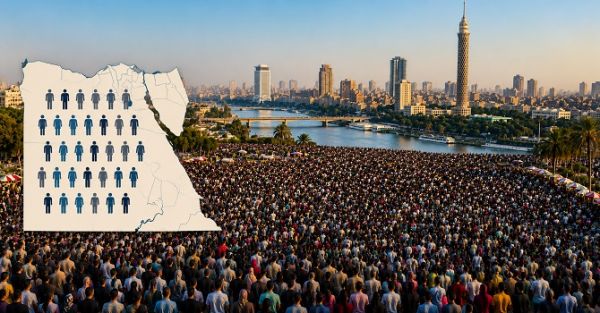
According to the United Nations' 2025 urbanization estimates, Cairo's urban agglomeration has a population of approximately 20.5 million people. This makes the Egyptian capital one of the world's great megacities and puts it among the largest urban areas on Earth.
However, you may also see much smaller figures when searching for Cairo population online. This is because different sources use different geographical boundaries and definitions. Understanding this distinction is important for travelers, researchers, and anyone curious about life in Egypt's capital.
Cairo's Population at a Glance
If you are looking for a quick answer, the best estimate for the wider Cairo urban agglomeration in 2025 is about 20.5 million people.
For comparison, Egypt's entire population was estimated by the United Nations at approximately 118.4 million in 2025. That means the Cairo urban agglomeration alone represents a huge concentration of Egypt's population.
But the figure of 20.5 million should not be interpreted as meaning that all of these people live within the administrative boundaries of Cairo Governorate. They do not. The metropolitan area stretches across several administrative jurisdictions and includes densely populated communities that are physically connected to Cairo.
This is why one website may say Cairo has around 10 million residents, while another says it has more than 20 million. Both numbers can be meaningful, depending on the definition being used.
Why Are There Different Population Figures for Cairo?
The main reason is that a city can be measured in different ways.
1. City Proper
This refers to the population living within officially defined administrative boundaries. In Cairo's case, this can produce a considerably smaller number than the population of the entire metropolitan area.
2. Urban Agglomeration
This includes the central city and the surrounding continuously built-up urban areas that have grown together. This is generally a more useful measurement when discussing how many people actually live in the wider urban environment of Cairo.
3. Greater Cairo
The term Greater Cairo is commonly used for the huge metropolitan region surrounding the capital. It includes Cairo and neighboring urban areas, particularly across:
- Cairo Governorate
- Giza Governorate
- Qalyubia Governorate
- Other connected urban communities and expanding suburbs
The United Nations notes that city boundaries vary significantly from one country to another. Its definition of an urban agglomeration includes the city itself as well as suburban and densely settled areas outside the official city boundaries.
This is one reason population comparisons between major world cities can sometimes be confusing.
Cairo Governorate Is Not the Same as Greater Cairo
One of the most important things to understand is that Cairo city and Greater Cairo are not exactly the same thing.
Cairo Governorate is an administrative area with defined boundaries. According to Egypt's official statistics agency, CAPMAS, the estimated population of Cairo Governorate was 10,299,821 on January 1, 2024.
That figure is much lower than the UN's 2025 estimate of approximately 20.5 million for the Cairo capital-city urban agglomeration.
The difference does not mean that one source is necessarily wrong. Rather, the two figures describe different geographical areas.
Think of it this way: if you are staying in central Cairo, you may quickly find yourself traveling through areas that are technically outside Cairo Governorate but are still part of the same enormous urban landscape.
The buildings, roads, businesses, traffic, and daily life continue across administrative boundaries.
For a traveler, this distinction is often less noticeable than it is on a map.
How Big Is Greater Cairo?
Greater Cairo is enormous by almost any standard.
The metropolitan area has developed along and around the Nile River and across both sides of the river. It includes:
- Historic neighborhoods
- Modern residential districts
- Industrial zones
- Commercial centers
- Densely populated suburbs
- Satellite cities
- Rapidly expanding new communities
The urban landscape can change dramatically from one neighborhood to another. You can move from the historic heart of Islamic Cairo to modern downtown streets, then toward Giza and the Pyramids, or into rapidly expanding suburban communities.
This continuous urban development is one reason Cairo feels much larger than the population figure of the administrative city alone might suggest.
The Nile has played a central role in shaping this growth. Egypt's geography is heavily concentrated around the Nile Valley and Delta, where most of the country's population lives.
Cairo developed at one of the most strategically important points along the river and became the country's political, economic, cultural, and transportation center.
Today, the metropolitan area is home to millions of people who live, work, study, and travel across its interconnected communities every day.
Cairo Is One of the World's Megacities
A megacity is generally defined as an urban area with at least 10 million inhabitants. By this definition, Cairo is clearly a megacity.
The United Nations' 2025 urbanization data identified 33 megacities worldwide, reflecting the rapid growth of large urban areas around the planet.
Cairo is ranked among the world's largest urban agglomerations and is one of the most important population centers in Africa and the Middle East.
You may notice that different UN datasets sometimes provide different population estimates for Cairo. This highlights an important point: population estimates can differ depending on the dataset, methodology, geographic definition, and statistical revision being used.
For general travel content, the safest approach is to say that around 20 to 25 million people live in the wider Cairo metropolitan or urban area, depending on the definition used.
If a precise figure is needed, the source and geographical definition should always be specified.
Why Does Cairo Feel So Crowded?
Even visitors who have never studied Cairo's population statistics often notice its enormous scale almost immediately.
Traffic can be intense, major roads can be busy throughout the day, and densely populated neighborhoods can feel extremely active.
The city has a constant rhythm of movement, with:
- Commuters
- Students
- Workers
- Tourists
- Taxis
- Buses
- Delivery vehicles
- Local residents
The impression of crowding is also influenced by the fact that Egypt's population is highly concentrated geographically.
Much of the country is desert, while most people live in the relatively narrow inhabited corridor around the Nile Valley and Delta.
Cairo therefore serves not only its own residents but also millions of people who travel into the metropolitan area for:
- Work
- Education
- Healthcare
- Shopping
- Government services
- Business
- Tourism
This helps explain why the city can sometimes feel even busier than its official population numbers suggest.
Is Cairo the Biggest City in Africa?
Cairo is certainly one of Africa's largest urban centers and is widely recognized as the continent's leading megacity by population.
Its enormous size gives it a unique position in Africa and the Middle East. The city's influence extends far beyond Egypt itself, making Cairo an important center for:
- Arabic-language media
- Cinema
- Education
- Culture
- Business
- Politics
- Tourism
For travelers, this means Cairo is more than simply a destination where you visit the Pyramids of Giza.
It is a living metropolis with millions of residents and a complex urban culture that has developed over centuries.
The contrast between ancient monuments and modern city life is one of Cairo's defining characteristics.
What Does Cairo's Population Mean for Travelers?
For visitors planning a trip to Egypt, Cairo's huge population is an important part of the travel experience.
The city is not a quiet historical town built around a few monuments. It is a massive, energetic capital where ancient history exists alongside modern urban life.
Tourists visiting places such as:
- The Pyramids of Giza
- The Grand Egyptian Museum
- The Egyptian Museum
- Islamic Cairo
- Coptic Cairo
- Khan el-Khalili
- The Nile Corniche
are experiencing only parts of a much larger metropolitan environment.
The sheer size of Cairo also means that travel times can vary considerably. Two attractions that look relatively close on a map may take much longer to reach during busy periods because of traffic.
For this reason, travelers often benefit from planning sightseeing by geographic area rather than trying to cross the entire metropolitan region several times in a single day.
The Real Meaning of Cairo's Population
Numbers alone cannot fully explain what it is like to experience Cairo.
A population of more than 20 million means that Cairo is not simply a historical capital surrounded by ancient monuments. It is a vast, constantly moving urban ecosystem where millions of people live their everyday lives against the backdrop of some of humanity's most famous archaeological treasures.
This is perhaps what makes Cairo so fascinating for curious travelers.
In one day, you can explore thousands of years of history and then return to a modern city filled with:
- Restaurants
- Cafés
- Universities
- Shopping centers
- Busy streets
- Modern neighborhoods
- Traditional markets
So, when someone asks "How many people live in Cairo?", the best answer is not just a number.
It is a reminder that behind the Pyramids, museums, mosques, churches, and Nile views is one of the world's great urban populations—a city that is both an ancient center of civilization and a modern megacity of millions.
Best Egypt Tours 2026
| Tour | Itinerary | Price |
|---|---|---|
| Egypt & Jordan Combined Tour | 10 Days | $ 2875 |
| Egypt and Kenya Tours | 15 Days | $ 6250 |
| Egypt and Dubai Tours | 8 Days | $ 999 |
| Cairo and Istanbul Tours | 8 Days | $ 1250 |
| Turkey and Egypt Tours | 12 Days | $ 2825 |
| Egypt and Petra Tours | 12 Days | $ 2255 |
| Egypt and Jordan Tours With Nile Cruise | 14 Days | $ 3066 |
| Egypt and Morocco Tours | 15 Days | $ 4499 |
| Egypt and Greece Tours | 14 Days | $ 3380 |
| Egypt Tanzania Tour | 14 Days | $ 6275 |
| Cairo to Petra Tour | 7 Days | $ 945 |
| Egypt and Holy Land Tours | 15 Days | $ 4100 |