
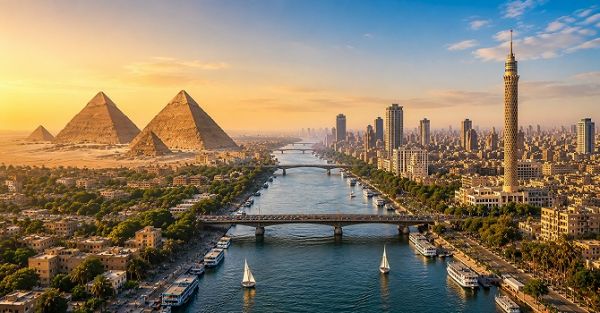
Understanding the Difference Between Cairo and Giza
If you are planning a trip to Egypt, you may quickly come across two names that seem almost interchangeable: Cairo and Giza. You may even notice that hotels, tours, restaurants, and attractions sometimes use the word “Cairo” when they are actually located in Giza.
So, are Cairo and Giza the same?
No, Cairo and Giza are not the same city or governorate. They are separate administrative areas located on opposite sides of the Nile River. However, they are so closely connected that, for travelers, they often feel like parts of one enormous urban area. Together with parts of Qalyubia Governorate, they form what is commonly known as Greater Cairo.
This is why the answer can seem confusing. Administratively, Cairo and Giza are different. Geographically and practically, however, they are part of the same huge metropolitan region.
Cairo and Giza: The Simple Difference
The easiest way to understand the difference is to think of the Nile River as a natural dividing line.
- Cairo Governorate is mainly on the eastern side of the Nile
- Giza Governorate lies primarily to the west side of the Nile
The two areas are connected by several bridges and roads, and millions of people travel between them every day.
Cairo is the capital of Egypt and one of the country's most important political, cultural, and economic centers.Giza, meanwhile, is famous around the world for the Giza Plateau, home to the Great Pyramid of Khufu, the pyramids of Khafre and Menkaure, and the Great Sphinx.
The official Cairo Governorate portal describes modern Greater Cairo as a broader metropolitan area that includes Cairo Governorate, Giza Governorate and parts of Qalyubia Governorate. The same source also identifies Giza as being on the western side of the Nile, directly across from Cairo.
Is Giza Part of Cairo?
This depends on what you mean by “Cairo.”
If you mean Cairo Governorate, then the answer is no. Giza Governorate is a separate administrative governorate from Cairo Governorate.
If you mean Greater Cairo, then the answer is yes, in a metropolitan sense. Giza is an essential part of the Greater Cairo urban area.
This distinction is particularly important for travelers. When someone says they are staying in “Cairo,” their hotel could actually be in Giza, especially if they want to be close to the pyramids. Likewise, a travel company may advertise a “Cairo hotel” even when the property is technically located on the Giza side of the Nile.
In everyday travel conversations, “Cairo” is often used as a convenient name for the wider metropolitan area rather than the precise administrative boundaries of Cairo Governorate.
Where Are the Pyramids: Cairo or Giza?
This is one of the most common questions visitors ask.
The Pyramids of Giza are in Giza Governorate, not Cairo Governorate. They stand on the Giza Plateau on the western bank of the Nile.
The Great Pyramid of Khufu, the Pyramid of Khafre, the Pyramid of Menkaure, and the Great Sphinx are all part of the Giza pyramid complex. The official Cairo Governorate tourism portal also describes the pyramids as being on the Giza Plateau in Giza Governorate, on the western bank of the Nile.
However, the pyramids are so closely associated with Cairo tourism that they are frequently described in travel guides and advertisements as being in “Cairo.” From a tourist's perspective, this is understandable because the pyramid complex is only a short journey from many central Cairo neighborhoods.
So, if you see a tour advertised as a Cairo and Giza tour, this usually means the itinerary combines attractions on both sides of the Nile.
Why Do Cairo and Giza Feel Like One City?
The answer lies in urban growth.
Over many decades, Cairo expanded beyond its traditional boundaries, while Giza developed into a major urban area of its own. Eventually, the built-up areas on both sides of the Nile became so interconnected that the boundary between them became almost invisible to visitors.
You can cross from Cairo to Giza over the Nile and continue through densely populated urban neighborhoods without feeling that you have entered a completely different city.
This is similar to what happens in many large metropolitan areas around the world. Two cities may have separate administrative governments but form one continuous urban landscape.
Greater Cairo is therefore best understood as a metropolitan region, while Cairo and Giza remain separate administrative entities.
What Is Cairo Famous For?
Cairo is the heart of modern Egypt and offers an enormous variety of historical and cultural experiences.
Visitors can explore Islamic Cairo, with its historic mosques, traditional streets, and centuries-old architecture. The area around Al-Muizz Street is particularly famous for its concentration of Islamic monuments.
The city is also known for attractions such as:
- the Egyptian Museum
- the Cairo Tower
- Khan el-Khalili
- historic Coptic Cairo
- the Nile Corniche.
Cairo's history extends far beyond the modern city. The wider capital region contains layers of Pharaonic, Greek, Roman, Coptic, and Islamic history, making it one of the most fascinating destinations for travelers interested in ancient civilizations and cultural heritage.
The official Cairo Governorate describes Cairo as both a city and a governorate and highlights its role as Egypt's capital and a major political, cultural, and historical center.
What Is Giza Famous For?
When travelers hear the word “Giza,” the first thing that usually comes to mind is the Pyramids of Giza.
The pyramid complex is one of the most famous archaeological sites on Earth and the only surviving member of the traditional Seven Wonders of the Ancient World.
But Giza is much more than the pyramids.
The governorate extends over a large area and includes:
- urban neighborhoods
- agricultural areas
- archaeological sites
and other historic locations. The wider Giza area is also associated with important ancient Egyptian sites, including parts of the ancient Memphis region and archaeological areas south of the main pyramid complex.
For many international visitors, however, the Giza Plateau is the main reason to visit this side of Greater Cairo.
Is It Better to Stay in Cairo or Giza?
The best location depends on what you want to experience.
If your main interests are
- historic Cairo
- Islamic architecture
- museums
- shopping
- restaurants
- nightlife
staying in central Cairo may be more convenient.
If your priority is seeing the pyramids, staying in Giza can place you much closer to the archaeological area. Some hotels in the Giza area also offer spectacular views of the pyramids, particularly from rooftop restaurants and terraces.
For travelers with limited time, choosing a hotel based on the location of your planned activities can make a significant difference. Cairo's traffic can be heavy, and the distance between attractions may take longer to cover than the map suggests.
A traveler visiting Egypt for the first time may therefore choose to stay in one location and visit the other during a day tour. Another option is to divide the trip between Cairo and Giza, especially on a longer holiday.
How Far Is Giza from Cairo?
The answer depends on which parts of Cairo and Giza you are comparing.
The two areas are directly connected by the Nile and several bridges, so some Cairo neighborhoods are only a short distance from Giza. However, the Giza Governorate is geographically large, meaning that the distance between a specific location in Cairo and a specific location in Giza can vary considerably.
For tourists, the more useful question is often: How far are the pyramids from my hotel?
A hotel in central Cairo may be relatively close to Giza in straight-line distance but still require considerable travel time because of traffic. A hotel near the Giza Plateau, on the other hand, may offer much easier access to the pyramids.
This is why travelers should always check the exact hotel location rather than relying only on the word “Cairo” in the hotel's name or description.
Cairo vs. Giza: Which Should You Visit?
The good news is that you do not really have to choose.
For most first-time visitors to Egypt, Cairo and Giza are best experienced together.
You can spend part of your trip exploring the pyramids and the ancient history of Giza, then explore Cairo's museums, historic neighborhoods, markets, and Nile-side attractions.
A typical Egypt itinerary might include a morning at the Giza Plateau, followed by an afternoon exploring another part of Cairo. Another day could focus on the historic Islamic districts, museums, and local experiences.
The two destinations complement each other perfectly: Giza takes you deep into ancient Egypt, while Cairo allows you to experience the country's living history and modern culture.
So, when planning your Egyptian adventure, don't think of Cairo and Giza as competing destinations. Think of them as two closely connected sides of the same extraordinary travel experience—one offering the monumental legacy of ancient Egypt and the other revealing the vibrant history and culture of the modern Egyptian capital.
Best Egypt Tours 2026
| Tour | Itinerary | Price |
|---|---|---|
| Egypt Solar Eclipse Tour | 9 Days | $ 8995 |
| All Inclusive Vacations Egypt | 10 Days | $ 2940 |
| Cairo and Luxor Holidays | 5 Days | $ 1305 |
| Pyramids and Nile Cruise Holidays | 8 Days | $ 1690 |
| Cairo Private Tours | 4 Days | $ 780 |
| Cairo City Breaks | 3 Days | $ 575 |
| Luxury Egypt Tours with Nile Cruise | 12 Days | $ 2610 |
| Nile Cruise and Red Sea Stay | 12 Days | $ 2815 |
| Cairo Nile Cruise and Hurghada | 12 Days | $ 2200 |
| Package Trips to Egypt | 10 Days | $ 2165 |
| Egypt Honeymoon Packages | 10 Days | $ 3180 |
| Wheelchair Accessible Nile Cruise | 4-5 Days | $ 1345 |