
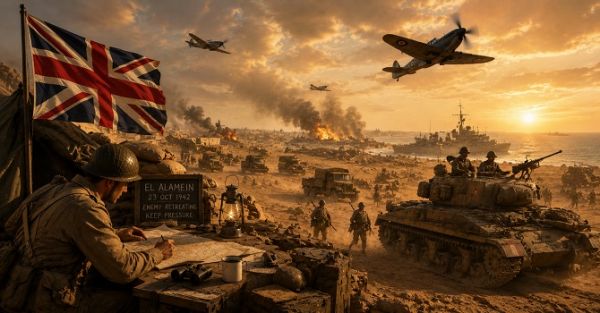
The Untold Story of the Desert War
When people think about World War II, countries like Germany, Britain, France, or Japan usually come to mind. Egypt is often overlooked, leaving many travelers and history enthusiasts asking: Was Egypt a part of World War II?
The short answer is yes—but not in the way many people assume.
Egypt was not one of the major powers fighting the war, yet it became one of the conflict's most important strategic battlegrounds. Some of the most famous desert battles of WWII took place on Egyptian soil, including the decisive Second Battle of El Alamein, often described as the turning point of the war in North Africa.
Today, visitors to Egypt can still explore battlefields, war cemeteries, museums, and memorials that preserve the story of one of history's greatest military campaigns.
Egypt's Political Status During WWII
Understanding Egypt's role requires looking at its political situation before the war.
Although Egypt became formally independent from Britain in 1922, Britain retained significant influence over Egyptian affairs. Under the Anglo-Egyptian Treaty of 1936, British troops remained stationed in Egypt, primarily to protect the Suez Canal, one of the world's most valuable shipping routes.
When World War II began in September 1939, Egypt officially declared itself neutral. However, because of Britain's military presence and treaty rights, the country quickly became a major Allied base.
In practice, Egypt supported Allied military operations even without initially declaring war on Germany.
Why Was Egypt So Important?
Egypt's importance came from geography rather than military strength.
Three key factors made Egypt one of the Allies' most valuable territories:
1. The Suez Canal
The Suez Canal connected Britain with India, Australia, New Zealand, and other parts of the British Empire.
Without it, Allied ships would have needed to sail around southern Africa, adding thousands of kilometers to every journey.
Keeping the canal open was considered essential for transporting:
- Soldiers
- Fuel
- Food
- Weapons
- Medical supplies
If Axis forces had captured the canal, the entire balance of the war in the Mediterranean could have changed.
2. A Gateway Between Continents
Egypt sits between Africa, Asia, and Europe.
Its location made it the ideal base for launching military operations across:
- North Africa
- The Eastern Mediterranean
- The Middle East
Large numbers of British, Australian, New Zealand, Indian, South African, and Free French forces gathered in Egypt before heading into combat.
3. Logistics and Air Bases
Egypt contained ports, railways, roads, and airfields that became critical for Allied logistics.
Cities such as:
- Cairo
- Alexandria
- Port Said
served as military headquarters, supply centers, and naval bases throughout the war.
The North Africa Campaign
One of the most famous chapters of WWII unfolded across the deserts of Egypt and neighboring Libya.
The North Africa Campaign lasted from 1940 to 1943, featuring dramatic advances and retreats across hundreds of kilometers of desert.
The main opponents were:
Axis Powers
- Germany
- Italy
Allied Forces
- Britain
- Australia
- New Zealand
- India
- South Africa
- Free France
- Later, the United States
The campaign became known as the Desert War because fighting took place in vast open deserts rather than forests or cities.
Rommel and the Drive Toward Egypt
In 1941, German General Erwin Rommel, nicknamed the "Desert Fox," arrived in North Africa.
His mission was to support struggling Italian forces and push Allied armies out of the region.
Rommel launched several successful offensives that brought Axis troops dangerously close to Egypt.
At one point, German forces advanced to within approximately 100 kilometers (62 miles) of Alexandria.
Many feared Cairo and the Suez Canal could soon fall.
The Battle of El Alamein
Everything changed at El Alamein, a small railway stop west of Alexandria.
There were actually two major battles fought there in 1942.
First Battle of El Alamein
The first battle halted the Axis advance.
Although neither side achieved a decisive victory, the Allies successfully prevented Rommel from reaching the Nile Delta.
Second Battle of El Alamein
The Second Battle of El Alamein, fought between October and November 1942, became one of the most important victories of the entire war.
Under General Bernard Montgomery, Allied forces launched a massive offensive against Rommel.
After weeks of fierce fighting, the Axis army retreated westward.
British Prime Minister Winston Churchill famously declared:
- "Before Alamein we never had a victory. After Alamein we never had a defeat."
While this statement simplifies the broader war, it reflects how significant the victory was for Allied morale.
Did Egypt Have Its Own Army in the Fighting?
Egypt maintained an army during WWII, but its role was limited.
Because of political agreements with Britain and Egypt's official neutrality during most of the conflict, Egyptian forces generally did not participate in the large-scale fighting against Germany.
Instead, Egypt contributed by providing:
- Infrastructure
- Transportation
- Medical facilities
- Labor
- Supplies
The country's railways, ports, and roads became essential to Allied operations.
Near the end of the war, in February 1945, Egypt officially declared war on Germany and Japan, allowing it to become a founding member of the United Nations.
How Did the War Affect Egyptian Civilians?
Although many major battles occurred away from Egypt's largest cities, civilians still experienced the war.
The conflict brought:
- Food shortages
- Inflation
- Military restrictions
- Blackouts
- Air raid precautions
- Large numbers of foreign soldiers
Cities like Cairo and Alexandria became crowded military hubs filled with troops from across the British Empire.
The wartime economy also created new jobs in transportation, construction, and logistics.
Can You Visit WWII Sites in Egypt Today?
Absolutely.
History travelers can still visit several fascinating WWII locations.
El Alamein
Located about 100 kilometers west of Alexandria, El Alamein remains Egypt's most famous WWII destination.
Visitors can explore:
- El Alamein Military Museum
- Commonwealth War Cemetery
- German War Memorial
- Italian War Memorial
These sites tell the stories of soldiers from many nations who fought in one of history's largest desert campaigns.
Alexandria
Alexandria served as a major Allied naval base throughout WWII.
While many military installations are no longer active, the city's strategic importance can still be appreciated by exploring its historic harbor and waterfront.
Cairo
Cairo functioned as one of the Allies' principal headquarters in the Middle East.
Many historic hotels and colonial-era buildings hosted military officers, diplomats, journalists, and political leaders during the war.
Why WWII History Matters for Travelers
Many visitors come to Egypt expecting only pyramids, temples, and pharaohs.
Yet WWII offers a completely different perspective on the country's history.
Exploring El Alamein reveals:
- International cooperation
- Military strategy
- Desert warfare
- Stories of courage and sacrifice
- Egypt's importance in global history
It demonstrates that Egypt's historical significance extends well beyond the ancient world.
Interesting Facts About Egypt During WWII
- Egypt officially remained neutral for much of the war.
- British forces were already stationed in Egypt before WWII began.
- The Suez Canal was one of the Allies' most strategically valuable assets.
- The North Africa Campaign involved soldiers from dozens of countries.
- The Second Battle of El Alamein is considered one of WWII's decisive turning points.
- Egypt declared war on Germany and Japan in February 1945.
- El Alamein remains one of the world's best-preserved WWII battlefield destinations.
So, was Egypt a part of World War II? The answer is yes, though its role was unique.
Rather than serving as one of the principal combatant nations, Egypt became the strategic heart of the North Africa Campaign. Its geography, infrastructure, and especially the Suez Canal made it indispensable to the Allied war effort. The battles fought across Egypt's western desert, particularly at El Alamein, helped shape the outcome of the war in North Africa and ultimately influenced the broader course of World War II.
For modern travelers, Egypt offers far more than ancient monuments. Its WWII heritage provides a compelling opportunity to explore battlefields, memorials, and museums that tell the story of a nation positioned at the crossroads of one of history's greatest global conflicts.
Planning a trip to Egypt? Add El Alamein to your itinerary alongside the pyramids and ancient temples to discover a lesser-known chapter of Egyptian history that changed the course of World War II.
Best Egypt Tours 2026
| Tour | Itinerary | Price |
|---|---|---|
| Cairo and Nile Cruise Package | 7 Days | $ 1465 |
| Nile Cruise and Stay | 8 Days | $ 2300 |
| Egypt Pyramid Tour Packages | 8 Days | $ 1775 |
| Luxor and Aswan Tours | 4 Days | $ 665 |
| 5 Star Egypt Tours | 8 Days | $ 1775 |
| Egypt Pyramids Nile Cruise | 10 Days | $ 2300 |
| Cairo Holiday Packages | 5 Days | $ 870 |
| Egypt Overland Tours | 8 Days | $ 1495 |