
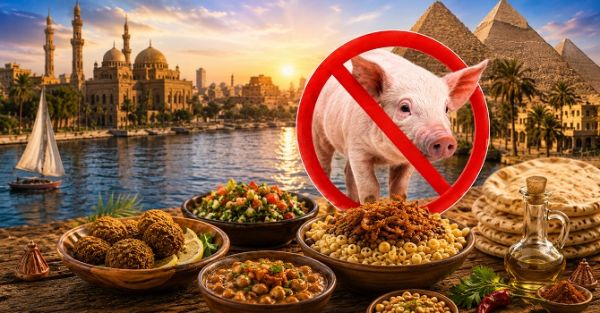
The Cultural, Religious, and Historical Reasons Explained
If you travel to Egypt, one of the first things you may notice is that pork is rarely found on restaurant menus or in traditional Egyptian cuisine. Visitors often wonder whether pigs are illegal in Egypt or if Egyptians simply dislike pork. The reality is far more interesting.
The overwhelming majority of Egyptians do not eat pork because of religious beliefs shared by both Muslims and many Coptic Christians. However, history, culture, economics, and changing food traditions have also played important roles in making pork one of the least common meats in the country.
Whether you're planning a trip to Egypt or are simply curious about Egyptian culture, understanding why pork is uncommon provides fascinating insight into one of the world's oldest civilizations.
Most Egyptians do not eat pork because:
- Islam prohibits pork consumption, and around 90% of Egyptians are Muslim.
- Many Coptic Christians also traditionally avoid pork, although their religion does not forbid it.
- Egyptian cuisine developed around beef, lamb, goat, poultry, and fish instead.
- Pork has never been an important part of Egypt's agricultural economy.
As a result, pork is considered a niche food rather than a staple.
Religion Is the Biggest Reason
Religion is by far the most significant reason pork is uncommon in Egypt.
Islam
The Quran explicitly prohibits Muslims from eating pork.
Since Muslims make up roughly 90% of Egypt's population, pork has naturally become absent from everyday life.
Unlike dietary preferences, avoiding pork is considered an important religious obligation for practicing Muslims.
This influences nearly every aspect of Egyptian food culture:
- Family meals
- Restaurants
- Hotels
- School cafeterias
- Street food
- Wedding celebrations
- Traditional dishes
Instead of pork, Egyptians commonly enjoy:
- Chicken
- Beef
- Lamb
- Goat
- Duck
- Rabbit
- Fish
These meats have shaped Egyptian cuisine for centuries.
What About Egyptian Christians?
One common misconception is that Egyptian Christians eat pork regularly.
The reality is more nuanced.
The majority of Christians in Egypt belong to the Coptic Orthodox Church.
Unlike Islam, Christianity does not generally forbid eating pork.
However, many Coptic Christians choose not to eat it for several reasons:
Cultural influence
Living alongside a predominantly Muslim population for centuries has influenced eating habits.
Many Christian families simply grew up without pork becoming part of their traditional cuisine.
Fasting traditions
The Coptic Orthodox Church observes numerous fasting periods throughout the year.
During these fasts, followers avoid all meat—not just pork—and often adopt a completely vegan diet.
Since fasting occupies a significant portion of the calendar, pork has never become an important dietary staple.
Personal preference
Many Egyptian Christians simply prefer traditional local foods they have always eaten.
As a result, pork remains relatively uncommon even among people who are religiously allowed to eat it.
Was Pork Ever Popular in Ancient Egypt?
Interestingly, pigs have existed in Egypt for thousands of years.
Archaeological discoveries show that pigs were raised during certain periods of ancient Egyptian history.
However, they never achieved the same cultural importance as cattle.
Ancient Egyptians highly valued:
- Cattle
- Sheep
- Goats
- Geese
- Ducks
These animals appeared frequently in religious ceremonies, artwork, agriculture, and daily life.
Pigs were generally associated with poorer farming communities and never became symbols of wealth or prestige.
Over time, especially after the spread of Islam beginning in the 7th century, pig farming declined dramatically.
Can You Buy Pork in Egypt Today?
Yes.
Contrary to popular belief, pork is completely legal in Egypt.
It is simply produced and consumed on a much smaller scale.
You can sometimes find pork in:
- Certain supermarkets
- Specialty butcher shops
- A few restaurants
- Some hotels serving international guests
- Areas with larger Christian communities
Visitors staying in major tourist destinations like Cairo, Alexandria, or resort cities may occasionally see bacon, ham, or pork sausages on international breakfast buffets.
However, they remain far less common than chicken or beef.
Why Isn't Pork Common in Egyptian Restaurants?
Restaurants serve what customers want.
Since the overwhelming majority of Egyptians do not eat pork, there is very little demand.
Most traditional restaurants focus on beloved Egyptian classics such as:
- Koshari
- Molokhia
- Fattah
- Grilled chicken
- Kofta
- Kebabs
- Stuffed pigeon
- Fresh Nile fish
These dishes reflect centuries of culinary tradition without relying on pork.
Even international restaurants often adapt their menus to local tastes.
Instead of bacon, you may find:
- Turkey bacon
- Beef bacon
- Smoked beef
- Chicken sausage
These alternatives allow restaurants to appeal to local customers while offering familiar breakfast items to international visitors.
Does Egypt Produce Pork?
Pig farming exists in Egypt but on a relatively small scale.
Historically, much of the country's pig farming was concentrated among Christian communities, particularly around Cairo.
The industry has always been tiny compared to poultry or cattle production.
Today, chicken remains by far Egypt's most widely consumed meat because it is:
- Affordable
- Readily available
- Quick to raise
- Accepted by everyone regardless of religion
Is It Difficult for Tourists Who Eat Pork?
Not usually.
Although pork is uncommon, most visitors never feel limited.
Egypt offers an enormous variety of foods including:
- Grilled meats
- Seafood
- Mediterranean cuisine
- Middle Eastern specialties
- International restaurants
- Italian food
- Asian cuisine
- Hotel buffets
Most travelers quickly discover that Egyptian cuisine has plenty of delicious alternatives.
If pork is particularly important to your diet, international hotels and some specialty restaurants in larger cities are your best options.
Common Myths About Pork in Egypt
Myth 1: Pork Is Illegal
False.
Pork can legally be raised, sold, and eaten in Egypt.
Myth 2: Egyptians Hate Pigs
False.
The avoidance of pork is primarily religious rather than emotional.
Most Egyptians simply follow cultural and religious dietary traditions.
Myth 3: Christians in Egypt Eat Pork Frequently
Not necessarily.
While permitted by their faith, many Coptic Christians rarely eat pork because of tradition, family habits, and extensive religious fasting.
Myth 4: Tourists Cannot Find Pork
False.
It is available in selected locations, especially international hotels and specialty outlets.
How Pork Fits Into Egyptian Culture
Food is one of the strongest expressions of culture.
In Egypt, meals are deeply connected to hospitality, religion, and family traditions.
When Egyptians gather for holidays, weddings, Ramadan iftars, or family celebrations, the meals typically feature dishes made with chicken, beef, lamb, or fish rather than pork.
Over generations, these culinary traditions became part of the national identity.
For many Egyptians, avoiding pork isn't something they consciously think about—it is simply how they have always eaten.
What Travelers Should Know
If you're visiting Egypt, there is no need to worry about finding excellent food.
Egyptian cuisine is incredibly diverse and flavorful without relying on pork.
Trying local specialties is one of the highlights of any visit, from aromatic grilled meats to hearty vegetarian dishes and freshly baked bread.
Understanding why pork is uncommon also helps travelers appreciate the country's rich cultural and religious heritage. Rather than seeing the absence of pork as unusual, it becomes another example of how history, faith, and tradition shape everyday life in one of the world's most fascinating destinations.
Planning to experience authentic Egyptian culture beyond the food? Explore our carefully crafted Egypt travel packages to discover historic landmarks, local traditions, vibrant markets, and unforgettable cuisine with expert local guides.
Best Egypt Tours 2026
| Tour | Itinerary | Price |
|---|---|---|
| Egypt and Kenya Tours | 15 Days | $ 6250 |
| Egypt and Dubai Tours | 8 Days | $ 999 |
| Cairo and Istanbul Tours | 8 Days | $ 1250 |
| Turkey and Egypt Tours | 12 Days | $ 2825 |
| Egypt and Petra Tours | 12 Days | $ 2255 |
| Egypt and Jordan Tours With Nile Cruise | 14 Days | $ 3066 |
| Dubai and Egypt Vacation Packages | 12 Days | $ 2270 |
| Egypt and Morocco Tours | 15 Days | $ 4499 |
| Egypt and Jordan Luxury Tours | 8 Days | $ 1275 |
| Egypt and Greece Tours | 14 Days | $ 3380 |
| Egypt Tanzania Tour | 14 Days | $ 6275 |
| Cairo to Petra Tour | 7 Days | $ 945 |
| Egypt and Holy Land Tours | 15 Days | $ 4100 |