
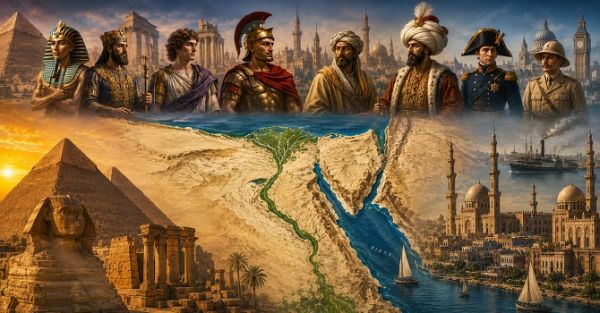
A Complete History of Foreign Rule in Egypt
For many travelers, Egypt is synonymous with pharaohs, pyramids, and one of the world's oldest civilizations. Yet one of the most common questions visitors ask is: Was Egypt colonized?
The short answer is yes—but the story is far more complex than many people realize.
Unlike countries that were colonized only during the age of European empires, Egypt experienced several periods of foreign conquest and rule over more than 2,500 years. Persians, Greeks, Romans, Arabs, Ottomans, the French, and finally the British all left their mark on Egyptian history. Despite these changes in leadership, Egyptian culture, language, traditions, and identity continuously evolved rather than disappeared.
Understanding Egypt's history of foreign rule helps travelers appreciate why modern Egypt is such a fascinating blend of ancient monuments, Islamic architecture, Mediterranean influences, and African heritage.
Egypt Before Colonization
Ancient Egypt emerged around 3100 BC, when Upper and Lower Egypt were unified under the first pharaoh. For nearly three millennia, Egypt was one of the world's greatest civilizations.
The Egyptians built:
- The Pyramids of Giza
- The Great Sphinx
- Luxor Temple
- Karnak Temple
- Abu Simbel
- Countless tombs and temples along the Nile
During much of this period, Egypt was an independent kingdom ruled by native dynasties.
However, as neighboring empires grew stronger, Egypt increasingly became a prize worth conquering.
The First Foreign Conquest: The Persian Empire
The first major foreign power to conquer Egypt was the Achaemenid Persian Empire.
In 525 BC, Persian King Cambyses II defeated Pharaoh Psamtik III during the Battle of Pelusium.
Egypt became a province of the Persian Empire.
Although the Persians ruled through Egyptian administrators and respected many local traditions, Egypt was no longer an independent kingdom.
Egypt briefly regained independence before being conquered by Persia once again in 343 BC.
Alexander the Great Changes Egyptian History
One of history's most famous conquerors arrived in 332 BC.
Alexander the Great defeated the Persians and entered Egypt almost without resistance.
Rather than treating Egypt simply as conquered territory, Alexander embraced Egyptian traditions.
He was declared the son of the god Amun at the Siwa Oasis and recognized as Pharaoh by Egyptian priests.
Alexander also founded one of history's greatest cities:
Alexandria
The city became the intellectual center of the ancient Mediterranean and housed the legendary Library of Alexandria.
The Greek Ptolemaic Dynasty
After Alexander died in 323 BC, his empire was divided among his generals.
Egypt fell under the control of Ptolemy I, who founded the Ptolemaic Dynasty.
Although the rulers were Greek, they adopted many Egyptian customs and portrayed themselves as pharaohs.
This period produced one of Egypt's most famous rulers:
Cleopatra VII
Despite popular belief, Cleopatra was of Macedonian Greek ancestry rather than ethnically Egyptian.
The Ptolemies ruled Egypt for nearly 300 years, blending Greek and Egyptian cultures in remarkable ways.
Visitors today can still see this fusion at temples such as Edfu, Dendera, and Philae.
Egypt Under the Roman Empire
In 30 BC, after Cleopatra's defeat alongside Mark Antony, Egypt became part of the Roman Empire.
Roman rule lasted for centuries.
Egypt became Rome's most valuable province because of its enormous grain production.
The fertile Nile Valley supplied food to millions of people throughout the empire.
During Roman rule:
- Christianity spread throughout Egypt.
- The famous Coptic Christian community emerged.
- Roman architecture blended with Egyptian traditions.
Many archaeological sites across Egypt contain both Roman and ancient Egyptian features.
The Arab Conquest
One of Egypt's most significant transformations occurred in 641 AD.
Arab Muslim armies conquered Byzantine-controlled Egypt.
Unlike earlier foreign rulers, the Arab conquest fundamentally changed Egypt's language, religion, and culture.
Over time:
- Arabic replaced Coptic as the dominant language.
- Islam became the majority religion.
- Cairo eventually became one of the Islamic world's greatest cities.
Modern Egyptian Arabic developed from this period, while Egypt's Islamic heritage flourished through magnificent mosques, schools, and markets.
Egypt Under the Ottoman Empire
In 1517, the Ottoman Empire conquered Egypt.
The Ottomans ruled Egypt for nearly four centuries.
Although Egypt remained part of the Ottoman Empire, local governors and later Muhammad Ali Pasha exercised considerable autonomy.
Muhammad Ali, who came to power in 1805, modernized Egypt by developing:
- Modern industry
- A stronger military
- Irrigation projects
- Expanded agriculture
- Educational reforms
Many historians consider him the founder of modern Egypt.
Napoleon's Invasion
In 1798, Napoleon Bonaparte invaded Egypt.
Although French control lasted only about three years, the invasion had lasting consequences.
Napoleon brought scientists, engineers, artists, and scholars who documented Egyptian monuments in extraordinary detail.
One of the most important discoveries during this campaign was the Rosetta Stone, which later enabled scholars to decipher ancient Egyptian hieroglyphs.
The French expedition also sparked Europe's growing fascination with ancient Egypt, often called "Egyptomania."
Was Egypt a British Colony?
This is where many people become confused.
Technically, Egypt was never a formal British colony in the same way as India or Kenya.
Instead, Britain occupied Egypt beginning in 1882 after intervening in a local revolt.
Although Egypt officially remained part of the Ottoman Empire, Britain exercised effective control over the country's government, military, finances, and foreign policy.
In 1914, during World War I, Britain declared Egypt a protectorate.
This made British control even more direct.
British interests focused heavily on one strategic asset:
The Suez Canal
Completed in 1869, the Suez Canal connected Europe with Asia through the Red Sea.
Control of the canal became essential for Britain's global empire.
Egypt Gains Independence
Egypt declared independence in 1922.
However, British influence remained significant.
Britain retained military forces and continued to exert considerable political influence, especially regarding the Suez Canal.
True sovereignty developed gradually over several decades.
One of the defining moments came in 1952, when the Free Officers Movement overthrew King Farouk.
The following year, Egypt became a republic.
In 1956, President Gamal Abdel Nasser nationalized the Suez Canal, triggering the Suez Crisis.
After intense international pressure, British, French, and Israeli forces withdrew.
This marked the effective end of British dominance in Egypt.
Did Colonization Change Egypt?
Absolutely—but Egypt also changed its conquerors.
Throughout history, foreign rulers often adopted Egyptian customs, religion, architecture, and traditions.
Rather than replacing Egyptian civilization, each period added new cultural layers.
Today's Egypt reflects influences from:
- Ancient Egyptian civilization
- Greek culture
- Roman administration
- Coptic Christianity
- Islamic civilization
- Ottoman traditions
- European modernization
This unique blend is one reason Egypt remains one of the world's most culturally diverse destinations.
What Travelers Can See Today
One of the most fascinating aspects of visiting Egypt is experiencing these different historical eras in one journey.
In Giza, you'll witness monuments built thousands of years before many empires even existed.
In Alexandria, Greek, Roman, and Mediterranean influences are evident throughout the city.
In Cairo, Islamic architecture dominates the skyline with magnificent mosques, medieval streets, and bustling bazaars.
In Luxor and Aswan, travelers can explore temples built under native Egyptian rulers, later modified by Greeks and Romans.
Each destination tells a different chapter of Egypt's remarkable history.
So, was Egypt colonized? Yes—but its history is far more nuanced than a simple yes or no.
Egypt experienced multiple periods of foreign conquest, occupation, and imperial rule, from the Persians and Greeks to the Romans, Ottomans, and British. Yet unlike many nations, Egypt maintained a remarkably strong cultural identity throughout these centuries. Every empire left traces in its architecture, religion, language, and governance, but none erased Egypt's enduring civilization.
For travelers, this layered history is one of Egypt's greatest attractions. Walking through the country is like moving across thousands of years of world history, where ancient temples stand alongside Roman ruins, medieval mosques, Ottoman-era buildings, and modern cityscapes. Few destinations offer such a rich and continuous historical journey, making Egypt an unforgettable place for anyone curious about the rise and fall of civilizations.
Planning to experience Egypt's incredible history in person? Explore our expertly guided Egypt tours and discover the pyramids, ancient temples, Islamic Cairo, Alexandria, and more with itineraries designed to bring every chapter of Egypt's remarkable past to life.
Best Egypt Tours 2026
| Tour | Itinerary | Price |
|---|---|---|
| Egypt and Kenya Tours | 15 Days | $ 6250 |
| Egypt and Dubai Tours | 8 Days | $ 999 |
| Cairo and Istanbul Tours | 8 Days | $ 1250 |
| Turkey and Egypt Tours | 12 Days | $ 2825 |
| Egypt and Petra Tours | 12 Days | $ 2255 |
| Egypt and Jordan Tours With Nile Cruise | 14 Days | $ 3066 |
| Dubai and Egypt Vacation Packages | 12 Days | $ 2270 |
| Egypt and Morocco Tours | 15 Days | $ 4499 |
| Egypt and Jordan Luxury Tours | 8 Days | $ 1275 |
| Egypt and Greece Tours | 14 Days | $ 3380 |
| Egypt Tanzania Tour | 14 Days | $ 6275 |
| Cairo to Petra Tour | 7 Days | $ 945 |
| Egypt and Holy Land Tours | 15 Days | $ 4100 |