
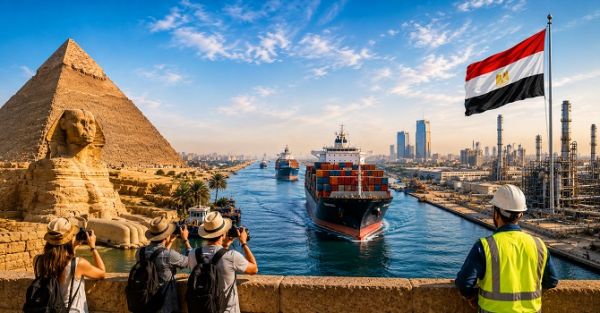
Understanding the Country's Biggest Sources of Income
Egypt is one of the Middle East and Africa's largest economies, but many travelers and curious readers wonder: What brings Egypt the most money? Is it tourism? The Suez Canal? Oil and gas? Or perhaps the ancient pyramids that attract millions of visitors every year?
The answer is more interesting than many people expect. While Egypt is globally famous for its archaeological treasures, tourism is only one piece of a much larger economic picture. The country's income comes from a diverse mix of strategic geography, natural resources, overseas workers, manufacturing, and agriculture.
Whether you're planning a trip to Egypt or simply curious about how the country's economy works, here's a detailed look at Egypt's largest sources of revenue.
The Suez Canal: Egypt's Strategic Gold Mine
If one sector consistently ranks among Egypt's largest earners of foreign currency, it is the Suez Canal.
Connecting the Mediterranean Sea with the Red Sea, the canal provides the shortest maritime route between Europe and Asia. Around 10–15% of global trade and a significant share of the world's container traffic passes through this waterway each year.
Every ship that crosses pays transit fees based on its size and cargo, generating billions of dollars in annual revenue for Egypt.
Why the Suez Canal is so valuable
- One of the world's busiest shipping lanes
- Saves ships thousands of miles compared to sailing around Africa
- Essential for global supply chains
- Major source of foreign currency
- Strategic importance during international trade disruptions
For travelers visiting Egypt, cities like Ismailia, Port Said, and Suez offer fascinating opportunities to witness enormous cargo ships passing through one of the world's greatest engineering achievements.
Tourism: Egypt's Most Famous Industry
When people think about Egypt's economy, tourism is usually the first thing that comes to mind.
Millions of international visitors travel to Egypt every year to experience:
- The Great Pyramids of Giza
- The Sphinx
- Luxor Temple
- Karnak Temple
- The Valley of the Kings
- Abu Simbel
- Nile River cruises
- Red Sea diving resorts
- Islamic Cairo
- Ancient museums
Tourism supports millions of jobs directly and indirectly through hotels, restaurants, transportation, tour operators, guides, souvenir shops, and airlines.
Why tourism matters
Tourists spend money on:
- Hotels
- Domestic flights
- Nile cruises
- Guided tours
- Museum tickets
- Local transportation
- Restaurants
- Shopping
This spending generates billions of dollars in foreign currency while supporting local communities across the country.
Oil and Natural Gas
Although Egypt is better known for its history than its energy resources, oil and natural gas represent one of the country's biggest economic sectors.
Large offshore gas discoveries in the Mediterranean transformed Egypt into an important regional energy producer.
Natural gas is used for:
- Domestic electricity generation
- Industrial production
- LNG exports
- Regional energy trade
The energy industry also attracts substantial foreign investment from international companies operating in Egyptian waters.
Money Sent Home by Egyptians Working Abroad
One of Egypt's largest and often overlooked income sources comes from remittances.
Millions of Egyptians work in countries including:
- Saudi Arabia
- United Arab Emirates
- Kuwait
- Qatar
- Oman
- Europe
- North America
These workers regularly send money home to support their families.
Remittances help:
- Household incomes
- Consumer spending
- Education
- Healthcare
- Housing construction
- National foreign currency reserves
In many years, remittances have rivaled or even exceeded tourism revenues.
Manufacturing and Industry
Egypt has a large manufacturing sector serving both domestic and export markets.
Major industries include:
- Food processing
- Fertilizers
- Chemicals
- Cement
- Steel
- Textiles
- Pharmaceuticals
- Electronics assembly
Factories are concentrated around Cairo, Alexandria, the Suez Canal Economic Zone, and several industrial cities developed in recent decades.
Egypt's growing industrial base plays an increasingly important role in economic diversification.
Agriculture
Agriculture has supported Egyptian civilization for over 5,000 years, thanks to the fertile Nile Valley.
Although agriculture contributes a smaller share of GDP than services, it remains essential for employment and exports.
Important agricultural exports include:
- Citrus fruits
- Potatoes
- Onions
- Grapes
- Strawberries
- Cotton
- Dates
- Herbs and spices
Egypt has become one of the world's leading exporters of oranges, supplying markets across Europe, Asia, and the Middle East.
Travelers visiting rural Egypt often discover a completely different side of the country, with lush green farmland contrasting dramatically with the surrounding desert landscapes.
Construction and Real Estate
Large infrastructure projects have become another significant contributor to Egypt's economy.
Recent decades have seen investment in:
- New highways
- Bridges
- Metro systems
- Ports
- Industrial zones
- New residential developments
- The New Administrative Capital
- Renewable energy projects
Construction generates employment across engineering, manufacturing, transportation, and building materials.
The Red Sea and Maritime Industries
Egypt benefits enormously from its location between two seas.
Ports such as Alexandria, Damietta, Port Said, Ain Sokhna, and Safaga support:
- International shipping
- Cargo handling
- Logistics
- Ship services
- Imports and exports
The country's maritime position complements the economic importance of the Suez Canal.
Which Industry Makes Egypt the Most Money?
The answer depends on the specific year.
Because global conditions change, different sectors sometimes move into first place.
Generally, Egypt's biggest sources of foreign currency include:
- 1.Suez Canal revenues
- 2.Remittances from Egyptians abroad
- 3.Tourism
- 4.Natural gas exports
- 5.Merchandise exports
During events such as global pandemics, tourism income may decline sharply, while canal revenues or remittances remain relatively strong. Likewise, changes in global energy prices can significantly affect natural gas revenues.
This diversity helps Egypt avoid relying entirely on a single industry.
Why Travelers Should Care
Understanding Egypt's economy makes traveling through the country even more rewarding.
When you book a local hotel, hire a licensed guide, dine in family-owned restaurants, or purchase authentic handicrafts, your spending supports one of Egypt's most important industries.
At the same time, you'll notice how the country's modern economy extends far beyond its ancient monuments.
You'll encounter:
- Massive container ships crossing the Suez Canal
- Modern industrial cities
- Expanding infrastructure
- Busy agricultural regions along the Nile
- International energy projects
- World-class Red Sea resorts
Egypt is simultaneously one of the world's oldest civilizations and one of the region's most strategically important modern economies
So, what brings Egypt the most money? While many people assume the answer is simply tourism, the reality is far more diverse. The Suez Canal remains one of Egypt's greatest economic assets, generating billions of dollars from global shipping. Alongside it, tourism, natural gas, remittances from Egyptians working abroad, manufacturing, and agriculture all play vital roles in supporting the nation's economy.
For visitors, this means Egypt offers much more than ancient temples and pyramids. It is a country where history, trade, modern industry, and global commerce intersect, creating a fascinating destination that continues to shape international trade while preserving one of humanity's richest cultural heritages.
Planning your own Egyptian adventure? Explore our carefully crafted Egypt travel packages to experience the Pyramids, Nile cruises, Luxor, Aswan, and the Red Sea with expertly guided itineraries designed for every type of traveler.
Best Egypt Tours 2026
| Tour | Itinerary | Price |
|---|---|---|
| Cairo and Nile Cruise Package | 7 Days | $ 1465 |
| Nile Cruise and Stay | 8 Days | $ 2300 |
| Egypt Pyramid Tour Packages | 8 Days | $ 1775 |
| Luxor and Aswan Tours | 4 Days | $ 665 |
| 5 Star Egypt Tours | 8 Days | $ 1775 |
| Egypt Pyramids Nile Cruise | 10 Days | $ 2300 |
| Cairo Holiday Packages | 5 Days | $ 870 |
| Egypt Overland Tours | 8 Days | $ 1495 |