
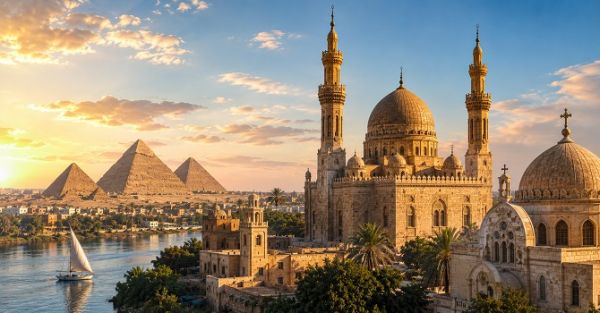
Understanding Faith in Egypt
If you're planning a trip to Egypt or simply curious about its culture, one question that often comes up is: Do Egyptians believe in God?
The simple answer is yes—overwhelmingly so. Egypt is one of the world's most religious societies, where belief in God is deeply woven into daily life, traditions, and national identity. Whether you're walking through the bustling streets of Cairo, sailing along the Nile, or exploring ancient temples in Luxor and Aswan, you'll quickly notice that faith plays a significant role in Egyptian society.
However, the story goes far beyond a simple yes or no. Egypt is home to one of the oldest continuous religious traditions on Earth, combining thousands of years of history with vibrant modern religious communities.
Religion Is a Central Part of Egyptian Life
For most Egyptians, religion is not confined to places of worship or special occasions. It influences family life, social customs, celebrations, hospitality, and even everyday conversations.
Visitors often hear expressions like:
- "Insha'Allah" (God willing)
- "Alhamdulillah" (Praise be to God)
- "Mashallah" (What God has willed)
These phrases are used naturally in everyday speech regardless of the situation and reflect how faith is integrated into daily life rather than reserved for formal religious settings.
Similarly, Egyptian Christians commonly use phrases such as "Thanks be to God" or "God willing" in Arabic conversation.
What Religions Do Egyptians Follow?
Egypt's population exceeds 110 million people, and the overwhelming majority believe in one God.
The country's religious landscape includes:
- Around 85–90% Muslims
- Approximately 10–15% Christians, most belonging to the Coptic Orthodox Church
- Very small communities of other faiths
Although exact percentages are difficult to determine because Egypt has not published official religious statistics in recent censuses, there is broad agreement that Islam is the majority religion while Christianity represents the country's largest minority.
Islam in Egypt
Islam arrived in Egypt during the 7th century and has shaped Egyptian culture for nearly 1,400 years.
Most Egyptian Muslims are Sunni Muslims, and Islamic traditions influence many aspects of society, including:
- Daily prayer
- Religious holidays
- Family celebrations
- Charity
- Community life
Travelers will hear the call to prayer (Adhan) echoing from mosques five times each day. Even visitors who are not religious often describe this as one of Egypt's most memorable cultural experiences.
Egypt is also home to Al-Azhar University, founded in the 10th century, one of the world's oldest continuously operating universities and among the most respected centers of Islamic scholarship.
Egypt's Christian Heritage
Many travelers are surprised to learn that Egypt has one of the oldest Christian communities in the world.
According to Christian tradition, Saint Mark the Evangelist brought Christianity to Egypt during the first century AD. Long before Christianity spread across much of Europe, Egyptian Christians had already established churches, monasteries, and thriving religious communities.
Today, most Egyptian Christians belong to the Coptic Orthodox Church, one of the world's oldest Christian denominations.
Some of Egypt's most remarkable Christian sites include:
- The Hanging Church in Old Cairo
- Saint Catherine's Monastery in Sinai
- The Monasteries of Wadi El Natrun
- Numerous ancient churches throughout Cairo and Upper Egypt
These locations attract both pilgrims and tourists interested in Egypt's rich religious history.
A Country With Thousands of Years of Religious History
Egypt's spiritual story began long before Islam and Christianity.
Ancient Egyptians believed in many gods and goddesses, including:
- Ra, the sun god
- Osiris, god of the afterlife
- Isis, goddess of motherhood
- Horus, the falcon god
- Anubis, associated with mummification
Religion shaped nearly every aspect of ancient Egyptian civilization, from monumental temples to elaborate burial practices.
When visitors explore Karnak Temple, Luxor Temple, Abu Simbel, or the Valley of the Kings, they are witnessing monuments built for ancient religious beliefs.
Later, Christianity became the dominant religion during the Roman and Byzantine periods before Islam gradually became the majority faith following the Arab conquest in the 7th century.
This remarkable succession of beliefs makes Egypt one of the world's richest destinations for religious history.
Is Egypt a Religious Country?
Yes.
Surveys conducted over many years consistently show that religion remains highly important to most Egyptians.
This can be seen through:
- High attendance at mosques and churches
- Religious holidays celebrated nationwide
- Strong family traditions
- Charitable giving
- Public expressions of faith
However, like every modern country, Egyptian society is diverse. Some people are deeply observant, while others practice their religion more privately. Urban and rural communities may also differ in how openly religion influences everyday life.
What Travelers Should Know
One of the best ways to enjoy Egypt is by understanding and respecting local customs.
Fortunately, Egypt is extremely accustomed to international visitors, welcoming millions of tourists every year from every background and religion.
A few simple guidelines include:
Dress Respectfully
While tourist resorts are generally relaxed, modest clothing is appreciated when visiting cities, villages, mosques, or churches.
Visiting Mosques
Many historic mosques welcome non-Muslim visitors outside prayer times.
Visitors should:
- Remove their shoes before entering prayer areas.
- Wear modest clothing.
- Speak quietly.
- Avoid interrupting worshippers.
Visiting Churches
Ancient Coptic churches are open to visitors, though modest dress and respectful behavior are expected.
Photography rules vary, so it's always best to ask before taking pictures inside.
Religious Festivals Worth Experiencing
Traveling during religious holidays offers a unique glimpse into Egyptian culture.
Ramadan
Ramadan is the Islamic month of fasting.
After sunset, cities come alive with festive decorations, family gatherings, lanterns, and communal meals known as iftar.
For many travelers, Ramadan is one of the most fascinating times to visit Egypt.
Eid al-Fitr and Eid al-Adha
These major Islamic holidays are celebrated with family visits, special meals, gifts, and community celebrations.
Coptic Christmas
Egyptian Christians celebrate Christmas on January 7, following the Coptic calendar.
Churches hold beautiful midnight services, and families gather for festive meals after completing the traditional Advent fast.
Hospitality and Faith
One of the strongest impressions many visitors take home is Egyptian hospitality.
Whether invited into a family home, chatting with a market vendor, or sharing tea with locals, visitors often experience remarkable warmth and generosity.
For many Egyptians, welcoming guests is not only a cultural tradition but also an expression of religious values emphasizing kindness, generosity, and respect for others.
So, do Egyptians believe in God? Absolutely. Faith remains a defining feature of Egyptian society, with the vast majority of Egyptians identifying as Muslim or Christian and belief in one God playing an important role in everyday life.
For travelers, understanding this religious landscape adds depth to every experience. The call to prayer drifting over Cairo, the ancient monasteries hidden in the desert, magnificent mosques, historic churches, and even casual conversations all reveal a country where spirituality has shaped civilization for thousands of years.
Whether you're exploring the pyramids, cruising the Nile, wandering through Old Cairo, or visiting remote desert monasteries, appreciating Egypt's religious heritage will help you better understand one of the world's oldest and most fascinating civilizations.
Best Egypt Tours 2026
| Tour | Itinerary | Price |
|---|---|---|
| Egypt Solar Eclipse Tour | 9 Days | $ 8995 |
| All Inclusive Vacations Egypt | 10 Days | $ 2940 |
| Cairo and Luxor Holidays | 5 Days | $ 1305 |
| Pyramids and Nile Cruise Holidays | 8 Days | $ 1690 |
| Cairo Private Tours | 4 Days | $ 780 |
| Cairo City Breaks | 3 Days | $ 575 |
| Luxury Egypt Tours with Nile Cruise | 12 Days | $ 2610 |
| Nile Cruise and Red Sea Stay | 12 Days | $ 2815 |
| Cairo Nile Cruise and Hurghada | 12 Days | $ 2200 |
| Package Trips to Egypt | 10 Days | $ 2165 |
| Egypt Honeymoon Packages | 10 Days | $ 3180 |