
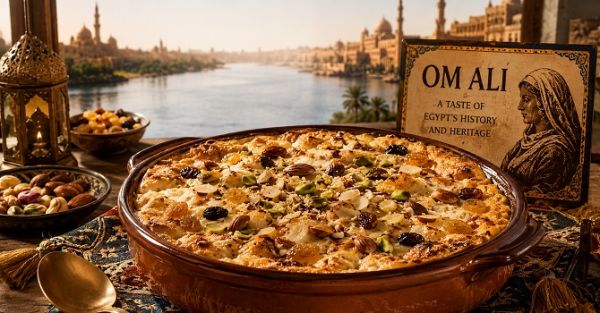
the Story Behind ‘Om Ali’
Have you ever wondered why one of Egypt’s most famous desserts is called “Om Ali” — literally, “Ali’s Mother”?
Unlike names such as baklava or basbousa, Om Ali sounds less like the name of a dessert and more like the name of someone you might meet in an Egyptian neighborhood. And behind it is a dramatic story involving medieval Egypt, royal rivalry, murder, and a legendary celebration.
But there is an important twist: the story is famous, while the historical connection between the story and the dessert is not proven.
What Is Om Ali?
Om Ali is a traditional Egyptian dessert made from layers or pieces of baked pastry soaked in sweetened milk, often enriched with cream, butter, nuts, raisins, and sometimes coconut. It is served warm and is known for its contrast between a golden, slightly crisp top and a soft, creamy interior.
For travelers visiting Egypt, it is one of the country's most recognizable traditional sweets. You may find it on restaurant dessert menus, hotel buffets, Egyptian family tables, and particularly during Ramadan and festive occasions.
Its ingredients are relatively simple, but the combination is wonderfully comforting: flaky pastry absorbs hot milk and cream while nuts and raisins add texture and sweetness.
Yet the most fascinating part of Om Ali is not what is inside the bowl. It is the story behind its name.
Why Is It Called “Om Ali”?
In Arabic, “Om Ali” (أم علي) literally means “Ali’s mother.”
The name is traditionally associated with a woman known as Om Ali, who was connected to Sultan Izz al-Din Aybak, one of the early rulers of Egypt during the Mamluk period.
According to the famous Egyptian legend, Om Ali was Aybak's first wife. His later marriage to Shajar al-Durr, a powerful former ruler of Egypt, became part of a dramatic political and personal struggle.
Shajar al-Durr was an extraordinary historical figure. She had played a major political role during the transition from Ayyubid to Mamluk rule and briefly ruled Egypt herself in 1250.
The story surrounding her death is where the legend of Om Ali becomes particularly dramatic.
The Royal Rivalry Behind the Legend
According to the popular version of the story, Sultan Aybak was killed during a conflict involving Shajar al-Durr. After his death, a struggle for power followed.
Shajar al-Durr was eventually killed in 1257. The traditional story says that Om Ali was involved in her death and that she ordered a celebration afterward.
The palace cooks supposedly created a rich dessert from ingredients available to them — pastry or bread, milk, sugar, and nuts. The dessert was then distributed to people, and it became known as Om Ali, after the woman who supposedly ordered its preparation.
It is an extraordinary story for an extraordinary dessert: political revenge allegedly transformed into one of Egypt's most beloved sweets.
But should travelers take this story as historical fact?
Not quite.
Is the Om Ali Story Actually True?
This is where the story becomes much more interesting.
There is no firm historical evidence proving that the dessert was created to celebrate Shajar al-Durr's death. Modern accounts frequently repeat the legend, but food historians have pointed out that the story is not supported by contemporary historical evidence.
One important clue is the history of Egyptian cookbooks. The earliest known written recipe associated with Om Ali dates from the 19th century, centuries after the events involving Shajar al-Durr and Aybak.
That does not prove the dessert did not exist earlier. Recipes can be passed down orally for generations without appearing in written cookbooks.
However, it does mean that the famous 13th-century origin story should be described as legend rather than established historical fact.
For curious travelers, this distinction makes Om Ali even more interesting. Egyptian cuisine is full of dishes whose histories combine documented events, oral traditions, family stories, and folklore.
Who Was Shajar al-Durr?
Understanding the story requires a quick look at one of the most remarkable women in medieval Egyptian history.
Shajar al-Durr became a central political figure during the crisis that followed the death of Sultan As-Salih Ayyub. She eventually became ruler of Egypt in 1250 and played an important role in the beginning of the Mamluk era.
Her story is closely connected with Sultan Izz al-Din Aybak, whom she married after her first husband's death.
Aybak became the first Mamluk sultan of Egypt, establishing the political dynasty that would dominate Egypt and much of the region for centuries.
The rivalry, marriages, assassinations, and succession struggles surrounding these figures provide the dramatic historical setting from which the Om Ali legend emerged.
So while the dessert itself is simple, its traditional story takes travelers directly into the turbulent world of medieval Cairo and the Mamluk sultans.
What Does Authentic Om Ali Taste Like?
If you visit Egypt and order Om Ali, expect something quite different from a light Western pudding.
Traditional versions combine pastry, milk, sugar, nuts, raisins, and often cream or butter. The pastry absorbs the sweetened dairy, creating a soft, rich base while the upper layer becomes golden and slightly crisp.
Pistachios, almonds, hazelnuts, raisins, and coconut are commonly used, although recipes vary from one kitchen to another.
That variation is part of the charm. There is no single universally standardized version of Om Ali. Egyptian restaurants, hotels, home cooks, and pastry chefs may all prepare it differently.
Some versions are especially creamy, while others emphasize crisp pastry and toasted nuts.
Om Ali and Egyptian Food Culture
Om Ali also tells a larger story about Egyptian cuisine.
Many Egyptian desserts rely on affordable ingredients such as bread, flour, milk, sugar, nuts, and dried fruit. These ingredients can be transformed into something luxurious without requiring exotic products.
Om Ali fits perfectly into this tradition.
It is also a good example of how food can preserve stories. Even if historians cannot prove that the dessert was created in the Mamluk palace after Shajar al-Durr's death, generations of Egyptians and visitors have continued to associate its name with that dramatic chapter of Egyptian history.
In that sense, the legend has become part of the cultural identity of the dish.
Where Can Travelers Experience Om Ali in Egypt?
One of the easiest ways to try Om Ali is simply to order it as dessert after an Egyptian meal.
It is commonly found in restaurants and hotels throughout Cairo, Giza, Luxor, Aswan, and other Egyptian tourist destinations. It is also particularly familiar during Ramadan, when traditional Egyptian desserts become an important part of evening meals.
For travelers taking a Nile cruise, Om Ali can also be a memorable dessert to look for on Egyptian and international-style menus served onboard.
Trying it while traveling through Egypt gives the dessert a different meaning. Instead of simply eating a sweet pastry pudding, you are tasting a dish connected to centuries of Egyptian culinary traditions and one of the country's most famous historical legends.
Ready to taste Egypt for yourself? Explore our Egypt travel packages, including unforgettable Nile cruises, Cairo, Luxor, and Aswan experiences that bring the country’s history, culture, and cuisine to life.
Best Egypt Tours 2026
| Tour | Itinerary | Price |
|---|---|---|
| Egypt Solar Eclipse Tour | 9 Days | $ 8995 |
| All Inclusive Vacations Egypt | 10 Days | $ 2940 |
| Cairo and Luxor Holidays | 5 Days | $ 1305 |
| Pyramids and Nile Cruise Holidays | 8 Days | $ 1690 |
| Luxury Egypt Tours with Nile Cruise | 12 Days | $ 2610 |
| Nile Cruise and Red Sea Stay | 12 Days | $ 2815 |
| Cairo Nile Cruise and Hurghada | 12 Days | $ 2200 |
| Package Trips to Egypt | 10 Days | $ 2165 |
| Egypt Honeymoon Packages | 10 Days | $ 3180 |
| Cairo and Nile Cruise for Disabled Travellers | 8 Days | $ 3300 |
| Cairo and Nile Cruise Package | 7 Days | $ 1465 |
| Nile Cruise and Stay | 8 Days | $ 2300 |
| Egypt Pyramid Tour Packages | 8 Days | $ 1775 |
| Luxor and Aswan Tours | 4 Days | $ 665 |
| 5 Star Egypt Tours | 8 Days | $ 1775 |