
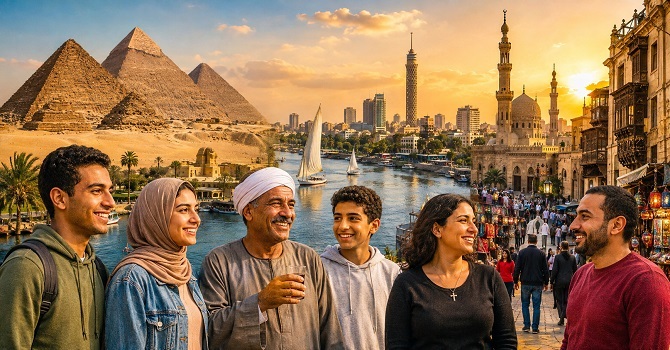
Culture, Identity & Heritage
Egypt is often introduced to travelers through its ancient civilization. The pyramids, temples, mummies, hieroglyphs, and pharaohs naturally dominate the image of the country abroad. But there is another fascinating question behind the monuments: Who are the Egyptians today?
The answer is more complex than simply saying that Egyptians are Arabs, Africans, or descendants of the ancient Egyptians. Modern Egyptian identity has developed over thousands of years, shaped by the Nile Valley, successive civilizations, religion, language, migration, and centuries of cultural exchange.
For travelers visiting Egypt, understanding this modern identity can make the experience much richer. The people you meet in Cairo, Luxor, Aswan, Alexandria, or the Nile Delta are part of a living culture that connects the country's ancient past with the modern world.
Egyptians Are a Distinct People of the Nile Valley
Egyptians today are the overwhelming majority of the population of Egypt, a country with more than 100 million people. CAPMAS, Egypt's official statistics agency, reported that the country's population reached 108.75 million in February 2026.
Most Egyptians live along the Nile Valley and Delta. This geography has played an enormous role in shaping Egyptian society. Although Egypt is geographically large, most of the country's population is concentrated in a relatively narrow inhabited area around the Nile.
This helps explain something visitors quickly notice: Egypt can feel extremely urban and densely populated in Cairo and Alexandria, yet very different landscapes and lifestyles appear as you travel south toward Luxor and Aswan or into rural communities.
Egyptians are therefore not a completely uniform population. Regional traditions, accents, food, clothing, architecture, and social customs can vary considerably.
Are Egyptians Arabs?
This is one of the most common questions about Egyptian identity.
The simplest answer is that Egyptians are Arabic-speaking and Egypt is part of the Arab world, but Egyptian identity is not limited to being Arab.
Arabic became the dominant language of Egypt over the centuries following the Arab-Muslim conquest in the seventh century. Today, Egyptian Arabic is the everyday language spoken by the vast majority of Egyptians. It is also one of the most widely understood varieties of Arabic because of the enormous influence of Egyptian cinema, television, music, and popular culture throughout the Arab world.
Yet Egyptian Arabic is distinctly Egyptian. A traveler familiar with Gulf, Levantine, or North African Arabic will still encounter vocabulary, pronunciation, expressions, and cultural references that are uniquely Egyptian.
This is why many Egyptians comfortably describe themselves as both Egyptian and Arab, while others place a stronger emphasis on their specifically Egyptian identity.
There is no single answer that represents every Egyptian.
The Ancient Egyptians Are Still Part of the Story
Another popular question is whether modern Egyptians are descendants of the ancient Egyptians.
The historically responsible answer is more nuanced than either extreme.
Egypt's population has lived in the Nile Valley for thousands of years, but Egypt has also experienced migrations, invasions, intermarriage, and cultural changes under Persian, Greek, Roman, Arab, Ottoman, and other periods of rule.
It would therefore be misleading to describe today's population as genetically or culturally identical to the people who lived in Egypt during the age of the pharaohs.
At the same time, it is equally misleading to imagine that the ancient Egyptian population simply disappeared and was completely replaced by newcomers.
Modern Egyptians emerged from a long history of population continuity and cultural transformation.
This connection is particularly visible in the pride many Egyptians feel toward ancient Egypt. A person who speaks Arabic, uses a smartphone, follows modern football, and lives in contemporary Cairo can still feel a powerful connection to the civilization represented by the pyramids and temples.
That is one of the most interesting aspects of Egyptian identity: the ancient past is not necessarily viewed as something separate from modern Egypt.
Who Are the Coptic Egyptians?
Egypt is also home to a large Christian community, predominantly belonging to the Coptic Orthodox Church.
The word "Coptic" itself has an interesting history. It derives from an ancient Greek term associated with Egypt and eventually became closely associated with Egyptian Christians.
Coptic Christianity has roots extending back to the early centuries of Christianity, and Egypt became one of the most important centers of early Christian thought and monasticism.
Today, Coptic Egyptians are an important part of Egyptian society and history. Coptic churches, monasteries, religious festivals, and communities can be found throughout the country.
It is important, however, not to treat "Coptic" simply as another name for all Egyptians. In modern everyday usage, Copt generally refers to Egyptian Christians, particularly members of the Coptic Christian tradition.
Muslim and Christian Egyptians share much of the same broader Egyptian culture, including language, food, music, family traditions, humor, and national identity.
Egypt Is African, Arab, Mediterranean, and Middle Eastern
One reason Egypt can be difficult to categorize is that it sits at the intersection of several worlds.
Geographically, Egypt is an African country. The vast majority of its territory is in Africa, while the Sinai Peninsula lies in Asia.
Culturally and historically, Egypt has deep connections with the Middle East and the wider Arab world. Its position on the Mediterranean has also connected it with Europe and the Mediterranean basin for thousands of years.
The result is a society influenced by several cultural spheres at once.
A visitor traveling through Egypt may notice African influences in the south, Mediterranean influences in Alexandria, Arab cultural traditions throughout the country, and distinctive Egyptian customs that do not fit neatly into any outside category.
Rather than asking whether Egyptians are "African or Arab," it is often more accurate to recognize that Egypt's identity contains several overlapping layers.
Egyptians Today Live in a Young and Changing Society
Modern Egypt is also a young country in demographic terms.
The contemporary Egyptian population includes enormous numbers of young people entering education, employment, technology, tourism, and other industries. The labor force reached more than 34 million people in 2025, according to CAPMAS data reported by Egypt's State Information Service.
This younger generation often combines traditional family values with global influences.
Egyptian young people may listen to international music, use social media, follow European football, study foreign languages, and work in modern technology industries while maintaining strong connections to family traditions and local culture.
This mixture is particularly visible in Cairo, where ancient monuments exist alongside shopping malls, universities, startups, cafés, international restaurants, and modern entertainment.
Family and Hospitality Remain Important
For travelers, one of the most noticeable aspects of Egyptian society is the importance of family and hospitality.
Family relationships remain central to everyday life, and several generations may maintain close relationships even when they do not live in the same home.
Hospitality is also an important social value. Visitors may be offered tea, coffee, food, or assistance in situations where they might not expect it.
Of course, Egyptians are individuals rather than a single personality type. Not every Egyptian is naturally outgoing or hospitable, and experiences vary from person to person. But social relationships and personal connections remain important features of Egyptian culture.
Egyptians Are Not Living in the Past
Perhaps the biggest misconception about Egyptians is that modern Egypt is simply an extension of ancient Egypt.
It is not.
Today's Egyptians live in a modern society dealing with contemporary issues such as education, employment, housing, technology, transportation, economic pressures, and globalization.
The country's cities are full of modern businesses, universities, hospitals, shopping centers, cafés, smartphones, social media, and rapidly changing lifestyles.
At the same time, ancient monuments remain part of the national landscape.
That contrast is precisely what makes Egypt so fascinating for travelers.
You can visit the pyramids in the morning, eat modern Egyptian street food in the afternoon, take a ride through contemporary Cairo in the evening, and speak with people whose families have lived in the Nile Valley for generations.
What Should Travelers Know About Egyptian Identity?
The best way to understand Egyptians is to avoid trying to fit everyone into one category.
An Egyptian can simultaneously be Egyptian, Arab, African, Muslim or Christian, modern and traditional, urban or rural, and deeply proud of ancient Egyptian history.
These identities do not necessarily contradict one another.
Egypt's modern population is the result of thousands of years of continuity and change. Ancient Egyptian civilization is an essential part of the country's historical heritage, while Arabic language and Islamic and Christian traditions are central to modern Egyptian life.
For travelers, this layered identity is one of the most rewarding parts of visiting Egypt. The country is not simply a destination where you can see the remains of an ancient civilization. It is a living society whose people have their own modern culture, humor, language, traditions, ambitions, and relationship with the past.
And perhaps that is the most interesting answer to the question "Who are the Egyptians today?"
They are not simply the people who inherited the pyramids. They are a modern people living within one of the world's oldest continuous cultural landscapes—carrying the past with them while creating a very different Egypt for the future
For travelers who want to experience this living culture firsthand, our Egypt travel packages combine iconic landmarks, authentic local experiences, and unforgettable Nile cruises into one seamless journey.
Best Egypt Tours 2026
| Tour | Itinerary | Price |
|---|---|---|
| Egypt Solar Eclipse Tour | 9 Days | $ 8995 |
| All Inclusive Vacations Egypt | 10 Days | $ 1999 |
| Cairo and Luxor Holidays | 5 Days | $ 1225 |
| Pyramids and Nile Cruise Holidays | 8 Days | $ 1595 |
| Luxury Egypt Tours with Nile Cruise | 12 Days | $ 2470 |
| Nile Cruise and Red Sea Stay | 12 Days | $ 2685 |
| Cairo Nile Cruise and Hurghada | 12 Days | $ 2065 |
| Package Trips to Egypt | 10 Days | $ 2065 |
| Egypt Honeymoon Packages | 10 Days | $ 3180 |
| Wheelchair Accessible Nile Cruise | 4-5 Days | $ 1145 |
| Cairo and Nile Cruise Package | 7 Days | $ 1375 |
| Nile Cruise and Stay | 8 Days | $ 2210 |
| Egypt Pyramid Tour Packages | 8 Days | $ 1775 |
| Luxor and Aswan Tours | 4 Days | $ 665 |
| 5 Star Egypt Tours | 8 Days | $ 1680 |