
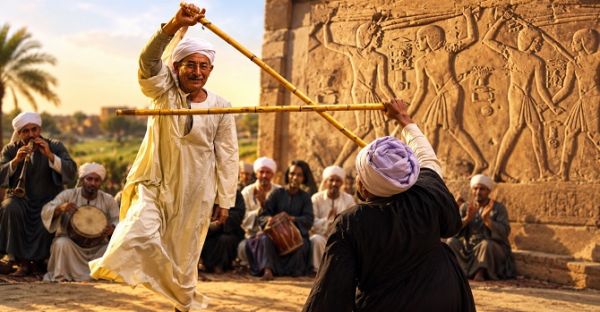
Discover Egypt’s Traditional Stick Dancing and Ancient Martial Art
What Is Tahteeb? Egypt’s Traditional Stick Dance
Imagine standing in a village square in Upper Egypt as the sound of traditional drums and the piercing melody of the mizmar fill the air. Two performers step forward, each holding a long stick. They circle one another, move in rhythm, and exchange carefully controlled movements as spectators gather around them. This is Tahteeb, one of Egypt’s most fascinating traditional cultural practices.
Also spelled Tahtib, Tahteeb is an Egyptian stick game that combines agility, balance, rhythm, and controlled combat. Although it is often described as Egyptian stick dancing, its traditional form is more than a dance. It developed from a martial practice into a festive performance that celebrates skill, courage, mutual respect, and community identity.
Today, Tahteeb remains an important part of Egyptian folk culture, particularly in Upper Egypt, where generations have passed its techniques and traditions from one person to another.
The Ancient Egyptian Origins of Tahteeb
Tahteeb has historical connections to ancient Egyptian stick-fighting practices. Scenes in ancient Egyptian tombs and monuments depict people using sticks in physical training and combat-related activities, providing valuable evidence of the long history of stick-based fighting in the Nile Valley.
However, it is important to distinguish between historical evidence of ancient stick-fighting and the modern tradition of Tahteeb. Although the two are connected, the exact development of today's festive game over thousands of years cannot be established in every detail.
Over time, stick-fighting practices became associated with social gatherings and celebrations. Instead of serving primarily as martial training, Tahteeb developed into a public game in which participants demonstrate their abilities before an audience.
This transformation reflects an important aspect of Egyptian cultural heritage: traditions can preserve elements of the past while adapting to the needs and values of contemporary communities.
In 2016, UNESCO inscribed Tahteeb on its Representative List of the Intangible Cultural Heritage of Humanity. The recognition highlights the practice's cultural importance and its role in bringing people together through shared traditions.
How Is Tahteeb Performed?
A traditional Tahteeb performance usually features two players, each carrying a long stick. They face one another and exchange movements that require coordination, quick reactions, concentration, and precise control.
The players may circle each other, change direction, raise their sticks, and respond to their opponent's movements. What might initially look like a fight is actually a structured exchange in which skill and restraint are essential.
Traditional Tahteeb is not intended to become a violent confrontation. Participants are expected to control their movements and respect one another throughout the performance. The emphasis is on demonstrating ability rather than causing harm.
Music is an important part of the experience. Traditional percussion and the lively sounds of the mizmar, a reed instrument commonly associated with Egyptian folk music, can accompany performances and create an energetic atmosphere.
For visitors to Egypt, watching Tahteeb offers an opportunity to appreciate how movement, music, social customs, and cultural identity can come together in a single performance.
The Cultural Meaning of Tahteeb in Upper Egypt
Tahteeb is particularly associated with Upper Egypt, known in Arabic as Sa'id. This region stretches along the Nile south of Cairo and includes culturally significant destinations such as Luxor, Qena, Sohag, and Asyut.
In many communities, Tahteeb represents more than physical skill. It expresses values such as courage, dignity, pride, friendship, and mutual respect. Players learn to recognize their opponents' abilities while maintaining self-control, making respect as important as strength.
The tradition is also closely connected to family and community life. Skills and knowledge are often passed down informally between generations, including from fathers to sons and between experienced practitioners and younger learners.
Local gatherings allow people to watch familiar performers, encourage new participants, and celebrate a tradition that belongs to their community. These occasions help keep Tahteeb alive beyond museums, historical monuments, and formal cultural exhibitions.
This community connection is one reason UNESCO recognition matters. Tahteeb is not simply an old performance preserved for tourists; it is a living cultural practice whose meaning comes from the people who continue to practise it.
When Can You See Tahteeb in Egypt?
Tahteeb may be performed at weddings, local festivals, religious moulid celebrations, and other social occasions. These gatherings provide opportunities for communities to celebrate together through music, movement, and traditional entertainment.
The exact availability of performances varies by location, season, and event. Travellers should not assume that a Tahteeb performance will take place automatically during a visit to any particular town.
If you are planning an Egypt cultural tour, ask your local guide or tour operator whether a genuine community performance or cultural event is scheduled during your stay. A locally organized event can offer a more meaningful experience than simply watching a staged demonstration without understanding its background.
Luxor and other destinations in Upper Egypt can be useful starting points for exploring regional traditions. Travellers interested in going beyond the most famous archaeological sites can ask about local music, folk performances, traditional crafts, and village celebrations.
It is worth remembering that Tahteeb is a living tradition, not a daily tourist show with a fixed timetable. Respecting local customs and asking permission before photographing performers can help make the experience enjoyable for both visitors and the community.
Tahteeb and Saidi Folk Music
One of the most memorable elements of a Tahteeb performance is its relationship with traditional Saidi music. The rhythm helps create the atmosphere and energy of the gathering, connecting the movements of the players with the wider celebration.
The mizmar is particularly recognizable for its strong, penetrating sound. Alongside percussion, it is associated with festive music in parts of Upper Egypt and is often heard at weddings and other celebrations.
Music and movement are also central to other Egyptian folk performances. For example, the Saidi cane dance, commonly known as Raqs Al-Assaya, uses a cane in a choreographed dance inspired by the region's stick traditions.
Although Tahteeb and Raqs Al-Assaya are related culturally, they are not identical. Tahteeb traditionally emphasizes an exchange between players, while the cane dance focuses on dance movements and performance. Recognizing this distinction helps visitors better understand the variety of Egyptian traditional arts.
Is Tahteeb the Same as Belly Dancing?
No. Tahteeb is a traditional stick game with martial roots, while belly dancing is a different form of dance with its own movements, musical styles, and performance traditions.
The confusion sometimes arises because Egypt has several folk performances involving canes, including Saidi cane dancing. In these performances, dancers may spin, balance, or move a cane in time with the music.
Traditional Tahteeb, by contrast, involves two players engaging in a controlled exchange of movements. Both practices are part of the broader landscape of Egyptian folk culture, but they have different purposes and techniques.
For travellers interested in Egyptian music and dance, exploring these distinctions makes cultural performances more rewarding. Each tradition tells a different story about the country's regional identities, celebrations, and artistic expression.
Why Should Travellers Discover Tahteeb?
Egypt is famous for the Pyramids of Giza, the temples of Luxor, the treasures of ancient tombs, and Nile cruises between Luxor and Aswan. Yet the country's heritage extends far beyond its monumental archaeological sites.
Tahteeb offers another way to understand Egypt: through the traditions that people continue to practise in their daily lives and celebrations.
Watching a performance can reveal the importance of rhythm, discipline, respect, and community in Upper Egyptian culture. It also provides a connection between Egypt's historical legacy and its contemporary cultural identity without treating modern Egyptians simply as guardians of an ancient past.
For culturally curious travellers, combining visits to archaeological landmarks with opportunities to experience local music and traditions can create a more complete picture of the country.
Whether you are exploring Luxor's ancient temples, sailing along the Nile, or learning about life in Upper Egypt, Tahteeb is a reminder that Egypt's history is not confined to stone monuments. It also lives through movement, music, shared memories, and the people who pass their traditions to the next generation.
Discover our Egypt travel packages to plan a journey that brings together ancient wonders, Nile adventures, and the cultural experiences that make Egypt unique.
Best Egypt Tours 2026
| Tour | Itinerary | Price |
|---|---|---|
| Cairo and Nile Cruise Package | 7 Days | $ 1465 |
| Egypt Pyramid Tour Packages | 8 Days | $ 1775 |
| Luxor and Aswan Tours | 4 Days | $ 665 |
| 5 Star Egypt Tours | 8 Days | $ 1775 |
| Egypt Pyramids Nile Cruise | 10 Days | $ 2300 |
| Cairo Holiday Packages | 5 Days | $ 870 |
| Egypt Overland Tours | 8 Days | $ 1495 |