
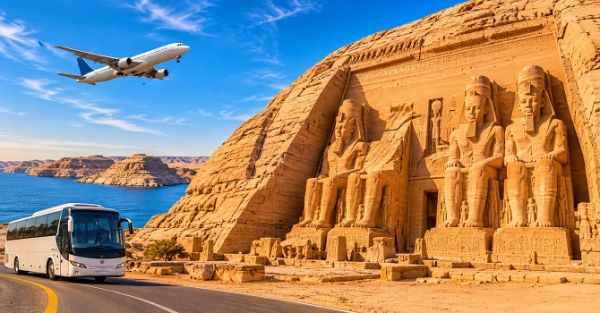
Choosing the Best Way to Experience Egypt’s Southern Temples
Visiting Abu Simbel is one of the most memorable experiences of travelling through Egypt. Located in southern Egypt, close to the Sudanese border, this extraordinary archaeological site is famous for its enormous rock-cut temples built by Pharaoh Ramesses II. Yet, before planning a visit, many travellers face an important question:
Should I visit Abu Simbel by road or plane?
Both options offer a rewarding way to discover one of ancient Egypt’s greatest monuments, but the experience can be quite different. Travelling by road provides an opportunity to appreciate the landscapes of southern Egypt, while flying offers a faster and more comfortable way to reach the temples, particularly for travellers with limited time.
Understanding the differences between these two options will help you choose the best Abu Simbel excursion according to your travel schedule, budget and preferred style of exploration.
Where Is Abu Simbel and Why Is It Worth Visiting?
Abu Simbel is situated approximately 280 kilometres southwest of Aswan, on the western shore of Lake Nasser. The archaeological complex consists of two magnificent temples commissioned by Ramesses II during the 13th century BC.
The Great Temple is dedicated to the gods Amun-Ra, Ra-Horakhty and Ptah, as well as the deified Ramesses II himself. Its impressive entrance is guarded by four colossal seated statues of the pharaoh, each approximately 20 metres high.
Nearby, the smaller temple was dedicated to the goddess Hathor and Queen Nefertari, Ramesses II's principal royal wife. Its façade features six standing statues representing the king and queen.
Abu Simbel is also famous for its remarkable relocation during the 1960s. Following the construction of the Aswan High Dam, the temples were threatened by the rising waters of Lake Nasser. An international UNESCO-supported operation carefully dismantled and reconstructed the monuments on higher ground, preserving them for future generations.
Today, visiting Abu Simbel is not simply about seeing ancient temples. It is an opportunity to experience an extraordinary achievement of ancient Egyptian architecture and modern conservation.
Visiting Abu Simbel by Road: A Scenic Journey from Aswan
For travellers who enjoy discovering destinations beyond the main tourist attractions, travelling to Abu Simbel by road can be an excellent choice.
The journey from Aswan covers approximately 280 kilometres and generally takes between three and four hours each way. Most organised excursions depart early in the morning to allow visitors enough time to explore the temples and return to Aswan on the same day.
The route crosses the beautiful desert landscapes of southern Egypt, offering a different perspective on the country's geography. Unlike the familiar Nile Valley scenery, this journey reveals vast stretches of desert, open horizons and the distinctive environment surrounding Lake Nasser.
Advantages of travelling by road
- A scenic experience: Enjoy the landscapes of southern Egypt and the journey through the Nubian desert.
- Flexible arrangements: Private vehicles allow greater control over departure times and the overall excursion schedule.
- More economical: Road excursions are generally more affordable than flights, particularly for families and private groups.
- A complete day trip: Explore both temples with a professional guide before returning to Aswan
The main disadvantage is the journey time. Spending approximately six to eight hours travelling in both directions can make the excursion tiring, especially for families with young children or travellers who prefer shorter transfers.
An early departure is also necessary, meaning you may need to leave your hotel before sunrise. For travellers who enjoy road trips, however, the journey itself can become part of the adventure.
Visiting Abu Simbel by Plane: The Faster and More Comfortable Option
Flying from Aswan to Abu Simbel is an attractive alternative for travellers who want to save time and avoid a long desert journey.
The flight takes approximately 40–45 minutes, compared with three to four hours by road. After landing at Abu Simbel Airport, you still need a short transfer to reach the archaeological site.
Organised flight excursions generally arrange airport transfers, entrance tickets and a professional guide, making the experience relatively straightforward.
Advantages of travelling by plane
- Significant time savings: Spend less time travelling and more time exploring ancient monuments.
- Greater comfort: Avoid several hours on a desert highway, particularly during warmer months.
- Ideal for short itineraries: Include Abu Simbel in a busy Aswan sightseeing programme.
- A different perspective: Depending on the flight route and weather, enjoy impressive aerial views of the surrounding desert and Lake Nasser.
The main disadvantage is the higher cost. Domestic flights generally make the excursion more expensive than travelling by road, especially for families and private groups.
Flight availability and schedules can also vary, so check departure and return times carefully before booking.
For travellers prioritising convenience, comfort and time, flying is often the better choice.
Abu Simbel by Road vs Plane: Which Is Better?
Both transportation options allow you to discover the same extraordinary archaeological treasures. The right choice depends mainly on your available time, budget and travel preferences.
Road travel takes approximately three to four hours each way and is generally more economical. It also offers greater flexibility when booking private transportation.
Flying takes around 40–45 minutes and reduces the time spent travelling considerably. However, it usually costs more and requires planning around airline schedules and airport transfers.
Our recommendation: Choose the road if you want a more economical excursion and do not mind an early start. Choose the plane if comfort, convenience and saving time are your priorities.
For most travellers spending several days in Aswan, either option can fit comfortably into an Egypt holiday.
Can You Visit Abu Simbel from Luxor or Cairo?
Abu Simbel is usually visited from Aswan because of its geographical location. However, travellers following longer Egypt itineraries can also include it when visiting other destinations.
From Luxor, the journey by road is considerably longer than from Aswan, making a direct day trip demanding. Spending a night in Aswan is generally a more comfortable alternative.
From Cairo, the practical option is usually to fly to Aswan and continue to Abu Simbel by road or plane. This requires careful coordination and can make for a long day.
For travellers following a classic Cairo, Luxor and Aswan itinerary, adding an overnight stay in Aswan is often the best way to enjoy Abu Simbel without rushing the experience.
What Is the Best Time to Visit Abu Simbel?
The best months to visit Abu Simbel are generally October through April, when temperatures are more comfortable for exploring the archaeological site.
Because the temples are surrounded by desert, the summer months can be extremely hot. Whichever transportation option you choose, an early arrival is advisable.
Two particularly special dates for visitors interested in ancient Egyptian architecture are 22 February and 22 October.
On these dates, a remarkable solar alignment allows sunlight to penetrate the Great Temple and illuminate statues inside the sanctuary. This phenomenon demonstrates the extraordinary astronomical and architectural knowledge of ancient Egyptian builders.
These dates attract additional visitors, so advance planning is particularly important.
How Much Time Should You Spend at Abu Simbel?
Allow approximately two to three hours to explore the archaeological complex comfortably.
Start with the Great Temple of Ramesses II, where you can admire the colossal façade, impressive interior halls and sanctuary. Then visit the smaller Temple of Nefertari, which offers a fascinating insight into the royal relationship between Ramesses II and his queen.
Take time to appreciate the detailed wall carvings, ancient inscriptions and architectural features that make these monuments unique.
If your schedule allows, consider staying overnight in Abu Simbel. This gives you the opportunity to experience the Sound and Light Show, subject to its operating schedule, and enjoy a more relaxed visit.
An Alternative Experience: Visiting Abu Simbel on a Lake Nasser Cruise
For travellers interested in a different way to explore southern Egypt, a Lake Nasser cruise offers another memorable experience.
Unlike traditional Nile cruises operating between Luxor and Aswan, Lake Nasser cruises explore the vast artificial lake created by the Aswan High Dam.
These cruises offer opportunities to discover several Nubian archaeological sites along the lake, including monuments that are less accessible by conventional road excursions.
Abu Simbel is often one of the highlights of these itineraries, allowing visitors to experience the temples as part of a wider historical journey through southern Egypt.
Although this option requires more time and a different travel budget, it provides a distinctive experience for travellers interested in archaeology, landscapes and luxury cruising.
Practical Tips Before Booking Your Abu Simbel Excursion
Whichever transportation method you select, a little preparation can make your visit more enjoyable.
- Book in advance: Particularly during the winter tourist season and around the solar alignment dates.
- Check flight schedules: Confirm both departure and return arrangements.
- Choose a professional Egyptologist guide: Understanding the history of Ramesses II, Nefertari and the temple relocation adds considerably to the experience.
- Wear comfortable clothing: Lightweight clothes, walking shoes, sunglasses and a hat are useful.
- Bring water and sun protection: Shade is limited around the archaeological complex.
- Confirm what is included: Check whether your excursion covers transportation, entrance tickets, transfers and guiding services.
Best Egypt Tours 2026
| Tour | Itinerary | Price |
|---|---|---|
| Egypt Solar Eclipse Tour | 9 Days | $ 8995 |
| All Inclusive Vacations Egypt | 10 Days | $ 2940 |
| Cairo and Luxor Holidays | 5 Days | $ 1305 |
| Pyramids and Nile Cruise Holidays | 8 Days | $ 1690 |
| Cairo Private Tours | 4 Days | $ 780 |
| Cairo City Breaks | 3 Days | $ 575 |
| Luxury Egypt Tours with Nile Cruise | 12 Days | $ 2610 |
| Nile Cruise and Red Sea Stay | 12 Days | $ 2815 |
| Cairo Nile Cruise and Hurghada | 12 Days | $ 2200 |
| Package Trips to Egypt | 10 Days | $ 2165 |
| Egypt Honeymoon Packages | 10 Days | $ 3180 |