
The Meaning Behind Egypt’s Warm Morning Greetings
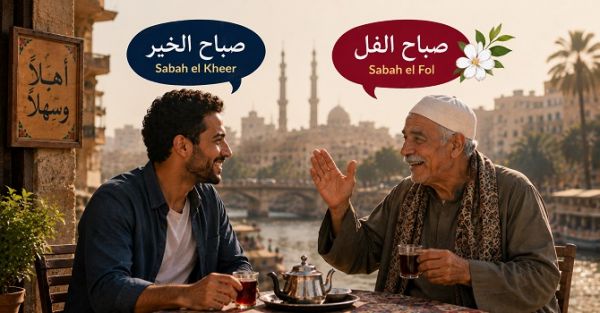
Have you ever heard an Egyptian say “Sabah el-kheer” and receive the surprisingly cheerful reply “Sabah el-fol”?
If you are visiting Egypt, learning Egyptian Arabic, or simply curious about Egyptian culture, this tiny exchange can be surprisingly revealing. Both expressions are morning greetings, but they do not carry exactly the same feeling.
The difference is less about literal meaning and more about tone, warmth, familiarity, and the playful way Egyptians use language in everyday life.
What Does “Sabah El Kheer” Mean?
Sabah el-kheer(صباح الخير) literally means “morning of goodness” or, more naturally in English, “good morning.”
It is the standard Arabic morning greeting and is widely understood throughout the Arab world. In Egypt, you can use it with friends, relatives, colleagues, shopkeepers, hotel staff, or someone you have just met.
For example:
- A: صباح الخير — Sabah el-kheer!
- B: صباح النور — Sabah el-noor!
This is a very common and natural exchange.
The expression is relatively neutral and polite. It does not necessarily tell you anything about how close the two people are.
For a traveler in Egypt, “Sabah el-kheer” is one of the safest Egyptian Arabic phrases to learn first.
So What Does “Sabah El Fol” Mean?
Here is where Egyptian Arabic becomes more colorful.
Sabah el-fol (صباح الفل) can literally be understood as “morning of jasmine.” The fol refers to a fragrant jasmine-like flower, not the famous Egyptian breakfast beans known as ful (فول).
That distinction is important for visitors.
In Egyptian Arabic, the phrase is a playful and warm variation of “good morning.” Egyptian Arabic learning resources specifically list:
- Sabah el-fol
- Sabah el-ward (“morning of roses/flowers”)
- Sabah el-yasmeen (“morning of jasmine”)
as colloquial alternatives to the standard greeting.
So when an Egyptian tells you:
“Sabah el-fol!”
they are not offering you a plate of ful for breakfast.
They are giving the ordinary morning greeting a little fragrance, friendliness, and personality.
Why Do Egyptians Change “Good” Into Flowers?
This is one of the charming characteristics of everyday Egyptian speech.
Instead of simply repeating “Sabah el-kheer”, Egyptians often play with the structure of the greeting:
- Sabah el-kheer — Good morning
- Sabah el-noor — Morning of light
- Sabah el-fol — Morning of jasmine
- Sabah el-ward — Morning of flowers/roses
- Sabah el-yasmeen — Morning of jasmine
- Sabah el-asal — Morning of honey
These expressions are not completely different greetings with complicated rules. They are variations that add emotion and character to an ordinary interaction. Egyptian Arabic teaching materials document several of these creative alternatives, including Sabah el-ward, Sabah el-yasmeen, and Sabah el-fol.
Egyptian culture has a particularly strong tradition of making everyday conversations expressive. Even a simple greeting can become an opportunity for humor, affection, or a little verbal creativity.
Is “Sabah El Fol” More Friendly Than “Sabah El Kheer”?
Usually, yes — but context matters.
“Sabah el-kheer” is the straightforward “good morning.”
“Sabah el-fol” sounds more informal, cheerful, and familiar.
Imagine walking into a small Egyptian neighborhood café.
You say:
“Sabah el-kheer!”
The person behind the counter might answer:
“Sabah el-fol!”
Nothing dramatic has happened. The second person has simply made the exchange warmer and more lively.
This is why translating the two expressions word-for-word does not fully explain their difference. The real distinction is social and emotional rather than grammatical.
What About “Sabah El Noor”?
For many learners of Egyptian Arabic, “Sabah el-noor” (صباح النور) is actually the response they will hear most often after “Sabah el-kheer.”
It means approximately “morning of light.”
So a classic exchange is:
- Person 1: Sabah el-kheer!
- Person 2: Sabah el-noor!
But Egyptians are not restricted to one official response. Depending on the relationship and personality of the speaker, you might hear Sabah el-fol, Sabah el-ward, or other playful variations. Egyptian Arabic educational resources describe these as colloquial alternatives and responses to “good morning.”
Does “Sabah El Fol” Mean the Person Is Being Affectionate?
Not necessarily.
This is an important point for travelers.
If someone says “Sabah el-fol”, you should not automatically interpret it as romantic or intimate. It can simply be a friendly Egyptian way of saying good morning.
The exact feeling depends on who says it, how they say it, and the relationship between the speakers.
A mother might say it to her child.
A friend might say it jokingly.
A colleague might use it casually.
A shopkeeper might say it warmly to a familiar customer.
And yes, someone can also use flowery greetings affectionately with a loved one.
The words provide the atmosphere, but the relationship provides the deeper meaning.
Can “Sabah El Fol” Be Sarcastic?
Absolutely — and this is where Egyptian humor enters the picture.
Egyptians frequently rely on tone of voice to transform an ordinary phrase.
Someone could say:
“Sabah el-fol!”
with genuine warmth.
But they could also say it dramatically or sarcastically after a friend arrives extremely late, makes an obvious mistake, or finally understands something everyone else knew.
The phrase itself is still positive. The tone and situation create the joke.
This kind of playful use of greetings is part of the broader Egyptian habit of turning ordinary expressions into humorous social exchanges. Even Egyptian writing about everyday greetings highlights how numerous and creative these variations can be.
Why Is This Interesting for Travelers?
Learning these expressions gives you something that a standard tourist phrasebook often misses.
Knowing “Sabah el-kheer” means you know how to say “good morning.”
Knowing that someone might answer “Sabah el-fol” helps you understand how Egyptians actually communicate.
That difference matters when you are sitting at a café in Cairo, walking through a local market in Luxor, boarding a Nile cruise, or chatting with an Egyptian guide.
You begin to recognize that Egyptian Arabic is not simply about translating individual words. The same basic greeting can be made formal, friendly, humorous, affectionate, or playful depending on the words and the tone.
What Should You Say as a Visitor?
If you are visiting Egypt for the first time, keep it simple.
You can confidently say:
“Sabah el-kheer!”
If an Egyptian replies:
“Sabah el-fol!”
you can simply respond with:
“Sabah el-noor!”
Or, if you want to join in the friendly style, you can say:
“Sabah el-fol!”
right back.
There is no need to worry about finding one perfect response. Egyptian greetings are flexible, and the friendly spirit behind the exchange is more important than memorizing a rigid formula.
“Sabah El Kheer” vs. “Sabah El Fol” at a Glance
Sabah el-kheer = the standard “good morning.”
Sabah el-noor = a traditional, bright-sounding response meaning roughly “morning of light.”
Sabah el-fol = a warmer, more playful “morning of jasmine.”
Sabah el-ward = “morning of flowers/roses.”
Sabah el-yasmeen = “morning of jasmine.”
The fascinating part is that none of these needs to be treated as a completely separate greeting system. They are examples of how Egyptian speakers add beauty, humor, affection, and personality to everyday language.
The Bigger Cultural Lesson
The real difference between “Sabah el-kheer” and “Sabah el-fol” is therefore not simply the dictionary translation.
It is the difference between saying:
“Good morning.”
and saying something closer in spirit to:
“A beautiful, fragrant morning to you.”
That small change captures something visitors often notice about Egyptian culture: ordinary conversations can be surprisingly expressive.
So the next time you hear an Egyptian say “Sabah el-fol,” don't start looking for breakfast beans.
Think flowers, friendliness, and a little Egyptian linguistic creativity.
And if you are lucky enough to hear it while sipping tea on a Nile cruise or starting a morning in Cairo, you have just learned one of the small phrases that makes experiencing Egypt beyond the famous monuments so rewarding.
If these everyday cultural details make you curious about experiencing Egypt for yourself, explore our Egypt travel packages for journeys combining Cairo, Luxor, Aswan, and the timeless Nile. A luxury Nile cruise is an especially memorable way to discover Egypt while experiencing the country beyond its famous archaeological sites.
Best Egypt Tours 2026
| Tour | Itinerary | Price |
|---|---|---|
| Egypt Solar Eclipse Tour | 9 Days | $ 8995 |
| All Inclusive Vacations Egypt | 10 Days | $ 2940 |
| Cairo and Luxor Holidays | 5 Days | $ 1305 |
| Pyramids and Nile Cruise Holidays | 8 Days | $ 1690 |
| Luxury Egypt Tours with Nile Cruise | 12 Days | $ 2610 |
| Nile Cruise and Red Sea Stay | 12 Days | $ 2815 |
| Cairo Nile Cruise and Hurghada | 12 Days | $ 2200 |
| Package Trips to Egypt | 10 Days | $ 2165 |
| Egypt Honeymoon Packages | 10 Days | $ 3180 |
| Egypt Wheelchair Accessible Tours | 10 Days | $ 3225 |
| Cairo and Nile Cruise Package | 7 Days | $ 1465 |
| Nile Cruise and Stay | 8 Days | $ 2300 |
| Egypt Pyramid Tour Packages | 8 Days | $ 1775 |
| 5 Star Egypt Tours | 8 Days | $ 1775 |
| Egypt Pyramids Nile Cruise | 10 Days | $ 2300 |