
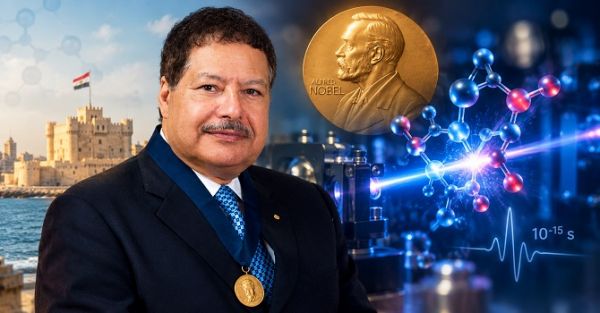
The Egyptian Scientist Who Made Chemistry Visible
From Damanhur and Alexandria to the Nobel Prize, Ahmed Zewail transformed the way scientists understand the fastest events in chemistry.
When visitors explore Egypt, they often encounter the names of ancient scientists, physicians, mathematicians, and scholars who helped shape human knowledge. But Egypt’s contribution to science is not limited to antiquity. In the modern era, one Egyptian scientist achieved a distinction that placed his name among the world’s most influential researchers: Ahmed Zewail, the Egyptian-American chemist and physicist who won the 1999 Nobel Prize in Chemistry.
Zewail became famous for developing techniques that allowed scientists to observe chemical reactions on an extraordinarily short timescale. His work created a new scientific field known as femtochemistry, giving researchers a way to study what happens to atoms and molecules while a chemical reaction is actually taking place.
For travelers interested in Egypt beyond the pyramids and temples, his story offers another fascinating side of the country: its continuing connection to education, science, and global innovation.
Who Was Ahmed Zewail?
Ahmed Hassan Zewail was born on February 26, 1946, in Damanhur, Egypt, and grew up in the nearby city of Alexandria. He studied chemistry at Alexandria University, where he earned his bachelor's and master's degrees before moving to the United States for his doctoral studies at the University of Pennsylvania.
In 1976, Zewail joined the faculty of the California Institute of Technology (Caltech), where he spent most of his scientific career. His research focused on one of the most difficult questions in chemistry: What exactly happens to atoms and molecules during a chemical reaction?
Chemists had long understood the starting materials and final products of many reactions. The challenge was seeing the incredibly rapid process that connects the two.
Zewail found a way to make that process observable.
What Did Ahmed Zewail Discover?
It is sometimes said that Ahmed Zewail "discovered femtochemistry," but the more accurate description is that he pioneered and established femtochemistry as a scientific field.
His breakthrough was developing experimental methods using ultrafast laser pulses to observe molecular changes occurring within femtoseconds. A femtosecond is one millionth of one billionth of a second, or 10⁻¹⁵ seconds.
To understand how incredibly short this is, imagine trying to photograph a moving object. If your camera takes pictures too slowly, you see only a blur. Zewail's research essentially provided chemistry with an extraordinarily fast "camera."
His laser techniques allowed scientists to follow the movements of atoms and molecules as chemical bonds were breaking and forming. This made it possible to investigate the transition states of chemical reactions—the fleeting configurations molecules pass through as they transform from reactants into products.
This was a major change in chemistry. Instead of simply studying what existed before and after a reaction, scientists could investigate the molecular events occurring during the reaction itself.
Why Is Femtochemistry Important?
The word "femto" refers to an extremely small unit of time. Femtochemistry therefore focuses on chemical processes occurring on the femtosecond timescale.
Atoms in molecules are constantly moving and vibrating. During a chemical reaction, their movements determine how bonds are broken, rearranged, and formed. These processes happen incredibly quickly—often on approximately the same timescale as molecular vibrations.
Before Zewail's pioneering work, directly observing such events was extremely difficult.
His research demonstrated that ultrashort laser pulses could be used to capture these molecular dynamics. Scientists could effectively take a sequence of extremely rapid "snapshots" and reconstruct what happens during a reaction.
This approach opened new possibilities across chemistry and related fields, including studies of molecular physics, photobiology, materials, and biological processes.
Did Dr. Ahmed Zewail Win a Nobel Prize?
Yes. Ahmed Zewail won the 1999 Nobel Prize in Chemistry.
He was awarded the prize as the sole recipient, with the Nobel Committee recognizing his studies of the transition states of chemical reactions using femtosecond spectroscopy.
The award recognized research that changed the way scientists could investigate chemical reactions. Rather than observing only the initial and final states, researchers could use ultrafast laser techniques to study molecular motion as the reaction unfolded.
Zewail's Nobel Prize therefore was not simply for discovering a particular chemical substance. It honored a new way of looking at chemistry.
His achievement also made him an important figure in the story of modern Egyptian science. He became one of the best-known Egyptian-born scientists internationally and received numerous other honors and honorary degrees during his career.
Who Is the Father of Femtochemistry?
Ahmed Zewail is widely regarded as the "father of femtochemistry."
The title reflects his pioneering role in establishing the field and demonstrating that chemical reactions could be studied on their natural, ultrafast timescale.
His Nobel lecture, titled "Femtochemistry: Atomic-Scale Dynamics of the Chemical Bond Using Ultrafast Lasers," described how femtosecond techniques could reveal the making and breaking of chemical bonds and the short-lived transition states involved in molecular transformations.
In simple terms, Zewail helped scientists move from asking "What changed?" to being able to ask "How did it change, atom by atom, and when?"
That distinction is what made his contribution so important.
From Ancient Alexandria to Modern Science
There is an interesting connection between Zewail's story and Egypt's much older scientific heritage.
Zewail grew up in Alexandria, a city historically associated with scholarship and scientific inquiry. The ancient Library of Alexandria became a symbol of the pursuit and preservation of knowledge, while the modern city became part of the educational journey of one of Egypt's most internationally recognized scientists.
In his Nobel biography, Zewail himself reflected on growing up near the Rosetta branch of the Nile, between Damanhur, Disuq, Rosetta, and Alexandria. He described Alexandria as a place connected to ancient learning and remembered his early interest in understanding natural phenomena.
For travelers, this adds another layer to visiting Egypt. The country's story is not frozen in its ancient monuments. Egypt has also produced scientists whose work has influenced modern chemistry, physics, and biology.
Ahmed Zewail's Work After the Nobel Prize
Zewail continued his scientific work after receiving the Nobel Prize. One of his later areas of research involved four-dimensional electron microscopy, an approach designed to visualize matter and biological behavior in both space and time.
This extended the basic idea behind his earlier work: if scientists can observe matter with extremely high spatial and temporal resolution, they can better understand how it behaves and changes.
His interests therefore expanded beyond chemistry into physics, biology, and materials science.
Zewail also remained strongly interested in science education and the role of scientific research in society, including the development of science and technology in Egypt.
Ahmed Zewail's Legacy in Egypt
Ahmed Zewail died on August 2, 2016, in Pasadena, California, at the age of 70.
His legacy, however, goes far beyond a Nobel medal.
For scientists, he helped create an entirely new way to study chemical reactions. For Egyptians, he became a powerful example of how education and scientific curiosity can lead from an Egyptian university to the highest levels of international research.
And for visitors curious about modern Egypt, his story provides a useful reminder: Egypt is not only a destination of ancient discoveries. It is also part of the modern history of science.
From the ancient scholars of Alexandria to Ahmed Zewail's femtosecond "camera," the Egyptian story of knowledge stretches across thousands of years—and continues to evolve.
Discover the story of modern Egypt for yourself with our carefully crafted Egypt travel packages, combining iconic historical sites, cultural experiences, and unforgettable journeys along the Nile.
Best Egypt Tours 2026
| Tour | Itinerary | Price |
|---|---|---|
| Egypt and Kenya Tours | 15 Days | $ 6250 |
| Egypt and Dubai Tours | 8 Days | $ 999 |
| Cairo and Istanbul Tours | 8 Days | $ 1250 |
| Turkey and Egypt Tours | 12 Days | $ 2825 |
| Egypt and Petra Tours | 12 Days | $ 2255 |
| Egypt and Jordan Tours With Nile Cruise | 14 Days | $ 3066 |
| Dubai and Egypt Vacation Packages | 12 Days | $ 2270 |
| Egypt and Morocco Tours | 15 Days | $ 4499 |
| Egypt and Jordan Luxury Tours | 8 Days | $ 1275 |
| Egypt and Greece Tours | 14 Days | $ 3380 |
| Egypt Tanzania Tour | 14 Days | $ 6275 |
| Egypt and Holy Land Tours | 15 Days | $ 4100 |