
The Legendary First Pharaoh of Ancient Egypt
Who Was Menes?
Who was the first pharaoh of ancient Egypt, and how did one king become associated with the birth of one of the world's greatest civilizations?
Menes is traditionally remembered as the ruler who united Upper and Lower Egypt around 3100 BCE, establishing the foundations of the ancient Egyptian kingdom. His name represents the beginning of a remarkable historical journey that eventually produced the pyramids of Giza, the temples of Luxor, and the magnificent tombs of the Valley of the Kings.
However, historians continue to debate Menes's true identity. Some Egyptologists identify him with Narmer, an early king known from archaeological discoveries, while others associate him with Hor-Aha, a ruler who may have succeeded Narmer.
Although his personal history remains uncertain, Menes provides a fascinating introduction to early Egyptian civilization and the archaeological sites travelers can explore to understand its origins.
The Meaning and Historical Origins of Menes
The name Menes appears in ancient Egyptian king lists and historical accounts written long after the period in which he supposedly lived.
The Greek historian Herodotus, writing during the fifth century BCE, described Menes as an early Egyptian king associated with the foundation of Memphis. Later, the Egyptian priest Manetho included Menes in his account of Egypt's dynastic history, written during the third century BCE.
These sources are important, but they were produced centuries after the beginning of Egypt's unified monarchy. Historians therefore compare their accounts with inscriptions, archaeological objects, and evidence from early royal tombs.
This distinction matters because the traditional story of a single founding king may simplify a longer process of political consolidation. Rather than uniting the country through one decisive event, early rulers may have contributed to the gradual integration of communities and territories along the Nile.
How Did Menes Unite Upper and Lower Egypt?
Ancient Egypt developed along the Nile River, whose fertile banks supported farming, settlement, and trade.
Upper Egypt refers to the southern Nile Valley, while Lower Egypt encompasses the northern region, particularly the Nile Delta. These geographical names can seem confusing to modern visitors because the Nile flows northward toward the Mediterranean Sea.
Before the emergence of a unified kingdom, different political communities developed throughout the Nile Valley. Over time, some rulers gained influence over increasingly large territories.
Tradition credits Menes with bringing Upper and Lower Egypt together under one crown. This achievement established a political structure that would become central to Egyptian kingship.
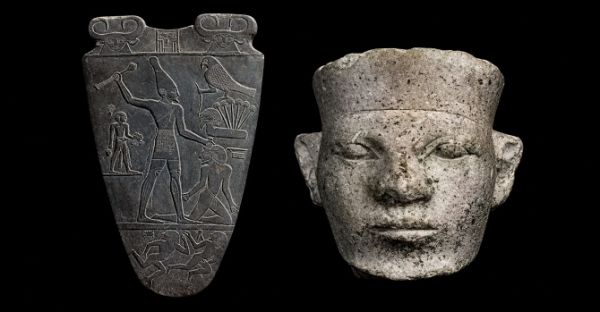
One of the most significant archaeological objects associated with this period is the Narmer Palette, discovered at Hierakonpolis. It depicts King Narmer wearing the crowns associated with Upper and Lower Egypt and is widely interpreted as expressing royal authority over both regions.
The palette does not conclusively prove that Narmer and Menes were the same person. Nevertheless, it offers valuable evidence of how early Egyptian rulers represented power and unity.
Was Menes the Same Person as Narmer?
The relationship between Menes and Narmer remains one of the most discussed questions in early Egyptian history.
Narmer is an archaeologically documented king associated with the beginning of Egypt's First Dynasty. His name appears on objects from the early dynastic period, including the famous Narmer Palette.
There are three main possibilities:
- Menes was Narmer: Some scholars identify Menes with Narmer, whose archaeological record is closely associated with Egyptian unification.
- Menes was Hor-Aha: Others suggest that Menes refers to Hor-Aha, a ruler generally placed after Narmer in early royal chronology.
- Menes represents a later historical tradition: The name may reflect how later generations remembered the complicated emergence of a unified kingdom.
There is no universally accepted answer that resolves the question completely.
For visitors interested in ancient Egyptian history, this uncertainty illustrates how archaeology works. Historians reconstruct the past by comparing physical evidence with written traditions, rather than relying on later accounts alone.
Why Was Memphis Important?
Memphis became one of the most important political and religious centers in ancient Egypt. Traditionally, its foundation is associated with Menes, although the precise circumstances remain uncertain.
Located near modern Mit Rahina, south of Cairo, Memphis occupied a strategic position close to the boundary between the Nile Valley and the Delta. Its location helped rulers oversee important agricultural territories, trade routes, and communication between northern and southern Egypt.
The city was also associated with Ptah, a god connected with creation and craftsmanship.
Although much of ancient Memphis has disappeared or lies beneath modern development, visitors can explore the archaeological area at Mit Rahina. Its open-air museum contains important sculptures, including a colossal statue of Ramesses II.
A visit to Memphis is often combined with nearby Saqqara, making both destinations excellent additions to a Cairo itinerary focused on ancient Egyptian history.
What Was Egypt Like During Menes's Time?
The Egypt associated with Menes looked very different from the country most travelers imagine when they picture pharaohs and pyramids.
The Great Pyramid of Giza had not yet been built. The monumental temples of Karnak and Luxor belonged to later historical periods, and the royal tombs of the Valley of the Kings were still far in the future.
Instead, early Egyptian society was developing the foundations of centralized government, royal administration, religious traditions, and distinctive artistic conventions.
The Nile played an essential role. Its annual flooding supported agriculture, while the river provided a natural transportation route for people and goods. Control over settlements and agricultural resources helped early rulers strengthen their authority.
Writing was also developing during this formative era. Early inscriptions and symbols provide evidence of emerging administrative practices and royal identity, although the precise stages in the development of hieroglyphic writing remain subjects of research.
The unification of Egypt therefore represented more than a political achievement. It marked the beginning of institutions and cultural traditions that would influence Egyptian civilization for thousands of years.
Where Can You Explore Menes's World in Egypt?
Although no major surviving monument can be confidently attributed to Menes himself, several archaeological destinations help explain the period in which he supposedly lived.
The Egyptian Museum in Cairo: Important collections of early Egyptian artifacts help visitors understand the development of kingship. The Narmer Palette is especially significant, although travelers should check its current display location before visiting.
Memphis and Mit Rahina: This archaeological area introduces visitors to the history of Egypt's early royal center. It is an accessible addition to a day trip from Cairo.
Saqqara: Famous for the Step Pyramid of Djoser, Saqqara demonstrates how royal burial architecture developed centuries after Egypt's earliest dynasties.
Abydos: This ancient religious and funerary center contains important royal burial grounds associated with Egypt's earliest kings. It offers valuable insight into the development of royal traditions and beliefs about the afterlife.
Hierakonpolis: Also known as Nekhen, this early urban center in Upper Egypt is closely associated with archaeological discoveries from the period of Egyptian unification.
Together, these sites reveal a more complete picture of early Egyptian civilization than the story of a single king can provide.
Why Is Menes Important Today?
Menes remains an important figure because his traditional story represents the beginning of unified pharaonic Egypt.
Although historians have not established his identity with certainty, archaeological evidence demonstrates that a major political transformation occurred around the beginning of the third millennium BCE.
The rulers associated with this transformation established foundations that later generations developed into a sophisticated civilization known for monumental architecture, religious traditions, artistic achievements, and powerful royal institutions.
Understanding Menes also helps travelers appreciate that Egypt's famous monuments did not appear overnight. They were the products of a civilization that evolved gradually along the Nile, beginning with early communities and the emergence of kingship.
For anyone planning an Egypt tour, the story of Menes provides an excellent starting point for exploring the country's earliest history, from the archaeological treasures around Cairo to the ancient sites of Upper Egypt
Explore ancient Egypt with our Egypt travel packages, featuring historic sites, private tours, and Nile cruises.
Best Egypt Tours 2026
| Tour | Itinerary | Price |
|---|---|---|
| Egypt and Kenya Tours | 15 Days | $ 6250 |
| Egypt and Dubai Tours | 8 Days | $ 999 |
| Cairo and Istanbul Tours | 8 Days | $ 1250 |
| Turkey and Egypt Tours | 12 Days | $ 2825 |
| Egypt and Petra Tours | 12 Days | $ 2255 |
| Egypt and Jordan Tours With Nile Cruise | 14 Days | $ 3066 |
| Egypt and Morocco Tours | 15 Days | $ 4499 |
| Egypt and Jordan Luxury Tours | 8 Days | $ 1275 |
| Egypt and Greece Tours | 14 Days | $ 3380 |
| Egypt Tanzania Tour | 14 Days | $ 6275 |
| Cairo to Petra Tour | 7 Days | $ 945 |
| Egypt and Holy Land Tours | 15 Days | $ 4100 |