
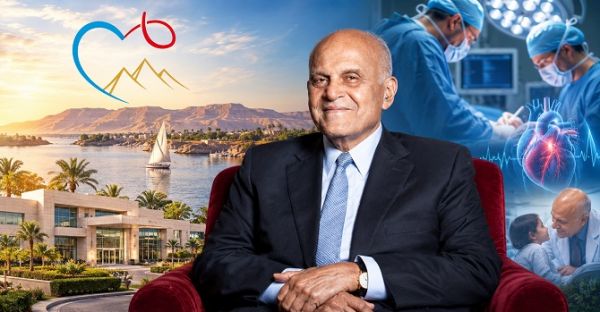
The Egyptian Heart Surgeon Who Changed Lives Around the World
When people think about Egypt, their minds often go first to the pyramids, ancient temples, the Nile, and the civilization of the pharaohs. But Egypt's story of achievement does not belong only to the ancient world. In modern times, Egyptians have also made important contributions to science, medicine, culture, and education.
One of the most internationally recognized examples is Professor Sir Magdi Yacoub, the Egyptian-born heart surgeon whose career transformed modern cardiac surgery and heart transplantation. From his early life in Egypt to his pioneering work in Britain and his continuing medical work in Egypt, his story connects two very different worlds: the ancient land of medical curiosity and the modern pursuit of scientific innovation.
Who Is Magdi Yacoub?
Magdi Yacoub was born in Egypt and graduated from Cairo University Medical School in 1957. He later moved to Britain, where he trained in cardiothoracic surgery and eventually became one of the world's best-known specialists in heart and lung transplantation.
His career was not limited to performing operations. He became deeply involved in medical research, education, surgical innovation, and international healthcare. He has also worked extensively with children born with serious congenital heart conditions.
For travelers interested in famous Egyptians, modern Egyptian history, or Egypt's contribution to science, Yacoub offers a fascinating example of how an Egyptian education became the foundation for an international medical career.
Why Did Magdi Yacoub Choose Heart Surgery?
The reason behind Yacoub's career choice is particularly personal.
His father was a general surgeon in Egypt, so medicine was already part of his childhood environment. But another experience had an even stronger effect on him: the death of his aunt from mitral valve disease when she was still a young woman.
According to accounts of his life and interviews, Yacoub was only about five or six years old when his aunt died. His father explained that heart surgery was developing and that her death might have been preventable.
That experience stayed with him.
Yacoub later described how the tragedy influenced his decision to become a heart surgeon. At the same time, he was fascinated by science and by the way the heart combines biological and mechanical functions. This combination of personal experience, scientific curiosity, and medicine eventually shaped his professional life.
It is a remarkable reminder that some of the most important career decisions can begin with a single childhood experience.
From Egypt to Britain
After graduating from medical school in Cairo, Yacoub continued his training abroad. He eventually established his career in Britain and became a consultant cardiothoracic surgeon at Harefield Hospital.
At Harefield, he developed a major heart and lung transplantation program. His work helped advance transplantation at a time when the procedures were still highly complex and carried enormous risks.
In 1983, Yacoub performed Britain's first heart-lung transplant. The operation became an important milestone in British cardiac surgery and contributed to the development of a procedure that would later benefit many patients.
His work also extended beyond transplantation. He developed and refined surgical techniques for complex congenital heart conditions, including operations for babies born with serious abnormalities of the heart and its major blood vessels.
A Pioneer in Heart Transplantation
One of Magdi Yacoub's greatest achievements was his contribution to heart and lung transplantation.
At Harefield Hospital, he established what Imperial College London describes as the world's largest heart and lung transplantation program, where more than 2,500 transplant operations were performed.
His approach to medicine was also strongly connected to research. He worked on areas including tissue-engineered heart valves, regeneration of heart muscle, artificial devices that support failing hearts, and technologies for monitoring patients.
This combination of surgery and scientific research became one of the defining features of his career.
For Yacoub, medicine was not simply about treating today's patient. It was also about finding ways to help tomorrow's patients.
The Story of the "Girl with Two Hearts"
One of the most fascinating cases associated with Yacoub is the story of Hannah Clark, a young Welsh girl who suffered from severe cardiomyopathy.
As a child, Hannah received a donor heart that was connected alongside her own heart in what is known as a "piggyback" or heterotopic transplant. The approach gave her failing heart time to recover.
Years later, complications from the medication required to prevent rejection of the transplanted heart created another serious problem. Eventually, doctors discovered that Hannah's original heart had recovered sufficiently.
The transplanted heart could therefore be removed.
Her story became an important example of the possibility of heart recovery and attracted international attention to Yacoub's work.
Bringing His Experience Back to Egypt
Although much of Yacoub's international career developed in Britain, his connection with Egypt remained strong.
One of his most important projects in Egypt is the Magdi Yacoub Heart Foundation, which established the Aswan Heart Centre in southern Egypt.
The centre provides specialized cardiac care and has a major focus on treating patients without charging them. It also supports education, training, and research, helping develop a new generation of Egyptian doctors, nurses, scientists, and medical technicians.
This is particularly meaningful in the context of modern Egypt. Aswan is internationally known for the Nile, its ancient monuments, and its beautiful landscapes. Yet the city is also home to an important example of contemporary Egyptian medical work.
The Aswan Heart Centre therefore represents another side of Egypt that travelers and curious readers may not immediately associate with the country: advanced medicine and scientific research.
Chain of Hope and Helping Children
Yacoub's work also extends beyond Egypt and Britain.
He founded Chain of Hope, an international charity that works to provide life-saving cardiac treatment to children in developing and war-affected countries. The organization also supports training and the development of local medical services.
This reflects another important part of Yacoub's philosophy: treating a patient is important, but building local expertise can allow many more patients to receive treatment in the future.
His work has therefore involved not only surgery but also education, research, international cooperation, and healthcare development.
Recognition Around the World
Magdi Yacoub's achievements have received major international recognition.
He was knighted for his services to medicine and surgery, and in 2014 he was appointed to the Order of Merit, one of Britain's highest honors, recognizing exceptional achievement in the arts, learning, literature, or science.
He has also been elected a Fellow of the Royal Society and received the Lister Medal for his contribution to surgical science.
But perhaps the most meaningful measure of his career is not found in awards. It is found in the patients treated, the surgeons trained, and the research that continues to influence cardiac medicine.
Magdi Yacoub and Modern Egypt
For visitors exploring Egypt, history is everywhere. The temples of Luxor reveal the achievements of an ancient civilization, while Cairo reflects centuries of scholarship, architecture, and cultural exchange.
Magdi Yacoub adds another chapter to that story.
His life demonstrates that Egypt's contribution to the world is not confined to antiquity. An Egyptian educated in Cairo went on to become a pioneer of modern heart surgery, establish major international medical programs, and return his expertise to help build a specialized cardiac centre in Aswan.
His story also provides a different way to understand Egypt: not simply as the home of ancient monuments, but as a country whose people continue to contribute to science, medicine, education, and humanitarian work.
For travelers curious about modern Egypt, famous Egyptians, Egyptian achievements, Egyptian doctors, medical history, and the Aswan Heart Centre, the story of Magdi Yacoub offers a fascinating journey beyond the traditional tourist landmarks.
It is a story that begins with a young boy in Egypt, shaped by a family in medicine and the loss of someone he loved, and eventually becomes an international story of surgery, scientific research, compassion, and hope.
Discover Egypt beyond its ancient monuments with our Egypt travel packages, combining Cairo, Luxor, Aswan, and the Nile through private tours and unforgettable Nile cruises.
Best Egypt Tours 2026
| Tour | Itinerary | Price |
|---|---|---|
| Egypt and Dubai Tours | 8 Days | $ 999 |
| Cairo and Istanbul Tours | 8 Days | $ 1250 |
| Turkey and Egypt Tours | 12 Days | $ 2825 |
| Egypt and Petra Tours | 12 Days | $ 2255 |
| Egypt and Jordan Tours With Nile Cruise | 14 Days | $ 3066 |
| Egypt Jordan Jerusalem Tours | 13 Days | $ 2700 |
| Dubai and Egypt Vacation Packages | 12 Days | $ 2270 |
| Egypt and Morocco Tours | 15 Days | $ 4499 |
| Egypt and Jordan Luxury Tours | 8 Days | $ 1275 |
| Egypt and Greece Tours | 14 Days | $ 3380 |
| Egypt Tanzania Tour | 14 Days | $ 6275 |
| Cairo to Petra Tour | 7 Days | $ 945 |
| Egypt and Holy Land Tours | 15 Days | $ 4100 |