
The Boy King of Ancient Egypt and the Secrets of His Tomb
Who Was Tutankhamun?
Tutankhamun, often called King Tut, is one of the most famous pharaohs of ancient Egypt. Although he ruled for only a short time and died at a young age, his name became known around the world after the discovery of his remarkably preserved tomb in the Valley of the Kings near Luxor in 1922.
His story offers a fascinating glimpse into ancient Egyptian history, royal traditions, religious beliefs, and burial practices. For travelers visiting Egypt, Tutankhamun is more than a famous name in a museum. He represents a remarkable connection to a civilization that flourished thousands of years ago.
Tutankhamun became pharaoh during the 18th Dynasty, a period when ancient Egypt was a powerful kingdom. His reign took place during the 14th century BC, when the country was recovering from major religious changes introduced by his predecessor, Akhenaten.
Despite his short life, Tutankhamun remains an important figure in understanding the history of ancient Egypt.
What Is Tutankhamun So Famous For?
Tutankhamun is famous primarily because his tomb was discovered almost intact by British archaeologist Howard Carter and his team on November 4, 1922. Unlike many other royal tombs in Egypt, which had been robbed in antiquity, Tutankhamun's burial chamber retained an extraordinary collection of objects.
The discovery revealed thousands of artifacts, including golden coffins, jewelry, ceremonial furniture, chariots, statues, weapons, and everyday objects intended to accompany the king into the afterlife.
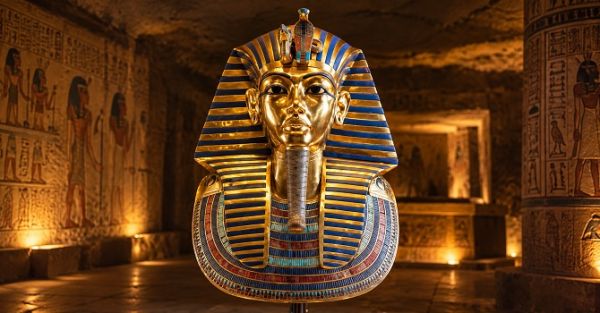
Among the most recognizable treasures is his magnificent golden funerary mask, decorated with gold, colored glass, and semiprecious stones. The mask has become one of the most enduring symbols of ancient Egyptian civilization.
The tomb's discovery attracted international attention and transformed public interest in Egyptology. It also provided historians with valuable evidence about royal craftsmanship, religious beliefs, and daily life during the New Kingdom.
Interestingly, Tutankhamun was not considered one of Egypt's most powerful pharaohs during his lifetime. His global fame developed thousands of years later, largely because of the extraordinary preservation of his burial treasures.
How Old Was King Tut When He Became King and When He Died?
Tutankhamun became pharaoh at approximately eight or nine years old, around 1332 BC. Because he was a child, experienced officials and royal advisers likely played important roles in governing the country.
During his reign, Egypt moved away from the religious changes associated with Akhenaten, who had promoted the worship of the sun disk Aten. Tutankhamun's restoration of traditional religious practices was reflected in the change of his name from Tutankhaten to Tutankhamun, meaning approximately "Living Image of Amun."
Amun was one of the most important gods in the traditional Egyptian religious system, and his name reflected the restoration of the god's position.
Tutankhamun ruled for approximately nine years. He died around 1323 BC, at about 18 or 19 years old.
His short reign meant that he had limited time to leave a lasting political or military legacy. Nevertheless, his burial treasures and the historical questions surrounding his death have made him one of the most widely studied rulers of ancient Egypt.
What Was the Reason King Tut Died?
The exact cause of Tutankhamun's death remains uncertain. Scientists have studied his mummy using modern imaging techniques and other scientific methods, but no single explanation has been conclusively established.
Researchers have identified several possible contributing factors. Studies have suggested that Tutankhamun had a partially fractured leg, and some researchers have proposed that an injury may have contributed to his death. Genetic and medical investigations have also raised the possibility that he suffered from inherited health problems.
Malaria has been identified as another possible factor in his final illness. Some researchers believe that a combination of malaria and other health complications may have weakened him.
However, it is important to distinguish scientific findings from speculation. There is no conclusive evidence proving that he was murdered, despite popular stories and documentaries that have explored this possibility.
The famous theory that a blow to the head killed Tutankhamun has also been questioned by later examinations of his mummy.
His death at such a young age remains one of the enduring mysteries of ancient Egyptian history. New research and improved scientific techniques may help historians understand his health and final days more clearly.
Is Tutankhamun Related to Cleopatra?
Tutankhamun and Cleopatra VII belonged to different periods of ancient Egyptian history and were separated by more than 1,300 years.
Tutankhamun lived during the 14th century BC, while Cleopatra VII, the famous queen associated with Julius Caesar and Mark Antony, lived from 69 to 30 BC.
Cleopatra belonged to the Ptolemaic dynasty, a Greek-speaking royal family that ruled Egypt after the death of Alexander the Great. Tutankhamun, by contrast, belonged to Egypt's 18th Dynasty, which ruled during the New Kingdom.
There is no established direct family relationship between Tutankhamun and Cleopatra. They are connected through the broader history of ancient Egypt, but they were not contemporary rulers and did not belong to the same royal dynasty.
This difference is important for visitors exploring Egyptian history. Ancient Egypt lasted for thousands of years, encompassing numerous dynasties, powerful rulers, religious transformations, and changing political relationships.
Tutankhamun represents the New Kingdom's royal traditions, while Cleopatra represents Egypt's final chapter as an independent kingdom before its incorporation into the Roman Empire.
Did King Tut Marry Cleopatra?
No. Tutankhamun did not marry Cleopatra.
Tutankhamun married Ankhesenamun, a royal woman who was closely related to him and is generally identified as his half-sister. She was a daughter of Akhenaten and likely the same royal woman originally known as Ankhesenpaaten.
Their marriage reflected the traditions of the Egyptian royal family, where close-kin marriages sometimes helped preserve royal status and legitimacy.
The couple had two daughters who were stillborn. Their remains were discovered in Tutankhamun's tomb, providing further evidence about the personal and family tragedies associated with the young king's life.
Cleopatra VII lived more than a millennium after Tutankhamun. Her best-known relationships were with Julius Caesar and Mark Antony, two leading Roman figures who played important roles in the political struggles of her time.
The confusion between Tutankhamun and Cleopatra is understandable because both are among the most recognizable names in ancient Egyptian history. However, they belong to very different historical periods.
Discovering Tutankhamun's Tomb in the Valley of the Kings
One of the most exciting experiences for travelers interested in Tutankhamun is visiting the Valley of the Kings on Luxor's west bank. This ancient royal burial ground contains dozens of tombs belonging to pharaohs and other members of the royal elite.
Howard Carter's discovery in 1922 followed years of archaeological work supported by Lord Carnarvon. When the entrance to Tutankhamun's tomb was uncovered, the find revealed a remarkable collection of objects that had remained hidden for centuries.
The tomb is known as KV62, reflecting its designation in the Valley of the Kings. Although relatively small compared with some other royal tombs, its contents made it one of the most important archaeological discoveries in history.
Visitors should understand that the treasures are not all displayed inside the tomb. Many objects have been conserved and exhibited in museums, while the burial site remains an important destination for understanding ancient Egyptian funerary traditions.
A visit to the Valley of the Kings can be combined with other major Luxor attractions, including the Temple of Hatshepsut, the Colossi of Memnon, and the magnificent Karnak and Luxor temple complexes on the east bank.
Where Can You See Tutankhamun's Treasures Today?
Tutankhamun's treasures are among the highlights of Egypt's museum collections. Visitors can explore the story of the king and his burial through exhibitions that explain the discovery, the objects, and their religious significance.
The Grand Egyptian Museum near the Giza Pyramids is a major destination for travelers interested in ancient Egyptian civilization and the royal treasures associated with Tutankhamun. Visitors should check current exhibition arrangements and ticket information before planning their visit.
Cairo's museum collections, together with archaeological sites in Luxor, help travelers connect the objects with the places where ancient Egyptians created, used, and buried them.
For the most rewarding experience, consider combining a museum visit with a journey to Luxor. Seeing the Valley of the Kings after learning about Tutankhamun's burial treasures helps bring the archaeological story to life.
Why Tutankhamun Still Captivates the World
Tutankhamun's fame is not simply the result of gold, jewelry, or the mystery surrounding his death. His tomb opened a rare window into the material culture, artistic achievements, and religious beliefs of ancient Egypt.
His story also reminds us that history is often shaped by unexpected discoveries. A young pharaoh with a relatively short reign became one of the world's best-known ancient rulers because his burial survived in extraordinary condition.
For anyone curious about ancient Egyptian history, Tutankhamun offers an excellent starting point for exploring the pharaohs, royal tombs, temples, and beliefs that shaped this remarkable civilization.
Explore Egypt's history in person with our Egypt travel packages, featuring private guided tours of the Pyramids of Giza, the treasures of Cairo, the Valley of the Kings in Luxor, and unforgettable Nile cruises through the heart of ancient Egypt.
Best Egypt Tours 2026
| Tour | Itinerary | Price |
|---|---|---|
| Egypt and Kenya Tours | 15 Days | $ 6250 |
| Egypt and Dubai Tours | 8 Days | $ 999 |
| Cairo and Istanbul Tours | 8 Days | $ 1250 |
| Turkey and Egypt Tours | 12 Days | $ 2825 |
| Egypt and Petra Tours | 12 Days | $ 2255 |
| Egypt and Morocco Tours | 15 Days | $ 4499 |
| Egypt and Jordan Luxury Tours | 8 Days | $ 1275 |
| Cairo to Petra Tour | 7 Days | $ 945 |
| Egypt and Holy Land Tours | 15 Days | $ 4100 |
| Egypt Tanzania Tour | 14 Days | $ 6275 |
| Egypt and Greece Tours | 14 Days | $ 3380 |