
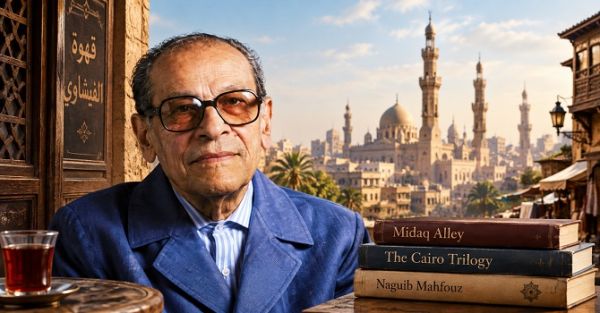
The Egyptian Writer Who Turned Cairo Into Literature
Have you ever walked through the narrow streets of Old Cairo and wondered what stories those ancient buildings, cafés, markets, and alleyways could tell? For millions of readers around the world, one Egyptian writer spent his life answering that question: Naguib Mahfouz.
Born in Cairo in 1911, Mahfouz became one of the most important Arab novelists of the 20th century and, in 1988, became the first Arabic-language writer to receive the Nobel Prize in Literature. His fiction transformed ordinary Cairo neighborhoods into unforgettable literary landscapes, making him an especially interesting figure for travelers who want to understand Egypt beyond its pyramids and temples.
Who Was Naguib Mahfouz?
Naguib Mahfouz was an Egyptian novelist and short-story writer who was born and died in Cairo. He studied philosophy at Cairo University and initially considered continuing his academic studies, but eventually decided to become a professional writer.
He began writing at the age of 17, and his first novel was published in 1939. Over a career spanning decades, he produced more than 30 novels and around 350 short stories. His work explored subjects including family, religion, love, politics, social change, identity, morality, and the passage of time.
Although Mahfouz sometimes wrote about ancient Egypt, much of his best-known fiction is rooted in modern Cairo. He knew the city's streets, cafés, markets, mosques, houses, and neighborhoods intimately, particularly the historic Gamaliya and Khan el-Khalili area, where he grew up.
For travelers, this is one reason reading Mahfouz can add another dimension to a trip to Cairo. Instead of seeing the city simply as a collection of monuments, his books encourage readers to notice the people and everyday life surrounding them.
What Is Naguib Mahfouz Famous For?
Mahfouz is famous for bringing ordinary Egyptian life into modern Arabic literature with remarkable realism and depth.
His characters are often shopkeepers, civil servants, students, parents, workers, intellectuals, and families dealing with everyday problems. Yet their personal struggles often reflect much larger questions about Egyptian society.
Cairo itself is almost a character in many of his novels.
His stories frequently move through narrow alleys, traditional homes, cafés, markets, and historic districts. The Nobel Prize recognized his contribution to Arabic narrative art, describing his writing as rich in nuance and capable of connecting local experiences with universal human concerns.
This combination of the local and the universal is central to Mahfouz's appeal. You do not need to be Egyptian or familiar with every period of Egyptian history to understand his themes.
What Is Naguib Mahfouz's Most Famous Book?
There is no single universally agreed answer, but The Cairo Trilogy is generally regarded as Mahfouz's most famous and influential body of work.
The trilogy consists of:
- Palace Walk
- Palace of Desire
- Sugar Street
Together, the novels follow several generations of the Al-Jawad family in Cairo. The story begins in the early 20th century and explores family relationships, changing social values, nationalism, religion, and Egypt's political transformation.
The trilogy is particularly valuable for anyone interested in Cairo because it presents the city through the lives of ordinary residents. The first volume, Palace Walk, is set largely in the Gamaliya district, the same historic area where Mahfouz was born.
Another extremely famous Mahfouz novel is Midaq Alley, published in 1947. It portrays a community in one of Cairo's old quarters and introduces readers to a colorful collection of characters whose ambitions, relationships, and struggles reveal different sides of Egyptian society.
Why Is Cairo So Important in Mahfouz's Books?
For Mahfouz, Cairo was much more than a setting.
He spent almost his entire life in the city, and its historic neighborhoods became the inspiration for many of his stories. The Nobel Prize notes that Cairo repeatedly provides the setting for his novels, short stories, and plays.
His childhood neighborhood, Gamaliya, is particularly important.
Today, travelers visiting the area around Khan el-Khalili, Al-Hussein, and the historic streets of Islamic Cairo can encounter the same kind of urban environment that inspired Mahfouz: narrow lanes, old buildings, cafés, shops, mosques, craftsmen, and people going about their daily lives.
One famous café associated with Mahfouz is Café Fishawi, a historic café in Khan el-Khalili. Mahfouz was known to spend time in the area, and cafés and alleyways became recurring elements in his literary world.
Reading Midaq Alley or the Cairo Trilogy before visiting Cairo can therefore make a walk through the historic center feel different. Familiar street names, architecture, and social scenes may suddenly have a literary connection.
What Religion Was Naguib Mahfouz?
Naguib Mahfouz was Muslim, and Islamic culture, religious questions, morality, and faith frequently appear in his writing.
However, his relationship with religion in literature was complex. His novels often explore questions rather than simply providing straightforward religious answers. He wrote about faith, doubt, morality, reason, knowledge, and the relationship between individuals and society.
This complexity became particularly significant with one of his most controversial novels, Children of Gebelawi, originally published in Arabic as Awlad Haretna.
Why Was Naguib Mahfouz Attacked?
Mahfouz was attacked in Cairo on October 14, 1994, when an assailant stabbed him in the neck. He survived but suffered serious injuries, including damage that affected his right arm.
The attack was connected to the long-running controversy surrounding Children of Gebelawi.
The novel uses allegorical characters and stories that draw on religious traditions. Some religious authorities objected to the book, and Egypt's Al-Azhar opposed its publication as a book in Egypt after its newspaper serialization. The controversy continued for decades.
The attack therefore cannot be understood simply as a literary disagreement. It occurred within a wider period of tension involving militant Islamist groups and debates about religion, literature, and freedom of expression in Egypt.
Mahfouz survived the attack and continued to write afterward.
Is Naguib Mahfouz Egyptian?
Yes. Naguib Mahfouz was Egyptian, born in Cairo on December 11, 1911.
Cairo remained his home for virtually his entire life. He died in Cairo on August 30, 2006, at the age of 94.
His deep connection to Egypt is one of the defining characteristics of his literature. Even when he explored philosophical or universal questions, he frequently approached them through Egyptian places, families, traditions, and historical experiences.
Which Egyptians Have Won the Nobel Prize?
Several Egyptians have received Nobel Prizes in different fields.
Naguib Mahfouz received the Nobel Prize in Literature in 1988, becoming the first Egyptian and the first writer whose native language was Arabic to receive the Literature prize.
Other Egyptian Nobel laureates include:
Ahmed Zewail — Nobel Prize in Chemistry, 1999, for his work using femtosecond spectroscopy to study chemical reactions. He was born in Damanhur and grew up in Alexandria.
Mohamed ElBaradei — Nobel Peace Prize, 2005, awarded jointly with the International Atomic Energy Agency for efforts to prevent nuclear energy from being used for military purposes and to promote its safe peaceful use.
Thus, Mahfouz's Nobel was part of a broader Egyptian contribution to international culture, science, and diplomacy.
Which Book Won Naguib Mahfouz the Nobel Prize?
An important point is that Mahfouz did not win the Nobel Prize for one particular book.
He received the 1988 Nobel Prize in Literature for his overall literary achievement. The Swedish Academy recognized the body of work through which he developed Arabic narrative art and explored both Egyptian experiences and universal human concerns.
His major works, including the Cairo Trilogy, Midaq Alley, Children of Gebelawi, The Thief and the Dogs, Miramar, and many short stories, form part of the literary achievement associated with his Nobel recognition.
Which Naguib Mahfouz Book Is the Easiest to Read?
For a first-time reader, Midaq Alley is often a good starting point because it is a single novel rather than the much longer Cairo Trilogy.
It is also particularly useful for travelers interested in Egypt because the story focuses on a Cairo alley and its residents. The book provides a close look at relationships, ambitions, poverty, social expectations, and everyday life in an old Cairo neighborhood.
Another option is Miramar, which is set in Alexandria and uses several characters' perspectives to tell its story. The Guardian has specifically recommended Miramar as a starting point for readers approaching Mahfouz in English.
For readers who want a deeper immersion into Cairo, however, the Cairo Trilogy is the natural next step.
Why Read Mahfouz Before Visiting Egypt?
Egypt is often introduced through its ancient monuments: the Pyramids of Giza, the temples of Luxor, the Valley of the Kings, and the Nile.
Mahfouz offers another Egypt.
His books take readers into Cairo's neighborhoods, families, cafés, alleys, social traditions, and changing identities. His Egypt is not only the country of pharaohs but also the Egypt of ordinary people living through political and social change.
That makes his work particularly valuable for curious travelers.
If the pyramids help you understand Egypt's ancient civilization, Mahfouz can help you understand another side of the country: the human landscape of Cairo.
Walking through Gamaliya, Khan el-Khalili, or the historic streets around Al-Hussein after reading Mahfouz can turn a sightseeing trip into something more personal. You begin to look beyond monuments and notice the streets, conversations, families, cafés, and everyday scenes that have shaped Cairo for generations.
Naguib Mahfouz ultimately made one of the world's oldest cities into one of modern literature's most recognizable settings. His stories remain an invitation to explore Egypt not only through what you see, but also through the people, memories, questions, and everyday life behind it.
If Naguib Mahfouz inspires you to discover Cairo beyond its monuments, explore our Egypt travel packages and Nile cruises to experience the country’s historic streets, culture, and timeless stories from Cairo to Luxor.
Best Egypt Tours 2026
| Tour | Itinerary | Price |
|---|---|---|
| Egypt and Kenya Tours | 15 Days | $ 6250 |
| Egypt and Dubai Tours | 8 Days | $ 999 |
| Cairo and Istanbul Tours | 8 Days | $ 1060 |
| Turkey and Egypt Tours | 12 Days | $ 2825 |
| Egypt and Petra Tours | 12 Days | $ 2255 |
| Egypt and Jordan Tours With Nile Cruise | 14 Days | $ 3066 |
| Dubai and Egypt Vacation Packages | 12 Days | $ 2270 |
| Egypt and Morocco Tours | 15 Days | $ 4499 |
| Egypt and Jordan Luxury Tours | 8 Days | $ 1275 |
| Egypt and Greece Tours | 14 Days | $ 3380 |
| Egypt Tanzania Tour | 14 Days | $ 6275 |